

Have you ever looked at your prescription bottle or insurance explanation of benefits and wondered why a simple painkiller is listed differently than a cancer medication? It’s not just about the price tag. Every generic drug belongs to several different "families" simultaneously. One system looks at what it treats, another at how it works inside your body, and a third at how addictive it might be.
Understanding these **generic drug classifications** isn’t just academic trivia. It affects what your doctor prescribes, what your pharmacist checks for interactions, and how much you pay out of pocket. With over 5,000 distinct substances cataloged globally, knowing which category your medication falls into helps you navigate healthcare decisions with confidence.
The Therapeutic Classification: What Does It Treat?
This is the most common way doctors think about medicine. The Therapeutic Classification is a system that groups drugs based on the medical condition they treat rather than their chemical makeup. If you have high blood pressure, you get a cardiovascular agent. If you have an infection, you get an antibiotic. It’s practical, intuitive, and directly tied to your symptoms.
The Food and Drug Administration (FDA) and the United States Pharmacopeia (USP) maintain the primary model for this in the U.S., known as the USP Therapeutic Categories Model. This system organizes medications into major buckets like Analgesics (pain relievers), Antineoplastics (cancer treatments), and Endocrine Agents (hormone-related drugs). Each of these broad categories breaks down further. For instance, Analgesics split into Non-opioid (like ibuprofen) and Opioid (like morphine) subcategories.
Why does this matter to you? Because hospital formularies-the lists of drugs a hospital stocks-rely heavily on this structure. According to data from the American Society of Health-System Pharmacists (ASHP), 92% of U.S. hospitals use therapeutic classification as their primary organizational tool. It reduces medication errors by creating a standardized language between nurses, doctors, and pharmacists. However, it has a blind spot: multi-purpose drugs. Aspirin, for example, is both an analgesic and an anticoagulant (blood thinner). In a strict therapeutic box, it can sometimes cause confusion if a provider only looks at one label.
The Pharmacological Classification: How Does It Work?
While therapeutic classification asks "what does it fix?", pharmacological classification asks "how does it do it?" This system groups drugs by their Mechanism of Action is the specific biological process or molecular target a drug interacts with to produce its effect.
This is where things get scientific. Instead of saying "antidepressant," a pharmacologist might classify a drug as a "Selective Serotonin Reuptake Inhibitor" (SSRI). This tells you exactly which neurotransmitter in the brain the drug targets. The National Center for Biotechnology Information (NCBI) identifies approximately 1,200 distinct pharmacologic classes in current literature.
Consider cancer treatments. You might hear about "Kinase Inhibitors." These aren't defined by the type of cancer they treat, but by the fact that they block specific enzymes called kinases that help cancer cells grow. A single class of kinase inhibitors might be used across 15 different types of cancer. This precision is vital for researchers and specialists, but it can be overwhelming for general practitioners. Dr. John Beckner of the American Pharmacists Association notes that while this framework is scientifically rigorous, it requires significant education to implement broadly in everyday clinical practice.
| Classification Type | Primary Focus | Best Used By | Key Limitation |
|---|---|---|---|
| Therapeutic | Medical condition treated | Primary Care Doctors, Nurses | Struggles with multi-indication drugs |
| Pharmacological | Molecular mechanism | Specialists, Researchers | Complex terminology; less bedside utility |
| Legal (DEA) | Abuse potential & safety | Law Enforcement, Regulators | Does not reflect clinical efficacy |
| Insurance Tier | Cost & formulary preference | Patients, Payers | Prioritizes cost over clinical nuance |
The Legal Classification: DEA Schedules
In the United States, the Drug Enforcement Administration (DEA) imposes a legal overlay on almost every controlled substance. This system, established by the Controlled Substances Act of 1970, divides drugs into five schedules based on two factors: accepted medical use and potential for abuse.
- Schedule I: No accepted medical use, high abuse potential (e.g., heroin, LSD).
- Schedule II: High abuse potential but has accepted medical use (e.g., oxycodone, fentanyl, Adderall).
- Schedule III: Moderate to low abuse potential (e.g., buprenorphine, testosterone).
- Schedule IV: Low abuse potential (e.g., Xanax, Valium).
- Schedule V: Lowest abuse potential, often containing limited amounts of narcotics (e.g., cough syrups with small doses of codeine).
This classification dictates how strictly a pharmacy must store the drug, how many refills are allowed, and whether a digital prescription is permitted. However, it is controversial. Dr. Nora Volkow, Director of the National Institute on Drug Abuse, has criticized the Schedule I designation for marijuana, noting that it impedes research despite evidence of therapeutic benefit. Meanwhile, critics argue that Schedule II opioids like oxycodone cause more overdose deaths than Schedule I substances, highlighting a gap between legal classification and public health reality.
The Economic Classification: Insurance Tiers
If you have private health insurance, you likely encounter a fourth classification system: the tiered formulary. This isn't about biology or law; it's about money. Insurance companies like Humana group drugs into tiers to manage costs.
- Tier 1: Preferred generics. These are the cheapest options, covering about 75% of generic drugs.
- Tier 2: Non-preferred generics. Slightly higher copay, often due to specific manufacturer contracts.
- Tier 3: Preferred brand-name drugs.
- Tier 4: Non-preferred brands or specialty non-biologicals.
- Tier 5: Specialty medications. These are the highest-cost drugs, representing the top 5-7% of covered expenses, often requiring prior authorization.
A frustrating reality for patients is that clinically identical drugs can end up in different tiers. Two generic versions of the same statin might look the same and work the same, but one could be Tier 1 and the other Tier 2 simply because of a contract negotiation between the insurer and the manufacturer. Pharmacists report that insurance tier disputes account for nearly half of all prior authorization requests, adding administrative burden to care.
The Naming Clues: Stem Conventions
There is a hidden code in the names of generic drugs themselves. Since 1964, the USP has used a stem naming convention to hint at a drug’s class. This is a quick visual check for healthcare providers.
For example, if a drug name ends in -lol, it is almost certainly a beta-blocker (used for heart conditions), such as propranolol or metoprolol. If it ends in -prazole, it is likely a proton pump inhibitor for acid reflux, like omeprazole or pantoprazole. There are currently 87 distinct stems recognized in the USP Dictionary. While this doesn't replace formal classification, it helps reduce medication errors. Dr. Paul Zeitz of UCSF noted that this convention has reduced errors by 18%, though it struggles with new biologic agents that don't fit traditional chemical patterns.

Global Standards: The WHO ATC System
Outside the U.S., the World Health Organization (WHO) uses the Anatomical Therapeutic Chemical (ATC) classification system. It is used by 143 countries and catalogs over 5,000 substances. The ATC system is hierarchical:
- Anatomical: Which part of the body does it affect? (e.g., Cardiovascular system)
- Therapeutic: What is the therapeutic subgroup? (e.g., Beta-blocking agents)
- Chemical: What is the chemical subgroup? (e.g., Ethanolamine derivatives)
This global standard allows researchers to compare drug usage patterns across borders. The WHO updates this list quarterly, adding hundreds of new codes annually to keep pace with new drug approvals. For international travelers or expats, understanding that your local medication might have a different ATC code than your home country's version is crucial for continuity of care.
How These Systems Intersect in Practice
In a real-world scenario, a single pill navigates all these systems at once. Take buprenorphine, used for opioid addiction treatment.
- Therapeutically: It is an opioid agonist-antagonist used for pain and addiction maintenance.
- Pharmacologically: It is a partial mu-opioid receptor agonist.
- Legally: It is a Schedule III controlled substance in the U.S.
- Economically: It may sit in Tier 2 or 3 depending on your insurance plan.
Healthcare professionals spend an average of 12-18 minutes per patient navigating these conflicting classifications, according to the American Medical Association. Misalignment between these systems can lead to delays in care or confusion. For instance, a doctor might prescribe a drug based on therapeutic need, only to have it blocked by insurance due to tier restrictions, requiring a switch to a pharmacologically similar but therapeutically distinct alternative.
Future Trends: AI and Personalized Medicine
These rigid boxes are starting to crack. As medicine moves toward personalization, drugs are increasingly designed to target specific genetic markers rather than broad disease categories. The FDA’s upcoming Therapeutic Categories Model 2.0 aims to handle drugs with multiple indications through a primary-secondary hierarchy. Meanwhile, AI platforms like IBM Watson Health are using machine learning to predict optimal drug placement with over 92% accuracy.
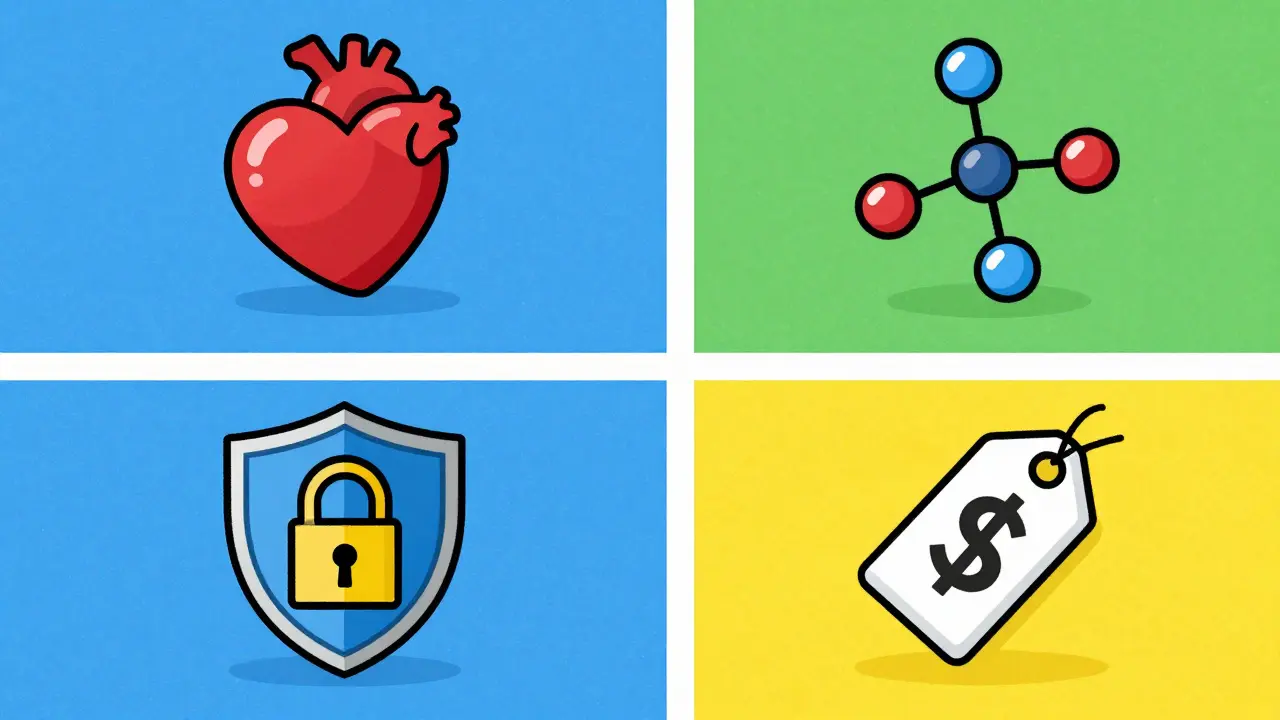
By 2028, industry analysts predict that 65% of new drugs will require novel classification approaches because they have multimodal mechanisms-they do two or three things at once. We are moving away from single-label categorization toward dynamic, hybrid models that integrate genomic data. For now, however, understanding the current four pillars-therapeutic, pharmacological, legal, and economic-remains essential for anyone managing their own health.
What is the difference between therapeutic and pharmacological classification?
Therapeutic classification groups drugs by the disease or symptom they treat (e.g., antidepressants), making it easy for doctors to choose treatments for specific conditions. Pharmacological classification groups drugs by their biological mechanism of action (e.g., serotonin reuptake inhibitors), which is more precise scientifically but requires deeper knowledge of how the drug interacts with the body.
Why are some generic drugs more expensive than others?
Even if two generic drugs contain the same active ingredient, they may fall into different insurance tiers. Tier 1 drugs are preferred generics with the lowest copays, while Tier 2 or higher drugs may cost more due to manufacturer contracts, supply chain issues, or specific formulation differences, despite being clinically equivalent.
What does DEA Schedule II mean for a prescription?
Schedule II drugs have a high potential for abuse but also have accepted medical uses. Examples include oxycodone and Adderall. Legally, these prescriptions cannot have refills; you must get a new prescription for each fill. Pharmacies must store them securely, and electronic prescribing is often mandated to prevent fraud.
Can I tell what class a drug belongs to by its name?
Often, yes. Generic drug names use standardized stems. For instance, drugs ending in '-pril' are usually ACE inhibitors for blood pressure (like lisinopril), and those ending in '-statin' are cholesterol-lowering drugs (like atorvastatin). This naming convention helps healthcare providers quickly identify a drug's class and potential interactions.
Is the WHO ATC system used in the United States?
Not primarily. The U.S. relies on the FDA's USP Therapeutic Categories and DEA scheduling for domestic regulation and prescribing. However, the WHO ATC system is widely used in research and global health statistics. Some U.S. databases may cross-reference ATC codes for international comparison, but clinicians typically use USP or DEA classifications.