
When a patient in a clinical trial gets sick after taking a new drug, what happens next? Not every side effect needs to be reported right away. In fact, most don’t. The difference between a serious adverse event and a non-serious one isn’t about how bad it feels-it’s about what it does to the patient’s life. And getting this wrong can waste weeks of staff time, delay life-saving data, or even put other patients at risk.
What Makes an Adverse Event "Serious"?
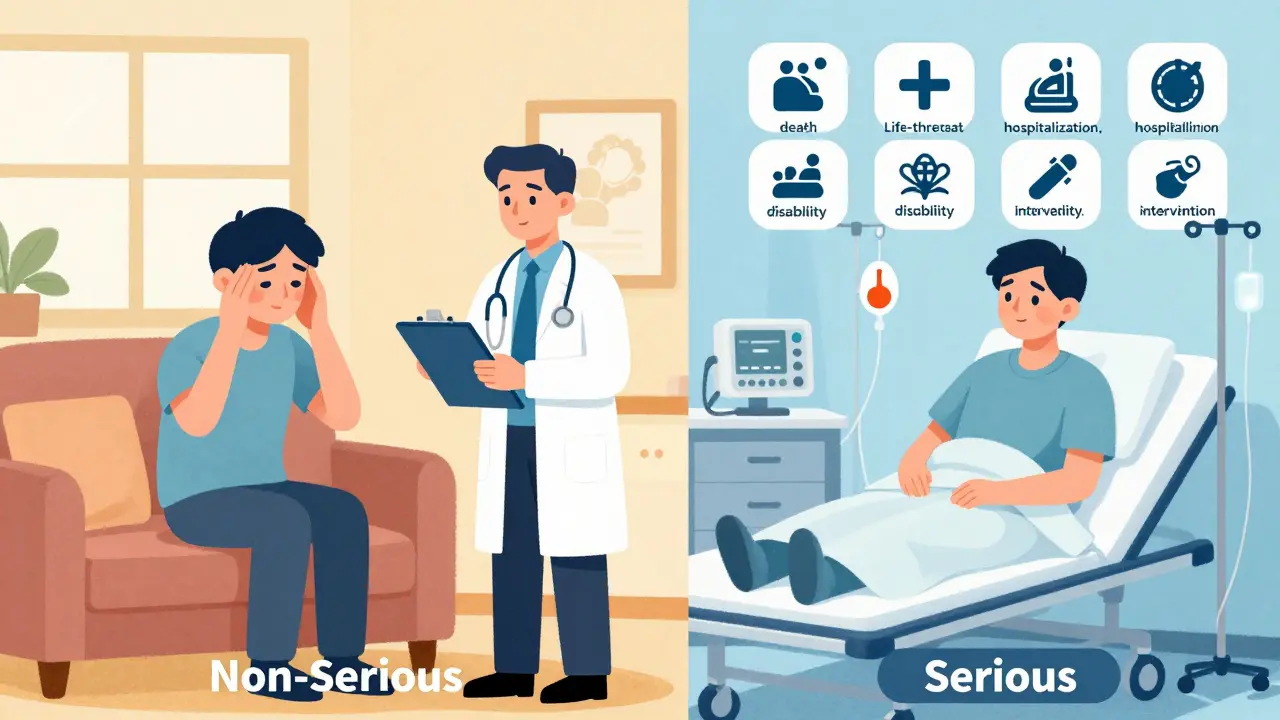
An adverse event (AE) is any unwanted medical occurrence during a clinical trial, whether or not it’s linked to the drug being tested. But only some AEs are classified as serious. The rules are clear, and they haven’t changed since 1995. According to the FDA and ICH E2A guidelines, an event is serious if it results in one of six specific outcomes:
- Death
- Life-threatening condition (the patient was at immediate risk of dying)
- Requires hospitalization or extends an existing hospital stay
- Causes permanent disability or significant incapacity
- Leads to a congenital anomaly or birth defect
- Requires medical or surgical intervention to prevent one of the above
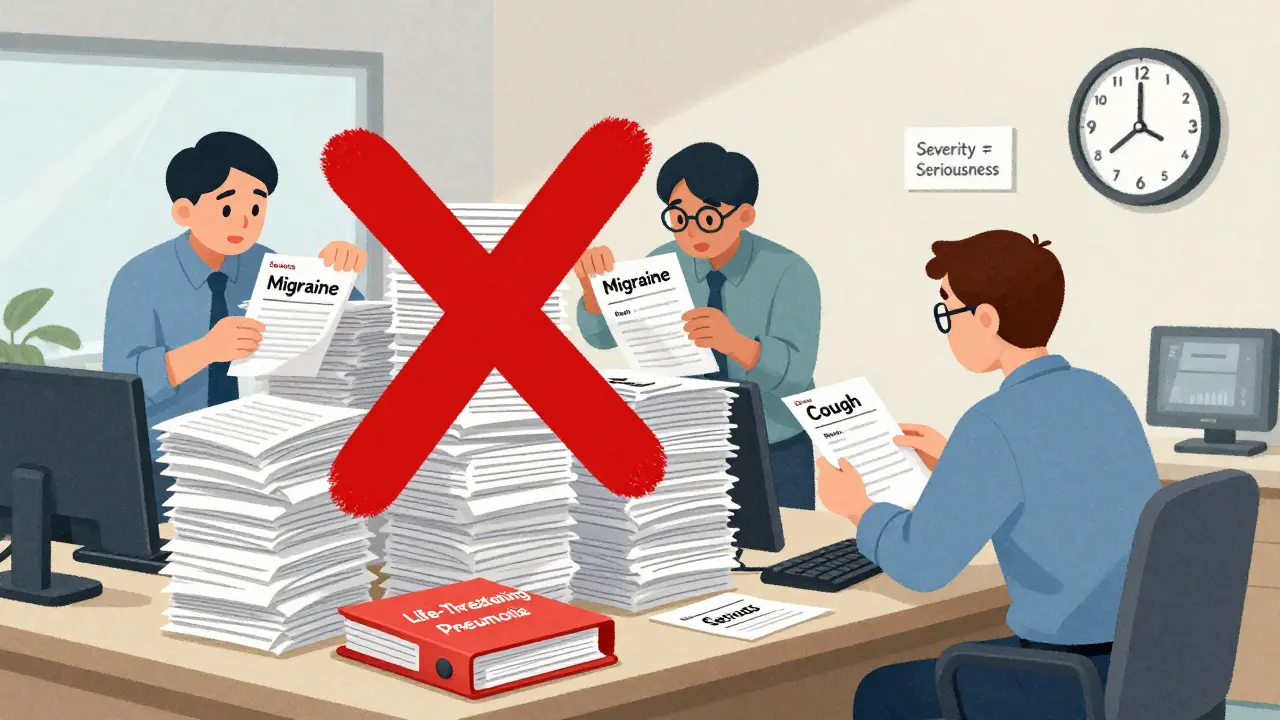
Notice what’s missing? Severity. A migraine that knocks someone out of work for three days isn’t serious. A headache that causes a stroke? That is. Severity describes how intense the symptom is-mild, moderate, or severe. Seriousness describes the outcome. You can have a severe rash that’s not serious. And you can have a mild drop in blood pressure that’s life-threatening.
Why the Confusion? Severity vs. Seriousness
One of the biggest mistakes in clinical research is mixing up severity with seriousness. A 2022 survey of 347 research sites found that 63.4% of them had inconsistent seriousness decisions across studies. In oncology trials, where patients often come in already weakened, it’s especially easy to misread what’s happening. A patient with cancer who gets pneumonia might be hospitalized-but was the pneumonia caused by the drug, or just their underlying illness? If you report every hospitalization as serious, you flood the system with noise.
Dr. Robert Temple, former FDA deputy director, called this confusion "one of the most persistent errors" in safety reporting. It’s not just a paperwork problem. When every minor side effect is flagged as serious, regulators miss the real red flags. The FDA’s Sentinel Initiative processed over 14.7 million reports by 2023-but only 18.3% met the seriousness criteria. That means more than 80% of reports were distractions.
When Do You Have to Report?
The clock starts ticking the moment the investigator learns about the event. For serious adverse events (SAEs), the timeline is tight:
- Investigator to sponsor: Within 24 hours. No exceptions. This applies whether the event seems related to the drug or not.
- Sponsor to FDA: 7 days for life-threatening events. 15 days for all other serious events.
- Sponsor to IRB: Within 7 days. Most institutional review boards require immediate reporting of any SAE, regardless of the trial phase.
For non-serious events, there’s no rush. These are documented in Case Report Forms (CRFs) and reported on the schedule set by the trial protocol-usually monthly or quarterly. Some protocols don’t even require reporting mild events unless they’re part of a specific safety signal.
The NIH’s 2018 guidelines and the FDA’s 2023 update both emphasize: Don’t report based on intensity. If a patient has a severe cough but doesn’t need hospitalization, isn’t at risk of death, and isn’t permanently disabled-it’s not serious. Save the 24-hour report for the ones that actually matter.
How Do You Decide? The Four-Question Rule
Most sites use a simple decision tree to avoid mistakes. The NIH recommends asking these four questions in order:
- Did the event cause death?
- Was the event life-threatening?
- Did it require hospitalization or extend an existing stay?
- Did it cause permanent disability or significant incapacity?
If the answer to any one is "yes," it’s serious. If all are "no," it’s non-serious. No need to guess. No need to debate. Just answer the questions.
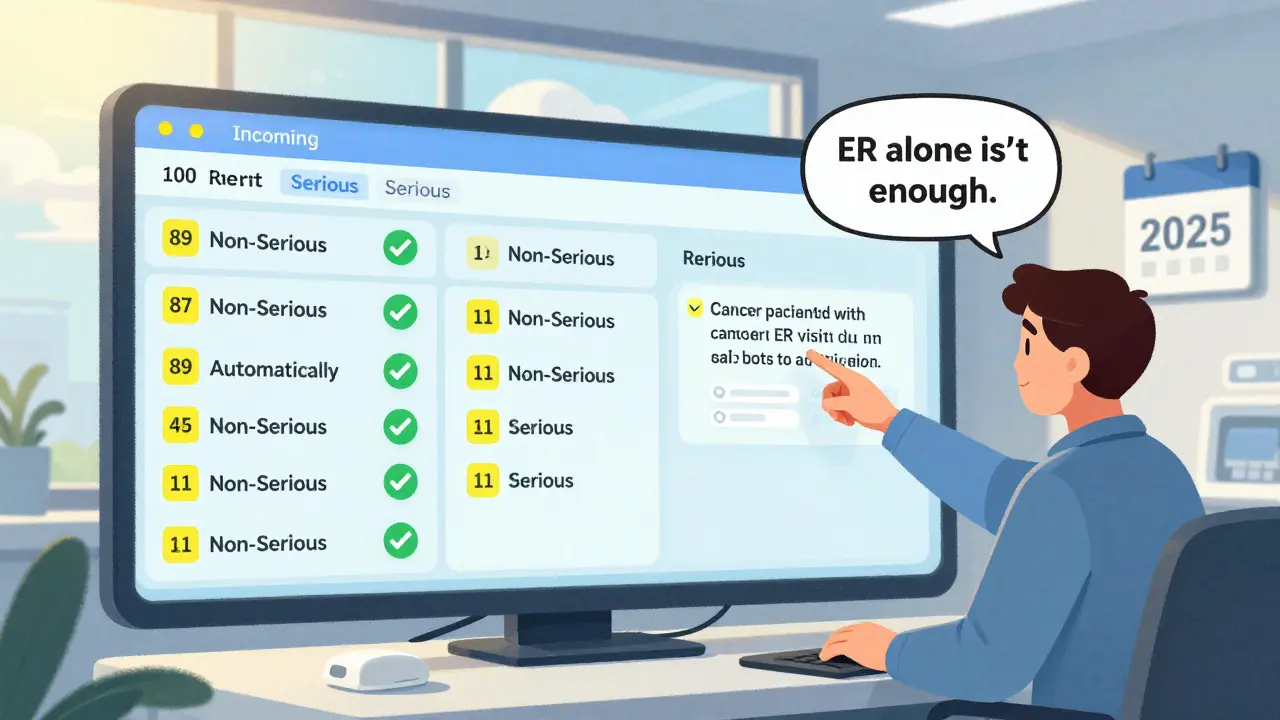
There’s one gray area: emergency room visits. The NIH’s 2023 update clarified that an ER visit alone doesn’t make an event serious-unless it leads to hospitalization or meets another criterion. A patient with chest pain who gets checked out and sent home? Not serious. A patient with chest pain who gets admitted for observation? That’s serious.
What Happens When You Get It Wrong?
Getting this wrong isn’t just a paperwork error-it’s a system failure.
The SWOG Cancer Research Network found that 31.8% of their SAE reports in 2021 had to be corrected because they were misclassified. That’s over 18 full-time hours a week spent fixing mistakes. At UCSF, 42.3% of AE reports in 2022 needed clarification, delaying reviews by nearly 10 business days each.
And the cost? Deloitte estimated that 62.7% of adverse event compliance spending in 2022 went toward processing non-serious events that were wrongly labeled as serious. That’s billions of dollars spent chasing ghosts while real signals get buried.
Even worse, over-reporting can desensitize reviewers. If every report is flagged as serious, the team stops taking them seriously. That’s exactly what Dr. Janet Woodcock warned about in 2022: "The current system is overwhelmed by non-serious events reported as serious, diluting attention from truly critical safety signals."
How Are Things Changing?
Tools are catching up. In 2020, only 62% of sponsors used automated tools to help classify events. By 2023, that number jumped to 89.7%. AI systems now correctly identify seriousness in nearly 9 out of 10 cases-better than human reviewers. But they’re not perfect. Humans still need to review the final call, especially in complex cases like psychiatric events or patients with multiple chronic conditions.
The EU’s Clinical Trials Regulation, fully in effect since January 2022, standardized seriousness rules across all 27 member states. That cut reporting confusion by over a third. The FDA is now testing AI-powered triage tools that could cut review time by nearly half by 2025.
But the biggest change isn’t technological. It’s cultural. More training programs now include real-world case studies-like a patient with severe nausea who didn’t get hospitalized, versus one who did. They show trainees how to separate symptom intensity from life-altering outcomes.
What Should You Do?
If you’re involved in clinical trials, here’s what matters:
- Know the six criteria for seriousness. Memorize them.
- Never use "severe" as a synonym for "serious." They’re not the same.
- Use the four-question checklist every time.
- Report SAEs within 24 hours-no delay, no excuse.
- Document non-serious events, but don’t rush them. Follow the protocol.
- Ask for training if your site doesn’t offer annual refreshers. ICH E6(R2) requires it.
There’s no gray area in the rules. Only in the interpretation. And if you’re ever unsure, err on the side of reporting. But don’t report because it sounds bad. Report because it meets the criteria. That’s how safety systems work-not by fear, but by precision.
Srividhya Srinivasan
Oh MY GOD. I can't believe this. I work in clinical trials, and let me tell you-EVERY SINGLE TIME, someone reports a 'severe headache' as serious. I mean, really? A headache?! Like, if I have a migraine after taking a placebo, is that a life-threatening condition? NO. But they still flag it. And then the FDA gets buried under 80% noise. I swear, if I had a dollar for every time someone confused 'severe' with 'serious,' I'd retire to a private island. Punctuation matters. Seriously. It's not just semantics-it's survival.!!!
Prathamesh Ghodke
Haha, yeah, I feel you. I used to be the guy who'd report every little thing just to be safe. Then I had a mentor pull me aside and say, 'Prathamesh, if you're not using the four-question checklist, you're not helping-you're cluttering.' Game changer. Now I just ask: Death? Hospitalization? Disability? Life-threatening? If no-move on. Save the 24-hour reports for the real emergencies. And honestly? The AI tools are getting scary good. They caught 9 out of 10 misclassifications in my last trial. Still, humans gotta review the weird ones-like when a patient with bipolar gets a 'mood episode' after a new drug. That's not just a headache.
Justin Archuletta
This is so important. Seriously. Don't over-report. Just don't. I've seen teams burn out over this. One hospital had 300 SAEs in a month-only 12 were real. The rest? Mild nausea. A little dizziness. A rash that went away. Stop. Breathe. Check the six criteria. If it doesn't hit one? File it in the CRF and sleep. You're not failing. You're protecting the system. 😊
Sanjana Rajan
LMAO. So we're supposed to just ignore 'severe' symptoms because they didn't lead to hospitalization? That's insane. What if the patient was too poor to afford hospital care? What if they self-medicated and hid it? You're telling me a woman with debilitating pain who can't work for a week isn't 'serious'? That's not safety-that's systemic gaslighting. The rules were written by rich white doctors in 1995. They didn't think about people who can't afford to go to the ER. So yeah, I report everything. Even if it's 'just' a migraine. Because sometimes, the system ignores the pain until it's too late.
Kyle Young
An interesting philosophical pivot here: when do we define 'seriousness' as an objective medical outcome versus a subjective human experience? The FDA criteria reduce suffering to binary outcomes-hospitalized or not, dead or alive. But what of the chronic, invisible suffering? A patient may never be hospitalized, yet live in constant pain, unable to care for their children. Is that not a form of 'permanent incapacity'? Perhaps the framework needs to evolve-not to dilute standards, but to expand them. We risk dehumanizing clinical safety if we only measure what can be quantified.
Aileen Nasywa Shabira
Oh, so the FDA says 'don't report unless someone dies or gets hospitalized'? Classic. Let me guess-the same FDA that approved opioids for 'moderate pain' and then acted shocked when millions overdosed? This isn't about safety. It's about liability. They want to bury the data. You think they care about 'signals'? No. They care about lawsuits. And if you report every minor thing? They'll say 'over-reporting inflates risk.' If you don't? They'll say 'you missed a red flag.' Either way-you lose. So why play their game? Just report everything. Let them drown in paperwork. I'm not the problem. The system is.
Kendrick Heyward
I just lost my sister to a drug trial. She had a rash. They said it wasn't 'serious.' She didn't get hospitalized. She didn't die. But she had a stroke three days later. The drug was never linked. Now I'm sitting here reading this like it's a textbook. Like her life was a footnote. I report everything now. EVERYTHING. Because maybe one day, someone will look at a 'mild' rash and say: 'Wait... that's the same one.' I'm not here for your protocols. I'm here for her. 💔
Ayan Khan
I appreciate the clarity here. In India, we often see patients who come from villages with no access to hospitals. A 'non-serious' event might mean they're bedridden for weeks. But we still follow the rules. Why? Because if we bend the criteria, we risk invalidating the entire trial. The system is flawed, yes. But it's the only one we have. So we train our teams: use the four questions. Document everything. And if a patient's life is changed-even if they didn't go to the ER-we still log it. Not as an SAE. But as a human story. And that matters too.
Emily Hager
I must express my profound disquietude regarding the prevailing normalization of the 'four-question checklist' as an infallible heuristic. The reduction of human suffering to a checklist of six legally codified outcomes is not merely reductive-it is ontologically negligent. The criteria were established in 1995, predating the widespread recognition of chronic fatigue syndrome, long COVID, and psychiatric iatrogenesis. To rigidly adhere to these metrics is to institutionalize epistemic violence against marginalized populations whose suffering does not conform to the archaic taxonomy of 'seriousness.' One must ask: who benefits from this silence?
Kal Lambert
Simple. Use the checklist. Report SAEs fast. Don't stress the rest. I've seen too many teams waste months chasing ghosts. AI helps. Training helps. But the real fix? Culture. Stop rewarding people for over-reporting. Stop punishing them for not reporting a 'bad headache.' We're not in a race to see who can submit the most forms. We're here to protect people. Keep it clean. Keep it clear. And if you're unsure? Ask. No shame in that.
Melissa Stansbury
Wait, so if someone gets a panic attack after taking the drug, and they go to the ER but don't get admitted, it's not serious? What if they're a single mom with no support? What if she can't work for a month? Is that not 'significant incapacity'? I'm not saying report everything-but don't ignore context. The rules are too rigid. I've seen patients get dismissed because they didn't meet the checklist. But their lives were shattered. That's not safety. That's bureaucracy pretending to be science.
cara s
i just read this whole thing and like… wow. i had no idea. i thought all side effects were serious. like if you get a headache? report it. but no. it’s only serious if you die or get hospitalized? what about the people who get so sick they can’t take care of their kids? or lose their job? i mean… isn’t that serious? also, i think the word ‘serious’ is spelled wrong in the title. should be ‘seriously’? idk. anyway. this is wild. i’m gonna go tell my cousin who works in pharma.
Amadi Kenneth
Let me tell you something. In Nigeria, we don’t have the luxury of AI tools or 24-hour reporting. We have nurses who work 72-hour shifts. We have patients who die at home because they can’t afford a taxi to the hospital. So when they say 'hospitalization'-what does that mean? If a man has chest pain and walks 10km to the clinic and they say 'come back tomorrow'-is that serious? Or is it just… life? The FDA rules? They were written for Harvard. Not for Lagos. So we report everything. Because if we wait for 'criteria,' people die before the paperwork clears. And no one cares. So we scream. Loud. And we report. Always.
Shameer Ahammad
I must formally object to the characterization of 'severity' and 'seriousness' as mutually exclusive concepts. The ICH E2A guidelines, while well-intentioned, exhibit a fundamental flaw in their epistemological framework: they presume a Cartesian separation between symptom intensity and systemic consequence. In reality, severe symptoms often precipitate serious outcomes-especially in comorbid populations. To mandate a rigid checklist without accounting for temporal progression, baseline vulnerability, or pharmacokinetic interactions is not merely inefficient-it is ethically negligent. Furthermore, the assertion that 'non-serious' events are merely 'noise' ignores the emergent signal potential inherent in aggregated low-grade adverse data. The current paradigm is not a safeguard-it is a blind spot. I recommend a revision to ICH E2A(R3) that incorporates longitudinal risk modeling and patient-reported outcome integration. The status quo is untenable.