
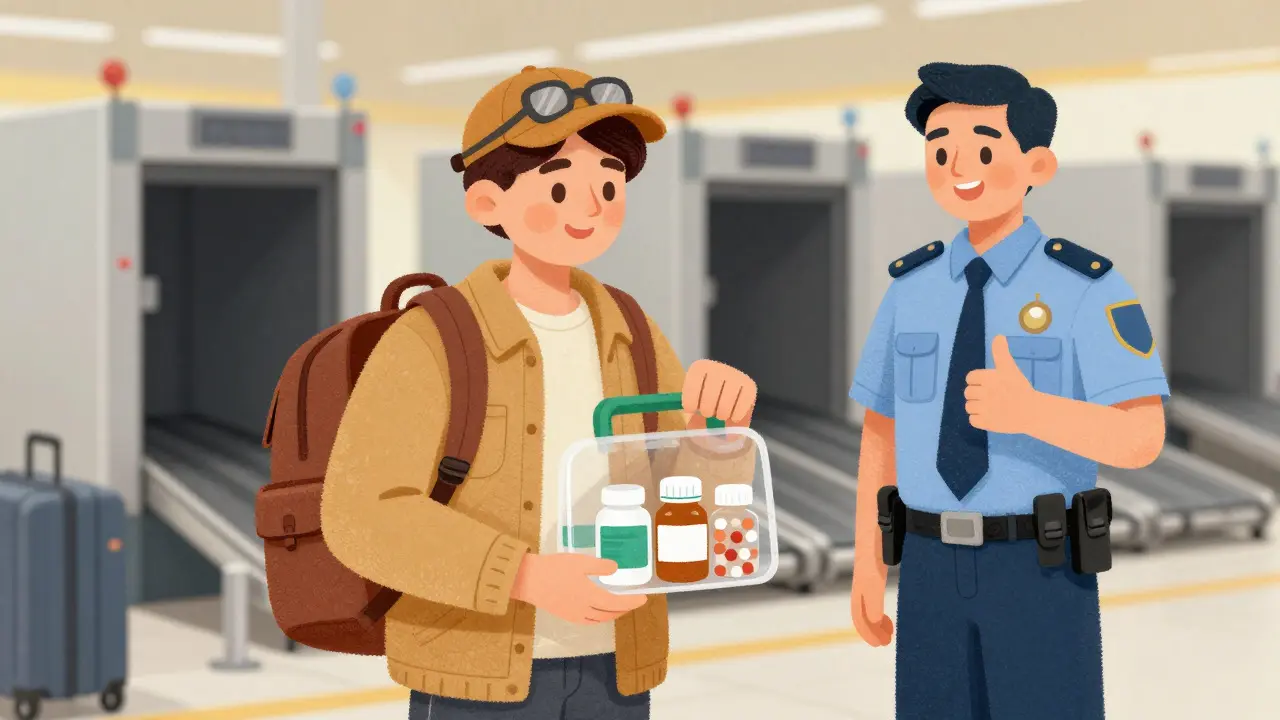
Packing for a trip usually means worrying about outfits and chargers. But if you take daily prescriptions, your biggest worry might be the pill bottle in your bag. Getting stuck at security because of liquid limits or denied entry because a common drug is banned in your destination country are real risks. The good news? You can avoid these headaches with a bit of planning.
Whether you are flying across town or crossing oceans, knowing how to pack, store, and declare your meds is crucial. Regulations change often, and what is legal in one place might be a crime in another. This guide breaks down exactly what you need to do to keep your health secure while you travel.
Quick Summary / Key Takeaways
- Keep meds in carry-on: Never check essential medications. If your luggage gets lost, so does your treatment.
- Liquids are exempt: Liquid medicines exceed the standard 3.4-ounce limit but must be declared separately at security.
- Original containers matter: Keep drugs in pharmacy-labeled bottles to reduce inspection times and prove legitimacy.
- Check destination laws: Common US drugs like Adderall or pseudoephedrine are banned or restricted in many countries.
- Plan for refills: For trips longer than 90 days, arrange mail shipments with proper documentation well in advance.
Navigating Airport Security with Ease
Airport security can feel like an obstacle course, especially when you are carrying medical supplies. The Transportation Security Administration (TSA) has specific rules that actually favor travelers with medical needs, provided you follow them correctly.
First, never put your daily medications in checked baggage. If your suitcase is delayed or lost, you are left without your medicine. Instead, pack everything in your carry-on luggage. This includes pills, injectables, and any devices like insulin pumps.
One of the most confusing parts of security is the liquid rule. Standard liquids are limited to 3.4 ounces (100ml). However, medically necessary liquids are exempt from this limit. You can bring reasonable quantities of juice, water, syrup, or liquid medication. Here is the catch: you must declare these items to the TSA officer before screening begins. They may need to be tested separately, which could add a few minutes to your process, but it prevents confiscation.
To speed things up further, keep your medications in their original pharmacy containers. Data shows that labeled bottles reduce inspection rates significantly compared to generic pill organizers. If you use a weekly pill box, bring the original bottles as backup proof. Also, consider using the TSA Cares program. Requesting a sunflower lanyard or notifying them ahead of time can cut your processing time by nearly half, as officers know to expect medical items.
| Item Type | Rule/Requirement | Tips |
|---|---|---|
| Solid Pills | No quantity limit | Keep in original bottles |
| Liquid Meds | Exempt from 3.4oz limit | Declare separately; reasonable amounts only |
| Ice Packs | Allowed if frozen solid | Must be fully frozen at screening |
| Medical Devices | Carry-on only | Notify officer; batteries <100Wh |
Keeping Your Meds Safe: Temperature and Storage
Getting through security is step one. Step two is keeping your medicine effective during the journey. Many people assume pills are indestructible, but heat and humidity can ruin them. Insulin, biologics, and certain antibiotics are particularly sensitive.
Insulin, for example, needs to stay between 36°F and 46°F (2°C-8°C) if unopened. Once opened, it can last at room temperature for a certain period, but extreme heat on a tarmac or in a hot car will destroy it. For these temperature-sensitive items, invest in pharmaceutical-grade cooling wallets. These aren't just coolers; they are tested to maintain stability for up to 72 hours even in ambient temperatures reaching 40°C (104°F).
If you are traveling to tropical regions, standard ice packs might melt too quickly. Use gel packs that remain frozen longer, or opt for dry ice if allowed by your airline (usually limited to 5.5 lbs and properly ventilated). Always check with your carrier regarding dry ice regulations.
For non-refrigerated meds, avoid leaving them in direct sunlight. A hotel mini-fridge is great, but make sure it is clean. Store your meds away from food to prevent cross-contamination. If you don't have a fridge, ask the front desk. Most hotels will accommodate guests with medical storage needs.
International Laws: What Is Legal Where?
This is where most travelers get into trouble. Just because a doctor prescribed it in the US doesn't mean it is legal in Paris, Tokyo, or Dubai. Drug laws vary wildly around the world, and ignorance is rarely a valid defense.
Controlled substances are the biggest risk. Medications containing opioids, benzodiazepines, or stimulants are heavily regulated. For instance, Adderall (amphetamine/dextroamphetamine) is banned in 17 countries, including France and Sweden. If you carry it without extensive paperwork, you could face arrest. Similarly, pseudoephedrine (found in cold meds like Sudafed) is prohibited in 22 countries because it can be used to make methamphetamine.
Before you book your flight, check the International Narcotics Control Board (INCB) database or contact your destination's embassy. Some countries require prior authorization for common anxiety meds like Xanax (alprazolam). Thailand, for example, demands pre-approval for benzodiazepines. In the UAE, all opioids are banned entirely.
Cannabis and CBD products are another minefield. While the TSA allows CBD with less than 0.3% THC domestically, countries like Singapore and Dubai have zero-tolerance policies. Bringing a CBD gummy back from a trip where it was legal locally could lead to serious legal issues upon re-entry or transit through strict jurisdictions.
Essential Documentation Checklist
Paperwork is your best friend when traveling internationally. It proves that the meds in your bag are yours and medically necessary. Without it, border agents might confiscate your supply or deny entry.
- Doctor’s Letter: Get a letter from your prescribing physician on official letterhead. It should state your diagnosis, the medication name, dosage, and that the drug is medically necessary. Translate this into the local language if possible.
- Original Pharmacy Labels: As mentioned, keep meds in bottles with your name, the doctor's name, and the pharmacy details. This matches the doctor's letter.
- Copy of Prescription: Carry a photocopy or digital scan of your actual prescription.
- Passport Copy: Keep a copy of your passport handy to link your identity to the medical documents.
The CDC recommends carrying a doctor's letter for 100% of international travel involving controlled substances. For non-controlled meds, it is still highly advised. If you are traveling with children, include a consent form from parents if you are not the primary guardian.
Handling Refills and Long Trips
What happens if you run out of meds? Or worse, what if you are staying abroad for months? The FDA allows personal importation of medication, but there are strict rules.
Generally, you can bring up to a 90-day supply of medication into most countries. If your trip exceeds three months, you need a plan. One option is to mail additional supplies to yourself. The FDA permits this under its Personal Importation policy, but you must coordinate with customs.
To mail meds to yourself abroad:
- Use a reputable courier service that tracks packages.
- Include the doctor's letter, a copy of your passport, and the English prescription inside the package.
- Label the package clearly as "Personal Medication - No Commercial Value."
Another strategy is to split your stash. Don't put all your pills in one bag. Distribute them between your carry-on, your personal item, and perhaps give some to a trusted travel companion. This way, if one bag is lost or seized, you still have a backup supply. Studies show that 92% of travelers who used this strategy avoided treatment disruption during luggage issues.
Common Pitfalls to Avoid
Even experienced travelers make mistakes. Here are the most common errors that lead to stress or confiscation:
- Assuming reciprocity: Thinking that because a drug is legal in Country A, it is legal in Country B. Always verify per destination.
- Using generic bags: Transferring pills to unlabeled containers saves space but invites suspicion. Stick to original packaging.
- Ignoring transit countries: If you fly through Dubai to get to India, you are subject to Dubai's laws during layovers. Check transit hubs too.
- Overpacking: Bringing more than a 90-day supply without justification can look like smuggling. Only bring what you need plus a small buffer.
Finally, don't forget to update your travel insurance. Ensure it covers medical emergencies related to your condition and the cost of replacing lost medications abroad. Some policies exclude pre-existing conditions unless declared upfront.
Can I bring liquid medication over 3.4 ounces?
Yes. Medically necessary liquids are exempt from the standard 3.4-ounce (100ml) limit. You must declare them to the TSA officer before screening. Bring only reasonable quantities needed for your trip, and be prepared for separate testing.
Is Adderall banned internationally?
Adderall is banned or strictly controlled in many countries, including France, Sweden, and Japan. Before traveling, check the INCB database or contact the embassy of your destination. You may need special permission or a substitute medication approved locally.
How long can I keep insulin out of the fridge?
Unopened insulin should be refrigerated at 36°F-46°F (2°C-8°C). Once opened, most insulins can be stored at room temperature (below 86°F/30°C) for up to 28 days, but check your specific brand's guidelines. Use a cooling wallet for travel to protect against extreme heat.
Do I need a doctor's note for domestic flights?
The TSA does not require a doctor's note for domestic flights within the US. However, it is recommended to carry one if you have large quantities of medication or controlled substances to ease any questions from officers.
Can I mail medication to myself while abroad?
Yes, the FDA allows mailing personal medication to yourself abroad. Include a doctor's letter, prescription copy, and passport copy in the package. Label it as "Personal Medication" and use a tracked shipping service. Ensure the destination country also accepts imported meds.
Are CBD products allowed in Europe?
CBD laws vary by European country. While some nations allow low-THC CBD, others have strict bans. Always check the specific regulations of your destination country before bringing CBD products, as enforcement can be severe.
What should I do if my medication is confiscated?
Stay calm and polite. Ask for a written explanation of why it was confiscated. Contact your embassy or consulate immediately for assistance. Have copies of your prescriptions and doctor's notes ready to prove medical necessity. If possible, seek a local pharmacy to buy a substitute medication approved in that country.