
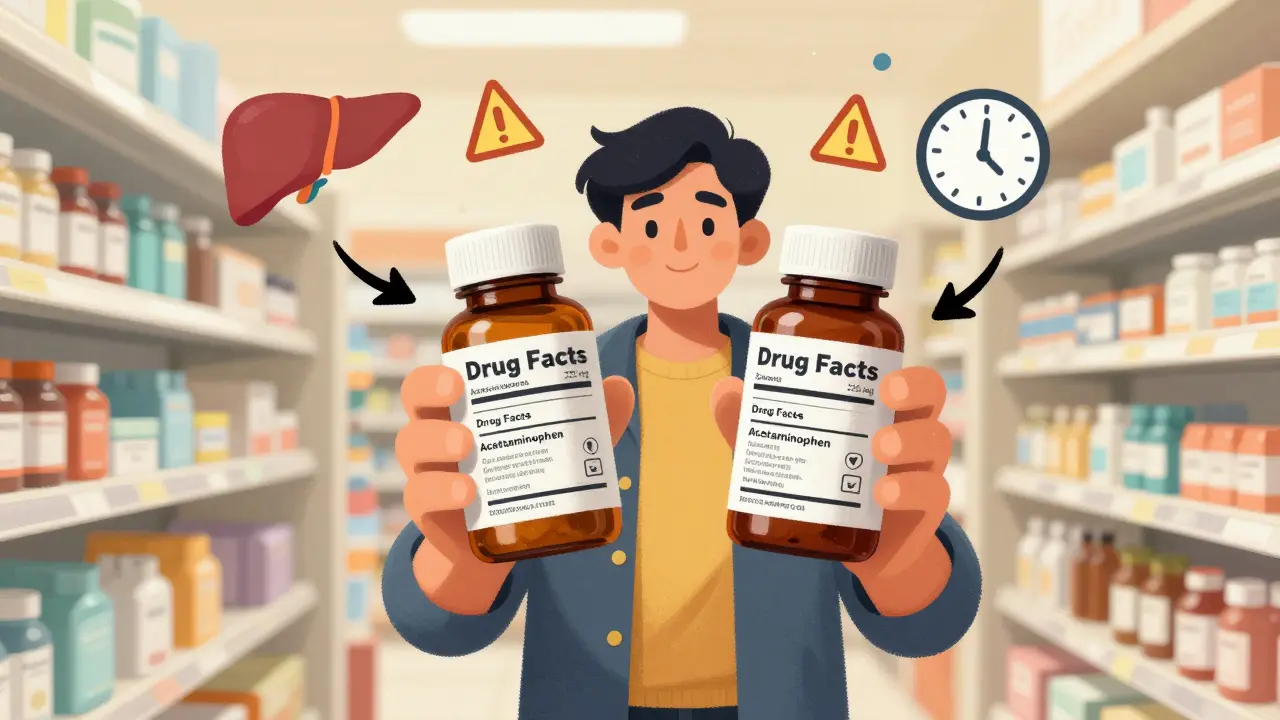
Every time you pick up a bottle of pain reliever, cold medicine, or antacid off the shelf, you’re holding a product designed to help you feel better. But do you know what’s actually making it work? The answer lies in the active ingredients-the chemicals that do the job. Most shoppers don’t check them. And that’s where things go wrong.
What Exactly Are Active Ingredients?
Active ingredients are the only parts of an OTC drug that produce the intended effect. Everything else-color, flavor, filler-is there to make the pill easier to swallow or look nice. The FDA requires every OTC product to list these ingredients clearly on the Drug Facts label, right at the top. No guessing. No hidden names. Just the chemical, followed by how much is in each dose.For example, if you see “acetaminophen 325 mg” on the label, that’s the active ingredient. It’s the same compound found in Tylenol, Excedrin, and store-brand pain relievers. The brand name doesn’t matter. The ingredient does.
There are over 800 active ingredients approved for OTC use in the U.S., grouped into 107 categories like pain relief, allergy control, cough suppression, and heartburn treatment. But you don’t need to memorize them all. You just need to know how to read the label.
The Drug Facts Label: Your Secret Weapon
Since 1999, the FDA has required all OTC drugs to use the same label format. It’s not optional. It’s the law. And it’s designed to make things simple-even if you’re tired, in pain, or rushing through the pharmacy.The label has seven sections. The first one-Active Ingredient(s)-is the most important. Here’s what to look for:
- Generic name only (no brand names)
- Exact amount per dose (e.g., 200 mg, not “a powerful dose”)
- Units listed clearly (mg, mL, etc.)
For example:
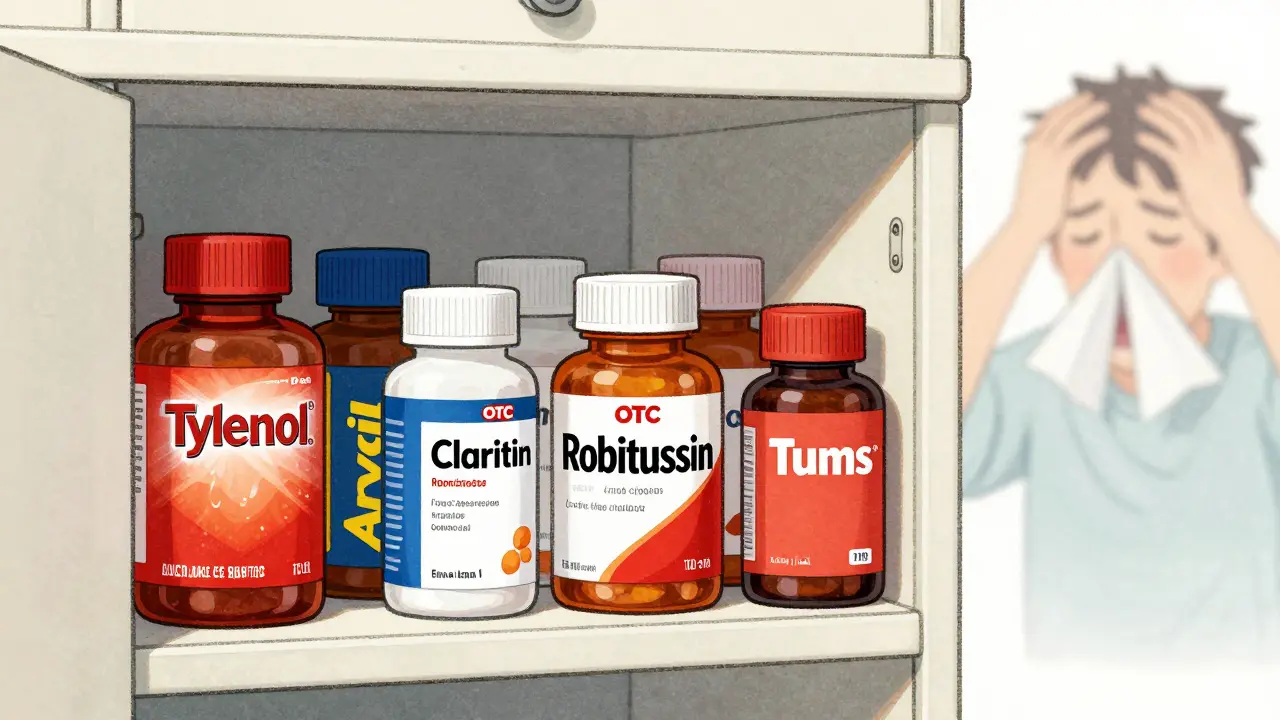
- Advil = ibuprofen 200 mg
- Claritin = loratadine 10 mg
- Robitussin = dextromethorphan 10 mg
Notice how the same ingredient appears under different brand names? That’s the trap. People think “this one’s different” because the bottle looks different. It’s not. The active ingredient is what matters.
Why This Matters More Than You Think
In 2022, the FDA reported that 70% of OTC medication errors happened because people didn’t realize they were taking the same active ingredient twice.Think about this:
- You take Tylenol for a headache.
- Later, you grab TheraFlu Nighttime for your cold.
- TheraFlu also contains acetaminophen-650 mg per dose.
- You’ve now taken 975 mg of acetaminophen in under 4 hours.
That’s over half the maximum daily limit for adults (4,000 mg). Do this a few times a week, and you risk liver damage. That’s not a myth. That’s a real ER visit.
A 2022 Reddit thread with over 2,800 upvotes featured users sharing stories of accidental overdoses. One person wrote: “I took two Tylenol and a cold med without checking. I woke up in the hospital with liver toxicity.”
And it’s not just acetaminophen. Cold medicines often contain diphenhydramine (an antihistamine), phenylephrine (a decongestant), or dextromethorphan (a cough suppressant). Each can interact with other meds-or cause drowsiness, high blood pressure, or even heart problems if taken too often.
Common Active Ingredients You Should Know
You don’t need to know all 800. But these 10 show up in 75% of OTC products:- Acetaminophen - Pain and fever. Found in Tylenol, Excedrin, NyQuil, Sudafed PE Cold.
- Ibuprofen - Pain, fever, inflammation. Found in Advil, Motrin, Aleve (naproxen is similar).
- Diphenhydramine - Allergy and sleep aid. Found in Benadryl, NyQuil, ZzzQuil.
- Loratadine - Non-drowsy allergy relief. Found in Claritin, Alavert.
- Cetirizine - Another non-drowsy antihistamine. Found in Zyrtec.
- Dextromethorphan - Cough suppressant. Found in Robitussin, Delsym.
- Phenylephrine - Nasal decongestant. Found in Sudafed PE, Mucinex D.
- Pseudoephedrine - Stronger decongestant (behind pharmacy counter).
- Calcium carbonate - Antacid. Found in Tums, Rolaids.
- Loperamide - Anti-diarrheal. Found in Imodium. (Warning: Misuse can be deadly.)
Pay attention to the numbers. OTC ibuprofen is capped at 200 mg per tablet. Prescription is 400-800 mg. Same drug. Different strength. More doesn’t mean better. It means more risk.
How to Avoid Mistakes (Simple Steps)
You don’t need a pharmacy degree. Just follow this four-step rule every time you buy an OTC medicine:- Find the Active Ingredient section. It’s always the first thing on the label.
- Write it down. Even if you think you’ll remember. Write “acetaminophen 325 mg.”
- Check what you’re already taking. Are you on another pill, syrup, or patch with the same ingredient? If yes, don’t double up.
- Ask yourself: “Do I really need this?” Many colds and headaches get better without meds. Rest and water often work better than extra chemicals.
The Nationwide Children’s Hospital recommends spending at least 45 seconds reading the label. Their study showed this cuts medication errors by 68% in parents.
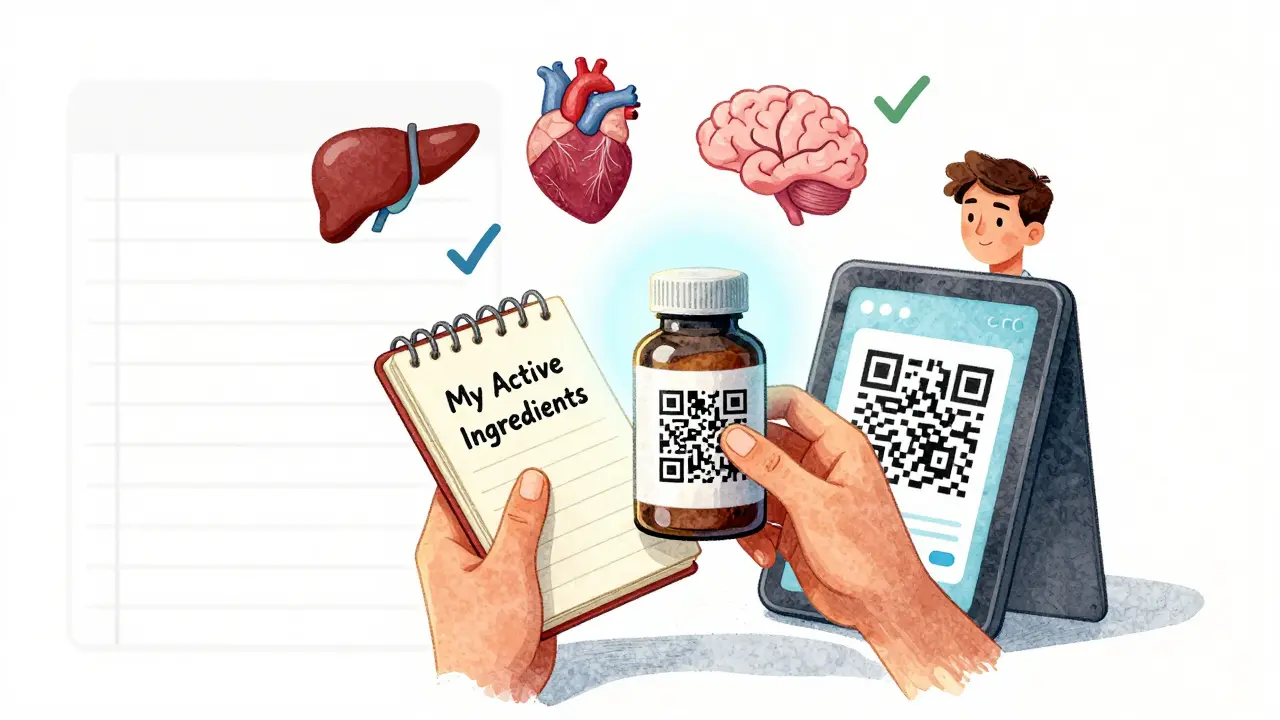
Another trick: Keep a small notebook or note on your phone listing every active ingredient you take regularly. Update it every time you buy something new. It takes 2 minutes. Could save your liver.
What About Inactive Ingredients?
They’re not useless. They’re just not the medicine. But they can still hurt you.Some people are allergic to dyes, preservatives, or fillers. Red dye #40, for example, triggers reactions in sensitive individuals. One parent on Drugs.com wrote: “My toddler broke out in hives after Children’s Motrin. I didn’t check the inactive ingredients. Turns out, it had red dye.”
Always read the “Inactive Ingredients” section if you have known allergies. And if you’re unsure, ask a pharmacist. They’re trained to spot these things.
The Big Change Coming in 2026
The FDA is pushing for QR codes on all OTC drug packaging by 2026. Scan the code, and you’ll get a full digital label with detailed info-including allergens, interactions, and even video explanations.Pilot programs showed a 47% improvement in understanding among people with low health literacy. That’s huge. But you don’t need to wait. Right now, you can go to the FDA’s website and download their free Active Ingredient Reference Chart. It lists 35 common ingredients, what they treat, and safe daily limits.
Final Thought: You’re the First Line of Defense
Pharmacists, doctors, and nurses can’t be with you every time you reach for a bottle. You are. And you don’t need to be an expert. Just careful.Next time you buy OTC medicine, pause. Look at the label. Read the active ingredient. Ask: “Is this the same as what I already took?”
It’s not complicated. But it’s life-changing.
Juan Reibelo
Finally, someone breaks this down without jargon. I used to grab whatever looked good on the shelf-until I ended up in the ER after doubling up on acetaminophen. Now I write it down. Always. Seriously, if you don’t check the label, you’re playing Russian roulette with your liver.
And yes-I still get side-eye from my mom for reading labels like they’re sacred texts. Worth it.
Luke Davidson
This is the kind of post that makes me feel like I’m not alone in overthinking medicine labels. I used to think 'it's just a cold pill'-until my cousin had a seizure from mixing dextromethorphan with antidepressants. Now I keep a note on my phone with every active ingredient I take. It takes 30 seconds. Could save your life. Or at least your sanity.
Thanks for this. Seriously.
Sawyer Vitela
70% error rate? That’s not surprising. Most people treat OTC meds like candy. And the FDA’s 'simple label' is still too complex for the average adult who can’t read past the word 'sugar-free.'
Also, QR codes by 2026? That’s not innovation-that’s a Band-Aid on a gunshot wound.
Jenna Allison
As a pharmacist, I see this every day. People take Tylenol for a headache, then grab NyQuil for a cough-no idea it’s the same chemical. I’ve had patients come in with liver enzymes through the roof. It’s preventable.
Pro tip: If you’re on more than three OTC meds at once, bring them to the pharmacy. I’ll check for clashes for free. No judgment. Just care.
Kat Peterson
OMG I’m literally crying rn 😭 I took 2 Tylenol and a cold med last week and thought I was being *so responsible*… turns out I was one step away from becoming a liver donation statistic. 🙈 I’m deleting my old meds app and starting fresh. Thank you for this. I’m not just alive-I’m *awake* now. 💪❤️
Patrick Gornik
Let’s be real-the FDA’s Drug Facts label is a performative gesture. It’s not designed to inform; it’s designed to absolve liability. The real issue? Corporate consolidation. 80% of OTC brands are owned by three conglomerates. They don’t want you to know that ‘Advil’ and ‘Store Brand’ are chemically identical. They want you to pay extra for the logo.
And don’t get me started on pseudoephedrine behind the counter-another profit-driven charade. The DEA doesn’t care about your sinus pressure. They care about meth labs. So you, the consumer, get punished with inconvenience while Big Pharma laughs all the way to the bank.
Read the label? Sure. But ask yourself: Who benefits from you reading it? And who benefits from you staying confused?
Amelia Williams
I used to roll my eyes at people who read labels. Now I’m the one holding up the line at CVS asking, 'Does this have diphenhydramine?' My partner thinks I’m nuts. But I’ve got a 7-year-old with allergies, and I refuse to risk another ER trip. This post? Perfect. I’m printing it and taping it to my medicine cabinet.
Also-yes, rest and water work better than half the stuff on the shelf. Who knew?
Elizabeth Cannon
im so glad someone finally said this. i used to think all cold meds were the same until i took one with phenylephrine and my heart felt like it was gonna explode. now i just read the damn label like its a novel. its not hard. its just that no one teaches you this stuff. thanks for being the voice i didnt know i needed. 💙
venkatesh karumanchi
In India, people buy OTC drugs from street vendors without any label. I’ve seen grandmas take four different painkillers at once. No one knows what’s inside. This post should be translated into every language. This isn’t just Western advice-it’s global lifesaving knowledge.
Thank you for making this clear. I’m sharing this with my family tonight.
blackbelt security
Simple. Effective. No fluff. This is the kind of info that should be taught in high school. Not algebra. Not Shakespeare. This. Right here. I’m sending this to my entire family. Your post just saved someone’s liver. Probably mine too.
siva lingam
Wow. A whole post about reading labels. Took you 1500 words to say 'check the bottle.' I'm impressed. Truly. Next up: 'Water hydrates you.'
Also, QR codes? Cool. Now can we get a QR code for common sense?
Viola Li
Everyone’s acting like this is revolutionary. Newsflash: this has been common knowledge since the 1980s. The real problem? People who don’t care. If you’re still mixing meds without checking, you’re not ignorant-you’re negligent. And you’re putting others at risk too.
Stop pretending this is hard. It’s not. You just don’t want to do it.
Izzy Hadala
While the intent of this exposition is commendable, one must critically interrogate the epistemological underpinnings of the FDA’s regulatory framework. The commodification of pharmacological information via standardized labeling constitutes a form of epistemic hegemony, wherein laypersons are granted superficial agency through syntactic clarity, while structural power remains vested in pharmaceutical cartels.
Furthermore, the proposed QR code initiative, while ostensibly democratizing, functions as a technocratic sop-redirecting attention from systemic issues of drug pricing and access.
One must ask: Is literacy in active ingredients a solution-or merely a distraction?