
MAOI Medication Tyramine Risk Checker
What are you checking?
Select Cheese Type
Select Processed Meat
Risk Assessment
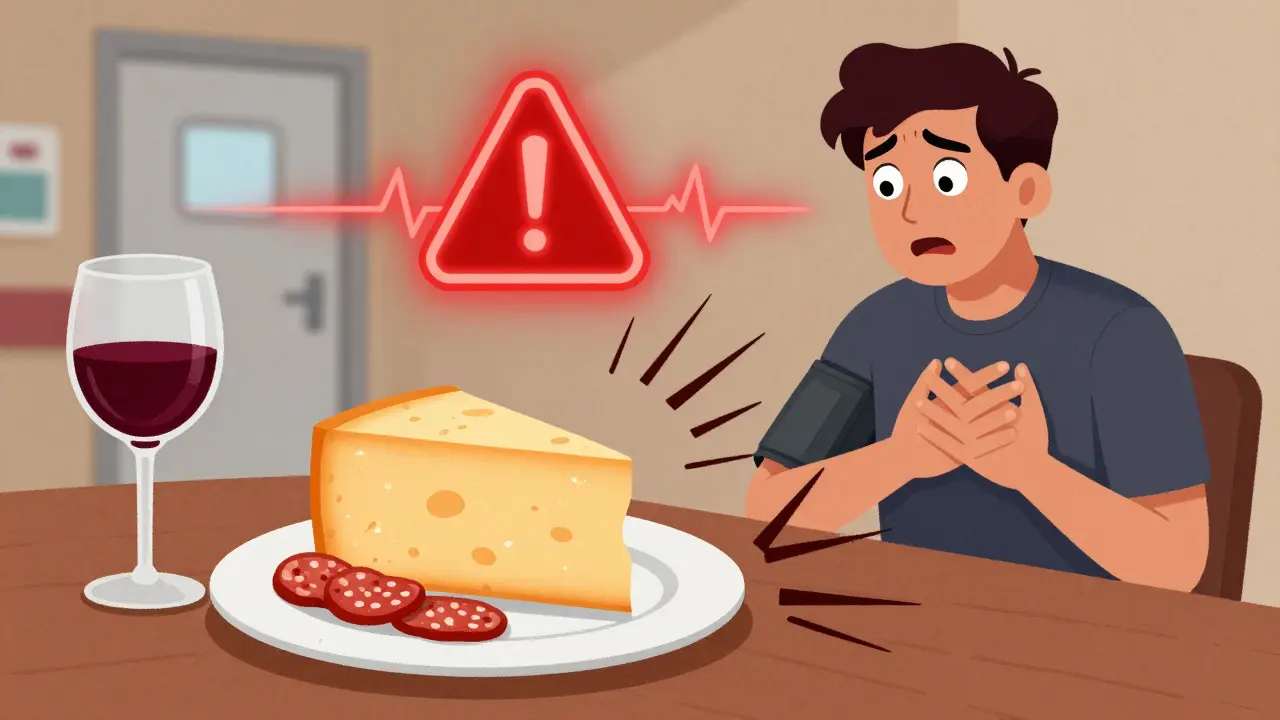
When you're on an MAOI antidepressant like Nardil or Parnate, your favorite cheese plate could be a silent health threat. This isn’t a myth or an old wives’ tale-it’s a life-or-death interaction backed by decades of clinical research. Aged cheeses and processed meats contain tyramine, a compound that, when combined with MAOIs, can trigger a sudden, dangerous spike in blood pressure. In minutes, your systolic pressure can jump from 120 to over 180 mmHg. The result? A hypertensive crisis that can lead to stroke, heart attack, or death.
Why Tyramine Is a Hidden Danger
Tyramine is a naturally occurring compound formed when proteins break down during aging or fermentation. It’s found in foods that have been stored, cured, or aged for long periods. The name itself comes from the Greek word for cheese-tyros. That’s no accident. Cheese was the first food linked to this reaction, back in the 1960s, when researchers noticed patients on early antidepressants were having severe high blood pressure episodes after eating cheese.MAOI medications block the enzyme monoamine oxidase, which normally breaks down tyramine in your gut and liver. Without this enzyme, tyramine builds up and forces your nerves to dump massive amounts of norepinephrine into your bloodstream. That’s what causes your blood pressure to skyrocket. The reaction isn’t slow-it can happen within 15 to 30 minutes of eating. And you won’t always feel it coming.
Which Cheeses Are Risky?
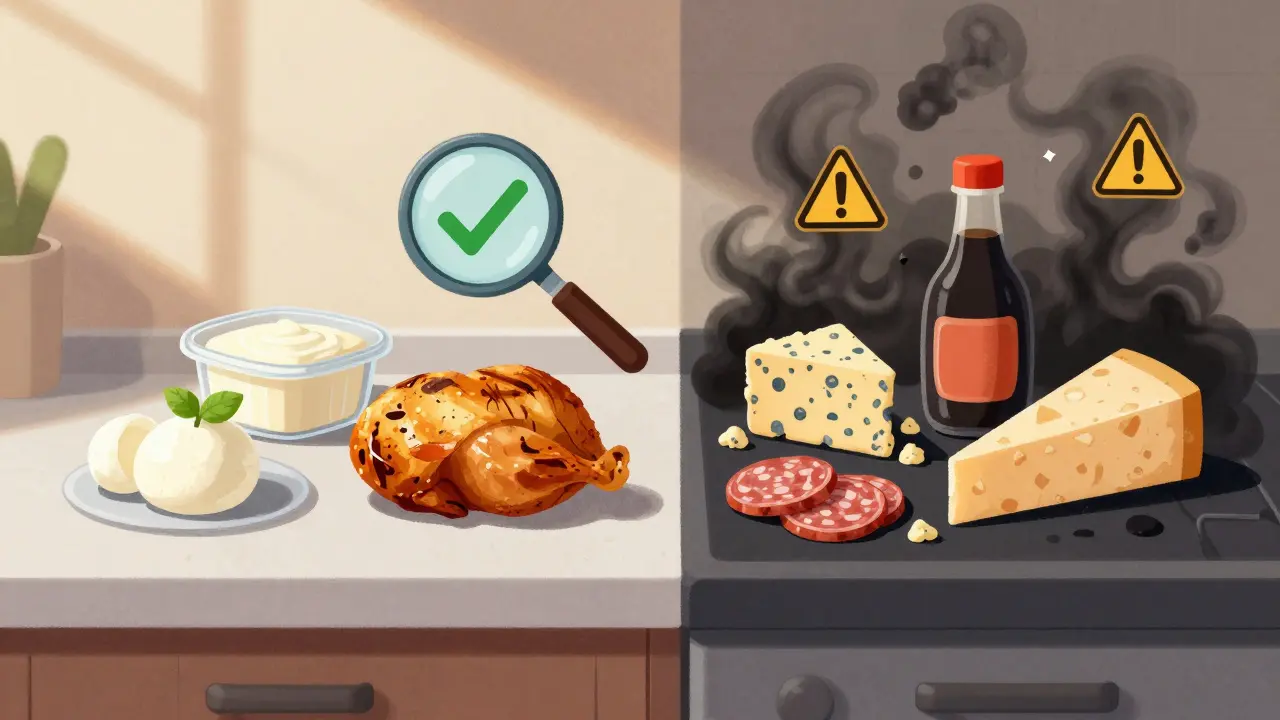
Not all cheeses are created equal when it comes to tyramine. Fresh cheeses are generally safe. But aged, fermented, or blue cheeses? These are the ones to avoid.- High-risk cheeses: Aged cheddar (72-953 mcg/g), Parmesan (610-1,400 mcg/g), Gorgonzola and Stilton (1,000-3,500 mcg/g), Swiss (400-1,200 mcg/g), and feta (350-800 mcg/g)
- Moderate-risk cheeses: Camembert, Brie (200-600 mcg/g), Gruyère, Edam (150-500 mcg/g)
- Safe cheeses: Cottage cheese (<30 mcg/g), ricotta (<40 mcg/g), fresh mozzarella (<25 mcg/g), cream cheese (<20 mcg/g), American cheese (<50 mcg/g)
A single 30-gram slice of aged cheddar can contain up to 28.6 mg of tyramine. For some people, as little as 6 mg can trigger symptoms. At 25 mg, the risk of a medical emergency becomes very real. That’s why even a small portion of blue cheese on a salad can be dangerous.
Processed Meats: The Other Hidden Risk
If you think cheese is the only problem, you’re missing half the danger. Processed meats are just as risky-often worse.- High-risk meats: Dry-cured salami (150-500 mcg/g), pepperoni (200-600 mcg/g), summer sausage (300-900 mcg/g)
- Moderate-risk meats: Bacon (75-250 mcg/g), corned beef (60-180 mcg/g), bologna (50-200 mcg/g)
- Safe options: Freshly cooked chicken, beef, pork, or fish-anything not cured, smoked, or aged
These meats are preserved through fermentation, drying, or smoking-processes that allow tyramine to build up over time. A single sandwich with pepperoni or salami can easily push you over the 10-25 mg danger zone. And unlike cheese, you might not even realize you’re eating it. Many deli meats are labeled as “natural” or “artisan,” which doesn’t mean they’re safe.
Other Surprising Sources of Tyramine
Cheese and meat aren’t the only culprits. Many common condiments and fermented foods pack a hidden punch.- Soy sauce: 1,000-2,500 mcg/g
- Miso paste: 800-2,000 mcg/g
- Fish sauce: 1,200-3,000 mcg/g
- Tap beer and red wine: Can contain 100-500 mcg/g depending on aging
- Overripe bananas: Less than 10 mcg/g-safe
- Chocolate: 50-150 mcg/g-generally safe in small amounts
- Peanuts: 75-200 mcg/g-safe in moderation
Many people assume that if it’s a fruit or snack, it’s safe. But fermented sauces, especially those used in Asian cooking, are among the most dangerous. A tablespoon of soy sauce can contain more tyramine than a slice of cheddar. And if you’re eating stir-fry with soy sauce and tofu that’s been fermented, you’re stacking the risk.
What Happens During a Hypertensive Crisis?
Symptoms don’t wait. They hit fast and hard.- Severe headache, often at the back of the head (occipital)
- Palpitations or racing heart
- Profuse sweating
- Blurred vision or sensitivity to light
- Nausea, vomiting, chest pain
- Confusion or anxiety
One user on Drugs.com described eating a Parmesan salad while on Nardil and waking up in the ER with a blood pressure reading of 198/112. “The headache was like nothing I’ve ever experienced,” they wrote. That’s not exaggeration. Blood pressure spikes this high can rupture blood vessels in the brain or heart. Emergency treatment often involves IV medications to lower pressure immediately.
Even if you’ve taken MAOIs for years without issue, one wrong bite can change everything. There’s no way to predict who will react-and how badly.
How Long Do You Need to Stay on the Diet?
You can’t just stop the medication and go back to your old eating habits. Your body needs time to recover.Monoamine oxidase enzyme levels take 14 to 21 days to return to normal after you stop taking an MAOI. That means you must continue avoiding high-tyramine foods for at least two to three weeks after your last dose. Stopping the drug doesn’t instantly make you safe.
Many patients think they’re fine after a week. That’s when most emergencies happen.

How to Manage the Diet in Real Life
This isn’t about giving up food. It’s about learning what’s safe and how to find it.- Read labels. Look for “aged,” “cured,” “fermented,” or “dry-cured.” If it’s not fresh, assume it’s risky.
- Choose fresh. Buy cheese from the deli counter and ask if it’s aged. Most stores now carry “MAOI-safe” fresh mozzarella cups.
- Use substitutes. Swap salami for grilled chicken in sandwiches. Use fresh mozzarella instead of Parmesan on pasta.
- Track your intake. Keep a food and blood pressure diary. Some people can tolerate 15g of aged cheese; others can’t handle 5g.
- Carry an emergency card. It should list your medication and dietary restrictions. Paramedics need to know this fast.
Restaurants are the biggest challenge. Ask: “Is this cheese aged or fresh?” “Is this meat cured or cooked fresh?” Most servers don’t know. Be specific. Say: “I’m on a medication that can’t mix with tyramine. Is this Parmesan or fresh mozzarella?”
New Tools and Future Solutions
The good news? Technology is catching up.In early 2023, the Mayo Clinic launched the “MAOI Diet Tracker” app. It scans barcodes and flags high-tyramine foods with 89% accuracy. It’s already helping thousands of users avoid dangerous mistakes.
The cheese industry has responded too. Companies like Sargento now sell refrigerated fresh mozzarella labeled specifically for MAOI users. Sales hit $14.7 million in 2022.
Future developments include enzyme supplements being tested by the NIH to break down tyramine before it enters your bloodstream. And by 2025, we may see food labels that list tyramine content-just like calories or sodium.
One researcher at the National Institute of Mental Health even predicts genetically modified cheeses with near-zero tyramine levels within five years. That could change everything.
Why This Still Matters Today
About 1.4 million Americans are on MAOIs. Most are prescribed for treatment-resistant depression or Parkinson’s disease. Despite decades of awareness, 61% of MAOI-related ER visits are due to dietary non-compliance.It’s not that people are careless. It’s that the rules are confusing. One study found that 41% of patients struggle to stick to the diet because of social pressure, lack of restaurant options, or simply not knowing what’s safe.
But the consequences are too serious to guess. A single bite of blue cheese or pepperoni can end in the ER. There’s no second chance.
Knowledge saves lives. And now, with better tools, clearer labels, and smarter food options, it’s easier than ever to stay safe-without giving up the foods you love.
Angela Fisher
They don't want you to know this but the FDA is hiding the truth about cheese and MAOIs... it's all about controlling the pharmaceutical industry's profits. They let you eat aged cheddar because they make more money selling you emergency blood pressure meds than they do selling you safe antidepressants. I've seen it with my own eyes. My uncle died after eating blue cheese and they called it 'natural causes'. 😡
Neela Sharma
Life is a delicate dance with our bodies
Some foods whisper warnings
Others scream in silence
But we keep eating because we forget we are not just cells
We are stories shaped by culture, memory, and fear
Let this be a gentle reminder to listen
To your body
To the wisdom of centuries
Not just the latest study
Peace.
Shruti Badhwar
The clinical data on tyramine-MAOI interactions is unequivocal. Multiple peer-reviewed studies from the 1970s through 2020 confirm the risk profile. This is not speculative. It is a well-documented pharmacological interaction with documented fatalities. Ignorance is not a defense. Compliance is non-negotiable.
Brittany Wallace
I'm from India and we have so many aged cheeses now-like paneer aged for weeks-but I never thought about tyramine until now. My mom used to say, 'If it smells strong, it's alive.' Maybe she knew more than we thought 😊
It's beautiful how traditional wisdom sometimes matches science. Let's honor that.
Michael Burgess
Had a friend on Parnate who ate a slice of sharp cheddar at a party and ended up in the ER with a migraine so bad he threw up for 12 hours. He thought it was just 'bad cheese'-turns out his blood pressure hit 210/130. Dude still doesn't get why he can't have blue cheese pizza. 🤦♂️
Pro tip: if you're on MAOIs, treat your cheese board like a minefield. And yes, that includes 'artisanal' stuff.
Liam Tanner
For anyone new to MAOIs: this isn't about fear-it's about awareness. You're not being punished. You're being protected. There are still so many delicious foods you can enjoy. It's just a new map to learn.
Palesa Makuru
Oh please. You're telling me I can't have properly fermented French brie? That's like telling a wine connoisseur not to drink red. You're just culturally insensitive. I've eaten Gorgonzola for 20 years and I'm fine. You're all overreacting. 😒
Also, did you know the FDA has a vested interest in promoting low-fat diets? Coincidence? I think not.
Vincent Sunio
Incorrect. The tyramine content in aged cheddar is not uniformly 72–953 mcg/g. That range is outdated and based on non-standardized sampling methods from the 1980s. More recent HPLC analyses show median values closer to 180 mcg/g with outliers exceeding 500 mcg/g. Your source is unreliable. Also, 'feta' is not consistently high-risk-it varies by production method. Please cite primary literature.
JUNE OHM
They want you to think cheese is dangerous... but what about the GMO corn syrup in your soda? The glyphosate in your bread? The fluoride in your water? They’re all poisoning you slowly while you’re too busy worrying about blue cheese. Wake up! 🇺🇸
Philip Leth
My abuela in Puerto Rico used to say, 'If it’s been sitting out, it’s been thinking.' She never knew about MAOIs, but she’d never let us eat anything that looked or smelled 'off'. Turns out she was a natural pharmacologist. 🤓
Shanahan Crowell
YES! THIS IS SO IMPORTANT!!! I was on Nardil for 3 years and I NEVER touched cheese!!! I told everyone!!! I even made a poster for my fridge!!! I’m so glad someone’s finally talking about this!!! WE NEED MORE AWARENESS!!! 🚨🔥💪
Kerry Howarth
Stick to fresh mozzarella, ricotta, and cream cheese. Everything else is a gamble. Your life isn’t worth the risk.
Tiffany Channell
Of course the comment section is full of people who think they’re exempt because they 'eat clean' or 'have a strong constitution.' You’re not special. You’re just dead sooner.