

The Steady Approach: What is Rate Control?
Rate control is essentially about damage control. It doesn't try to stop the irregular rhythm of the atria; instead, it focuses on slowing down how fast the ventricles (the lower chambers) respond. Think of it as putting a governor on an engine-the engine might still be idling unevenly, but you're preventing it from redlining. To make this work, doctors aim to keep the resting heart rate typically below 80 to 110 beats per minute. The RACE II trial provided some peace of mind here, showing that "lenient" control (under 110 bpm) is generally just as effective as "strict" control (under 80 bpm) when it comes to mortality and heart failure hospitalizations. This makes the treatment much easier to manage for patients and clinicians alike. Common medications used for this approach include:- Beta-blockers: Such as metoprolol, which slow the heart rate and lower blood pressure.
- Calcium channel blockers: Like diltiazem, which relax the blood vessels and slow the heart.
- Digoxin: Often used when other options aren't enough or for patients with specific heart failure needs.
The Reset Approach: What is Rhythm Control?
While rate control manages the symptoms, rhythm control tries to fix the problem. The goal here is to restore and maintain a Sinus Rhythm, which is the normal, steady beating of the heart. This is like hitting the reset button on the heart's electrical system. There are two main ways to achieve this. First, there are pharmacologic options using Antiarrhythmic Drugs (AADs). Medications like amiodarone or flecainide are used to keep the heart in rhythm. Second, there are procedural interventions. Electrical cardioversion involves a timed electric shock to "reset" the heart, while Catheter Ablation involves using heat or cold to destroy the tiny areas of heart tissue that are causing the irregular signals. For a long time, the AFFIRM trial suggested that rhythm control didn't offer a survival advantage over rate control. However, that trial happened before we had the advanced ablation techniques we have today. Modern ablation has seen complication rates drop from 20% in the early 2000s to less than 5% now. More recent evidence, specifically the EAST-AFNET 4 trial, shows that if you start rhythm control early (within a year of diagnosis), you can reduce the risk of cardiovascular death, stroke, and heart failure hospitalizations by about 21%.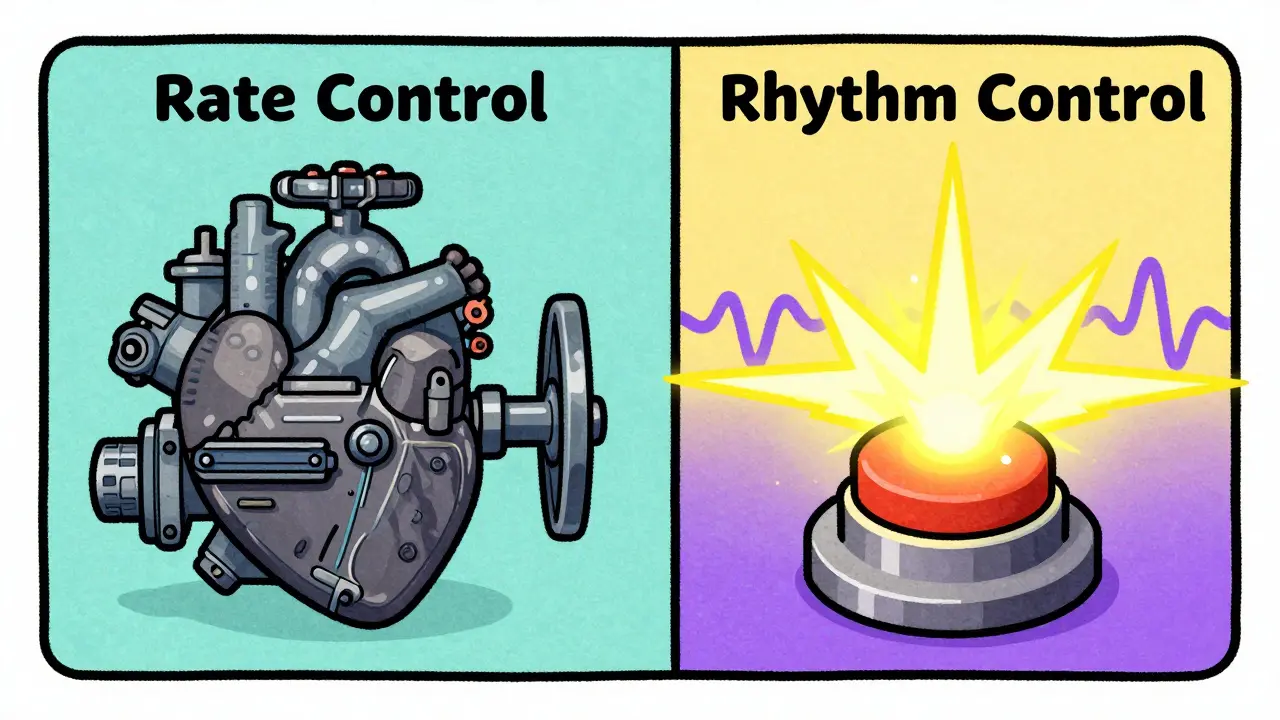
Comparing the Two Strategies
Choosing between these two isn't a one-size-fits-all decision. It depends on your age, your symptoms, and how long you've had the condition.| Feature | Rate Control | Rhythm Control |
|---|---|---|
| Primary Goal | Slow heart rate (BPM) | Restore normal sinus rhythm |
| Common Methods | Beta-blockers, Calcium blockers | Ablation, Antiarrhythmic drugs |
| Best For | Older adults, asymptomatic patients | Younger patients, symptomatic patients |
| Main Advantage | Easier to start, lower risk | Better symptom control, potential long-term gain |
| Main Risk | Heart remains in AF | Procedural risks, drug toxicity |
The Non-Negotiable: Stroke Prevention
Here is the most critical point: whether you choose rate control or rhythm control, neither of them "cures" the risk of stroke. Many people mistakenly believe that if their heart is back in a normal rhythm, they can stop taking their blood thinners. This is a dangerous misconception. Data from the AFFIRM trial showed that most strokes happened when patients stopped taking their anticoagulants or when their levels were too low. Anticoagulation (using medications like warfarin or newer direct oral anticoagulants) is the only way to effectively prevent the blood clots that lead to strokes in AF patients. The strategy you use to manage your heart rate is about how you feel and how your heart functions; the anticoagulation is about staying alive and avoiding permanent brain damage.
Who Should Choose What?
If you're trying to figure out which path is right for you, it usually comes down to a few key markers. Doctors often use the CHA2DS2-VASc score to determine stroke risk, which then helps guide the urgency of treatment. Rhythm control is generally preferred for:- People under 65 who are experiencing significant symptoms like shortness of breath or extreme fatigue.
- Those with heart failure, as getting the heart back into rhythm can improve the overall pumping efficiency.
- Patients in the early stages of AF, where the "electrical remodeling" of the heart hasn't become permanent yet.
- Patients over 75 who may not tolerate the side effects of powerful antiarrhythmic drugs.
- People who feel perfectly fine even though their heart is in AF.
- Those with severe comorbidities where the risk of a surgical procedure like ablation outweighs the potential benefits.
The Future of AF Management
We are moving toward a much more personalized approach. We're seeing a shift where rhythm control is offered much more widely and earlier. The 2023 European Society of Cardiology (ESC) guidelines now suggest that early rhythm control should be offered regardless of how severe the symptoms are, because the long-term cardiovascular benefits are becoming too significant to ignore. New research, like the ongoing ASSERT II trial, is looking specifically at how ablation helps people with heart failure and preserved ejection fraction. As these tools become more precise and safer, the "default" setting of simply managing the rate is being replaced by a more proactive attempt to fix the rhythm. However, the golden rule remains: never stop your stroke prevention medication without a direct order from your cardiologist.Does rhythm control cure Atrial Fibrillation?
Not necessarily. While rhythm control (like ablation or medication) can restore a normal heart rhythm, AF can sometimes return. The goal is to maintain that rhythm for as long as possible to improve quality of life and reduce the risk of heart failure.
Can I stop taking blood thinners if my heart is back in sinus rhythm?
No. This is a common and dangerous mistake. Even if your heart is beating normally, the underlying tendency for blood to pool and clot often remains. You must continue anticoagulation as directed by your doctor to prevent strokes.
What is the difference between a beta-blocker and an antiarrhythmic drug?
A beta-blocker is used for rate control; it slows down how fast the heart beats but doesn't stop the irregular rhythm. An antiarrhythmic drug is used for rhythm control; it attempts to stop the irregular rhythm and put the heart back into a steady, normal beat.
Is catheter ablation safe?
Modern ablation techniques are significantly safer than they were twenty years ago, with complication rates now typically under 5%. However, like any medical procedure, it carries some risks which your cardiologist will discuss with you based on your specific health history.
Why is early rhythm control better?
The heart undergoes "remodeling" when it stays in AF for too long-the tissue physically changes, making it harder to fix. By intervening early (within the first year), doctors have a better chance of permanently restoring the rhythm and reducing the long-term risk of stroke and heart failure.
Benjamin cusden
The simplification of the AFFIRM trial in this text is practically quaint. One must understand that the failure of rhythm control in that era wasn't a failure of the concept, but a failure of the pharmacological tools available at the time. The shift toward ablation is an obvious evolution for anyone who actually follows cardiology literature. It is honestly amusing how we treat these breakthroughs as new revelations rather than inevitable progressions of medical technology.
Kathleen Painter
It is so important to remember that everyone's journey with their heart health is different, and it's really wonderful to see how much the options have expanded over the years to fit different lifestyles and age groups. I've spent quite a bit of time talking with friends who felt completely overwhelmed by the choice between rate and rhythm control, and I think the analogy of the drummer is just such a gentle, accessible way to explain a complex medical condition without making people feel intimidated by the jargon. We should always encourage people to have those deep, open conversations with their specialists because there is no one-size-fits-all answer, and sometimes the "simpler" path of rate control is exactly what a person needs to maintain their quality of life while they focus on other holistic ways of healing and staying mindful. It's all about finding that balance that feels right for your specific body and your specific life stage, and it's heartening to know that the medical community is moving toward a more personalized approach that acknowledges the human element of care rather than just treating a set of symptoms on a chart.
Windy Phillips
One would think that the danger of stopping anticoagulants would be common sense... but apparently not!!! It is simply exhausting to see how many people gamble with their brain health because they "feel fine"... just truly tragic!!!
jack hunter
the whole idea of "fixing" the rhythm is just another way to keep us dependent on the system. why do we trust these electrical shocks to reset our souls? its probably just a way to make us more compliant with the medz. truth is the heart wants to beat its own way and we just force it into a box for the sake of some trial data from 2023 that probably has hidden agendas anyway.
Ruth Swansburg
Stay strong everyone! Managing AF is a marathon, not a sprint. You have the tools to win this!
Ethan Davis
Big Pharma just wants you on those blood thinners forever. They don't want a cure, they want a subscription model for your heart.
Nikhil Bhatia
Too much text, but basically just says talk to your doctor.
Dhriti Chhabra
It is most commendable that the latest guidelines emphasize early intervention to preserve cardiovascular health. Such a proactive approach surely benefits the patient community significantly.