
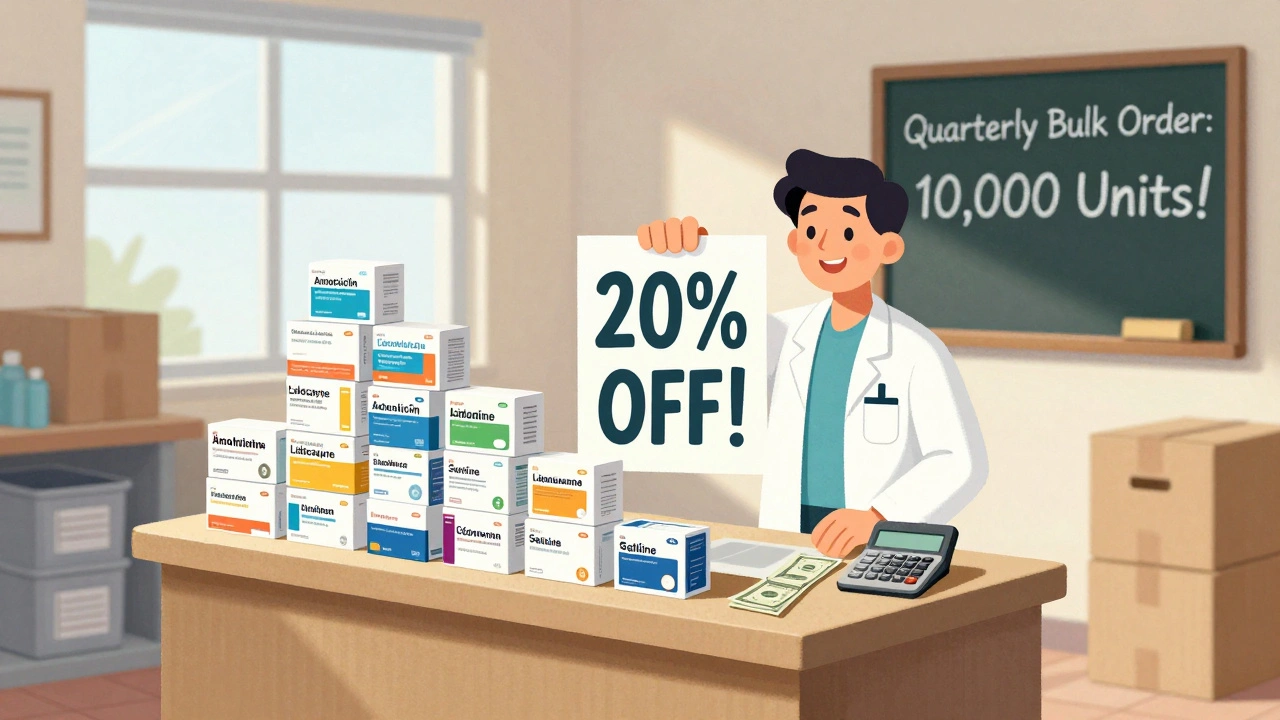
When you walk into a clinic or urgent care center, you rarely think about how much the doctor’s office paid for the antibiotics, lidocaine, or saline bags they just handed you. But behind the scenes, the difference between paying full price and buying in bulk can mean the difference between staying open and shutting down. In the U.S. healthcare system, bulk purchasing of generic medications isn’t just a smart business move-it’s often the only way small providers can afford to keep essential drugs on the shelf.
Generic drugs make up over 90% of all prescriptions filled in the U.S., yet they account for only about 25% of total drug spending. That’s because manufacturers sell them at low list prices, but the real savings come from volume. When a clinic buys 10,000 units of amoxicillin instead of 500, the price per pill can drop by 20% or more. This isn’t magic. It’s simple economics: the more you buy, the less you pay per unit. And in a world where profit margins are razor-thin, that adds up fast.
How Bulk Purchasing Actually Works
Bulk purchasing isn’t just about ordering more. It’s about negotiating with the right partners using the right tools. There are three main ways providers get discounts: direct volume discounts, rebate agreements, and short-dated stock.
Direct discounts kick in when you buy over 1,000 units of a single drug. For most generics, that means a 5% to 15% reduction off the invoice. But if you’re buying 10,000 units or more-like a chain of urgent cares stocking up on injectables-the discount can jump to 20% to 30%. These deals are common with secondary distributors like Republic Pharmaceuticals, which specialize in serving smaller providers who can’t negotiate with the big wholesalers.
Rebates are trickier. Pharmacy Benefit Managers (PBMs) negotiate these with drugmakers, promising to push more of a drug through their networks in exchange for cash back. But here’s the catch: PBMs don’t always pass those savings along. Studies show only 50% to 70% of rebate money ends up benefiting the actual payer-whether it’s a clinic, employer, or Medicaid program. That’s why direct bulk deals often make more sense for providers who want real, immediate savings.
Then there’s short-dated stock. These are medications with 6 to 12 months left before expiration. Most pharmacies avoid them, fearing waste. But smart buyers know: if you use a lot of lidocaine or antibiotics, buying 1,000 vials with 8 months left on the clock can cut your cost by 25%. One Ohio clinic slashed their injectable spending by nearly a quarter in just three months by switching to this model. The key? Good inventory tracking. If you can forecast usage accurately, you’ll use every pill before it expires.
Who’s Buying, and Who’s Selling
The market is split between three types of suppliers: the big three wholesalers, secondary distributors, and multi-state buying pools.
McKesson, AmerisourceBergen, and Cardinal Health control 85% of the U.S. pharmaceutical distribution market. They’re reliable, but their discounts for small providers are usually just 3% to 8%. That’s barely enough to cover shipping. For clinics, these companies are often the default-because they’re the only ones with a sales rep who shows up regularly.
Secondary distributors like Republic Pharmaceuticals fill the gap. They don’t have nationwide warehouses, but they specialize in high-volume generic purchases for urgent cares, dermatology clinics, and podiatry offices. Their discounts? 20% to 25%. They also offer more flexible terms: no minimum order requirements on some items, no allocation limits during shortages, and better documentation. One Florida medical director told us, “Switching to Republic gave us options we didn’t have before. No allocations, no games-just the inventory we needed at prices that make sense.”
Then there are state buying pools like the National Medicaid Pooling Initiative (NMPI) and the Sovereign States Drug Consortium (SSDC). These let multiple states combine their buying power to get 3% to 5% better prices than they could alone. Medicaid programs that join these pools save more than those that go it alone. But these deals are mostly for government programs-not private clinics.
What Drugs Save the Most
Not all generics are created equal when it comes to bulk savings. The biggest wins come from high-volume, low-cost drugs that clinics use every day.
- Lidocaine: Used in nearly every urgent care for minor procedures. Buying in bulk cuts costs by 20%+.
- Antibiotics: Amoxicillin, azithromycin, doxycycline-these are prescribed by the thousands. Volume discounts here pay off fast.
- Corticosteroids: Injectable and oral forms used for inflammation. High usage + low cost = perfect for bulk.
- Saline solutions: IV bags and flushes. Used constantly. Even a 5% discount on 500 bags a month saves hundreds.
- Metformin and atorvastatin: Common oral meds for diabetes and cholesterol. Point-of-sale discount programs now automatically apply bulk prices at the pharmacy counter, cutting patient copays by 30% to 50%.
On the flip side, bulk buying doesn’t help with low-use drugs like specialty injectables for rare conditions. You won’t hit volume thresholds, and the risk of expiration outweighs the savings. It also fails during drug shortages. As of November 2023, the FDA listed 298 active shortages of generic drugs. If you’ve committed to buying 10,000 units of a drug that’s suddenly unavailable, you’re stuck.
Real-World Savings: A Case Study
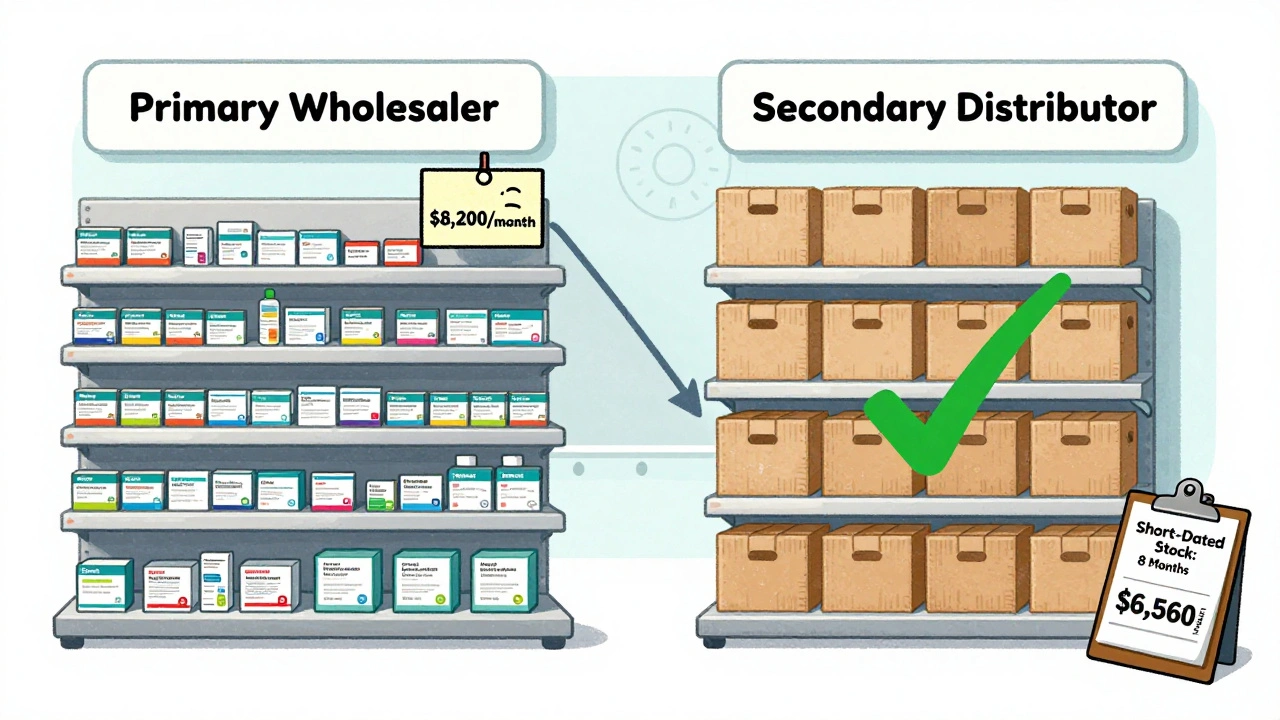
A Texas urgent care center had a problem: their monthly drug bill was climbing. They were buying antibiotics, lidocaine, and saline from their primary wholesaler at standard rates. Their monthly spend on just those three items was $8,200.
They switched 60% of their purchases to a secondary distributor, ordering quarterly instead of monthly. They also started buying short-dated stock for injectables. Within two months, their drug spend dropped to $6,560-a 20% reduction. They didn’t change their formulary. They didn’t cut services. They just bought smarter.
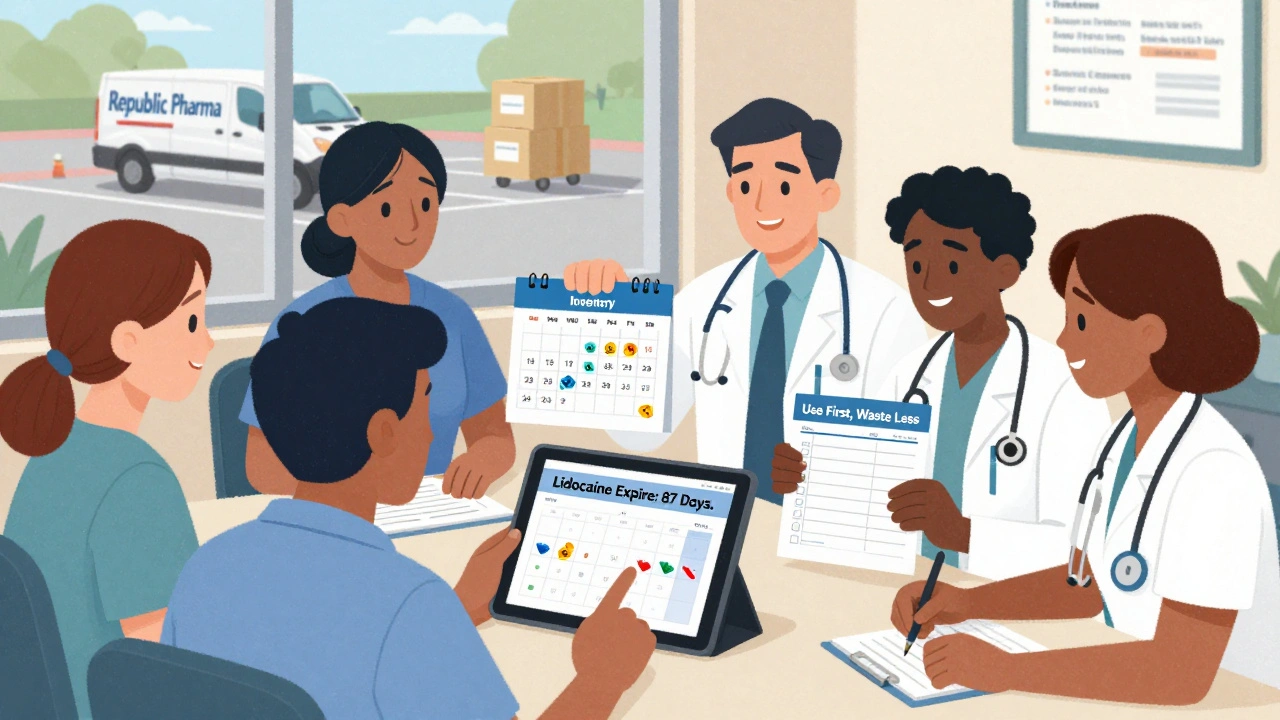
Their inventory team spent 20 hours over six weeks learning how to track expiration dates. They set up alerts in their EHR system to flag drugs with less than 90 days left. They never had a stockout. They used 97% of their short-dated stock. And they saved over $19,000 in the first year.
Challenges and Pitfalls
Bulk purchasing isn’t easy. It comes with real headaches.
One big issue: cash flow. Buying 10,000 units at once means a $5,000 to $10,000 upfront payment. For a small clinic, that’s a lot of money tied up. A 2023 MGMA survey found 15% to 25% more working capital is needed to manage bulk buys.
Minimum order requirements are another trap. Some suppliers force you to buy 5,000 units of a drug you only use 1,000 of per year. That’s not savings-that’s waste. Always ask: “What’s the minimum? Can I buy smaller batches?”
Inventory management is critical. If you don’t track expiration dates, you’ll throw out thousands of dollars in expired meds. One provider said they lost $3,000 in expired lidocaine because their staff didn’t check the dates. That’s why successful clinics dedicate 5 to 10 hours a month to inventory optimization. They use simple spreadsheets or low-cost software to flag soon-to-expire items.
And don’t forget: not all suppliers are equal. Secondary distributors like Republic Pharmaceuticals scored 4.3 out of 5 in user guides, while primary wholesalers averaged just 3.1. Clear instructions matter. If you’re new to bulk buying, start with a supplier that gives you step-by-step onboarding.
The Bigger Picture: Why This Matters
Bulk purchasing won’t fix the entire U.S. drug pricing crisis. The system is broken-manufacturers hike list prices, PBMs keep rebates, and patients pay the price. But for clinics, pharmacies, and providers on the front lines, bulk buying is a lifeline.
The Inflation Reduction Act’s new Medicare drug price negotiations will bring down costs for 10 high-price drugs starting in 2026. But those are just a drop in the bucket. For the 90% of prescriptions that are generics, bulk purchasing remains the most powerful tool available.
As the market evolves, secondary distributors are gaining ground. They now handle 12% of non-340B generic procurement for independent practices. And point-of-sale discount programs are making it easier than ever-no more separate discount cards. Just walk up to the counter, and the lower price is applied automatically.
The future isn’t about choosing between big and small suppliers. It’s about using all the tools: direct bulk deals, short-dated stock, and transparent pricing. The clinics that survive won’t be the ones with the fanciest equipment. They’ll be the ones who know how to buy smart.
How to Start Bulk Purchasing
If you’re a clinic owner, pharmacist, or administrator ready to cut drug costs, here’s how to begin:
- Identify your top 15-20 drugs. Look at your dispensing records. Which generics make up 60-70% of your spending? Focus there first.
- Calculate your monthly usage. How many pills, vials, or bags do you use per month? Multiply that by 3 to get your quarterly target.
- Reach out to secondary distributors. Look for companies that specialize in urgent care, dermatology, or primary care. Ask about volume discounts and short-dated stock options.
- Compare terms. Don’t just ask for price. Ask about minimum orders, return policies, and documentation quality.
- Start small. Try one drug first. Buy 2,000 units instead of 500. See how it works before scaling up.
- Set up inventory alerts. Use your EHR or a simple spreadsheet to track expiration dates. Flag anything with less than 90 days left.
- Train your team. Make sure someone is responsible for checking stock weekly. A 10-minute check can save thousands.
The savings are real. The process is simple. And the payoff? More money in your budget, better care for your patients, and less stress over rising drug costs.
Can small clinics really save money with bulk purchasing?
Yes. Even small clinics can save 15% to 25% by buying high-volume generics like antibiotics, lidocaine, and saline in bulk. Secondary distributors like Republic Pharmaceuticals offer deals tailored to practices that can’t meet the minimums of big wholesalers. One urgent care center cut its drug bill by $19,000 in a year just by switching to quarterly bulk orders and using short-dated stock.
What’s the difference between a primary wholesaler and a secondary distributor?
Primary wholesalers-McKesson, Cardinal Health, AmerisourceBergen-control 85% of the market and serve large hospitals and pharmacy chains. Their discounts for small clinics are usually 3% to 8%. Secondary distributors focus on smaller providers and offer deeper discounts-20% to 25%-on high-volume generics. They also offer more flexibility, better documentation, and access to short-dated stock.
Is short-dated stock safe to use?
Absolutely. Medications don’t suddenly become ineffective the day after their expiration date. The FDA allows a 10-20% safety margin beyond the printed date for most generics. Short-dated stock (6-12 months left) is safe if stored properly and used before expiration. Clinics that track usage carefully report zero safety issues and 25% cost savings.
Do I need special software to manage bulk purchases?
You don’t need expensive systems. Many clinics use simple Excel spreadsheets to track inventory, expiration dates, and usage rates. Some EHR systems have basic inventory modules. The key isn’t the tool-it’s the habit. Dedicate 10 minutes a week to check stock. Flag items expiring soon. Use them first. That’s how you avoid waste and maximize savings.
Why don’t more providers use bulk purchasing?
Most don’t know it’s an option. Many assume they have to buy from their usual wholesaler. Others fear the upfront cost or think managing inventory is too complicated. But once they try it-starting with just one drug-they see the savings. The biggest barrier isn’t logistics-it’s awareness.
Can I combine bulk purchasing with Medicare’s new drug price negotiations?
Yes. Medicare’s negotiated prices will apply to 10 high-cost drugs starting in 2026, but they won’t cover most generics. Bulk purchasing still works for the 90% of prescriptions that are low-cost generics. In fact, the two strategies complement each other: Medicare lowers prices on expensive drugs, while bulk buying saves on the everyday ones.
Martyn Stuart
Wow, this is one of those posts that makes you realize how much we take for granted in healthcare logistics.
Buying in bulk isn't just smart-it's survival for small clinics. I've seen practices shut down because they couldn't afford even basic antibiotics at retail prices.
The part about short-dated stock? Game-changer. I used to think expired meds were a liability-now I see them as an opportunity if you've got good systems.
One thing I'd add: always verify the manufacturer. Some secondary distributors source from overseas labs with sketchy QC. Not all generics are equal.
And yes, inventory tracking matters. I had a clinic lose $12k in expired saline because no one checked the dates. It's not glamorous, but it's essential.
Start with lidocaine or amoxicillin. Low cost, high volume. You'll see the savings fast.
Also-don't trust PBMs. They're middlemen who pocket rebates and pretend they're helping you. Direct deals with distributors? That's where the real money is.
Finally-training your staff. One person should own inventory. Not 'everyone,' not 'whenever you get around to it.' One person. Weekly check. 10 minutes. That's it.
This isn't rocket science. It's just discipline.
Shofner Lehto
Biggest myth: you need fancy software to track expiration dates. I use a printed spreadsheet taped to the fridge in the supply closet. Every Monday, I circle anything expiring in the next 60 days. Done.
Cost savings? 22% last year. No magic. Just consistency.
Yasmine Hajar
I love how this post breaks it down like a roadmap-not just a lecture.
But let’s be real: most small clinics are run by overworked people who are barely keeping their heads above water.
Yes, bulk buying saves money-but it also adds stress. Who’s going to manage the inventory when the front desk is short-staffed and the nurse just quit?
It’s not just about the numbers. It’s about human capacity.
Maybe the real solution isn’t just buying smarter… it’s getting paid more so we can hire someone to handle this stuff.
Also-short-dated stock? YES. But only if you have a team that won’t panic every time they see a date that’s not 2027.
We need systems that assume we’re tired, busy, and underpaid-not robots with perfect inventory control.
Jake Deeds
How quaint.
Real healthcare reform isn't about buying 10,000 vials of lidocaine-it's about dismantling the entire broken pharmaceutical-industrial complex.
Why are we even talking about secondary distributors like they're heroes? They're just band-aids on a hemorrhage.
Meanwhile, the real villains-Big Pharma, PBMs, and the FDA's archaic approval processes-are still laughing all the way to the bank.
You can optimize all you want, but until we force manufacturers to cap generic drug prices at production cost, you're just rearranging deck chairs on the Titanic.
And let’s not pretend this is ‘smart business.’ It’s desperation dressed up as innovation.
Also, ‘Republic Pharmaceuticals’? Sounds like a startup that got a name from a Mad Men pitch meeting.
Chase Brittingham
Just wanted to say thank you for writing this. I’m a clinic admin in rural Kansas, and I’ve been trying to convince my boss to try bulk buying for months.
He kept saying ‘we’re too small.’ Then I showed him your case study.
We started with amoxicillin. Bought 3,000 instead of 800. Saved $1,400 in one quarter.
Now we’re doing the same with saline. No drama. No software. Just a spreadsheet.
It’s not sexy. But it works.
And honestly? It feels good to know we’re not getting ripped off every time we order meds.
Bill Wolfe
Let me guess-you’re one of those people who thinks ‘bulk buying’ is some kind of moral victory.
Newsflash: the entire system is rigged. You’re not ‘saving money’-you’re just playing the game better than the next guy.
And let’s not forget: those ‘short-dated’ drugs? They’re often recalled, mislabeled, or diverted from failed recalls.
I’ve seen it. I’ve reported it. And now you’re glorifying it like it’s some grassroots movement?
What’s next? Buying expired insulin from a guy on Craigslist because it’s ‘cheaper’?
Real safety isn’t about saving 25% on lidocaine-it’s about knowing your supply chain is clean.
And if you’re trusting a ‘secondary distributor’ with your patients’ lives… you’re either naive or reckless.
Or both.
michael booth
Efficient procurement practices are essential to sustainable clinical operations.
Volume-based pricing models, when properly implemented, yield demonstrable reductions in unit cost.
Inventory turnover metrics must be monitored to mitigate obsolescence risk.
Secondary distributors provide a viable alternative to primary supply chains, particularly for practices lacking economies of scale.
Recommendation: initiate pilot programs with high-utilization, low-cost pharmaceuticals prior to full-scale adoption.
Documentation and audit trails are non-negotiable.
Thank you for the comprehensive analysis.
Carolyn Ford
Oh, so now it’s ‘smart’ to buy expired meds? That’s brilliant.
Let me guess-you also think it’s fine to use old needles because ‘they’re still sterile’?
And you’re praising a company called ‘Republic Pharmaceuticals’ like it’s a nonprofit?
What’s next? Buying drugs from a guy in a van behind the Walmart?
Do you even know how many generic drug recalls happened last year? 172.
And you’re telling people to buy 10,000 units of something with 8 months left on the clock?
That’s not ‘smart.’ That’s gambling with people’s lives.
And don’t get me started on PBMs-yes, they’re corrupt-but so are these ‘secondary’ middlemen who don’t even have FDA oversight.
You’re not helping. You’re enabling.
Rudy Van den Boogaert
Love this. I run a small dermatology clinic in Arizona.
We started with tretinoin cream-bought 500 tubes instead of 100. Saved $1,800 in 3 months.
Then we did the same with hydrocortisone. Same deal.
Used a free Google Sheet. Set up a monthly alert. Assigned one person to check dates.
Zero waste. Zero issues.
My staff used to hate inventory. Now they’re the ones reminding me to reorder.
It’s not hard. It’s just not taught.
Thanks for making it feel doable.
Gillian Watson
Been doing this for 8 years. No drama.
Buy bulk. Track dates. Use oldest first.
Save money. Keep the lights on.
Simple.
Karl Barrett
The entire discourse around bulk purchasing reveals a fundamental epistemological flaw in contemporary healthcare economics: we’ve outsourced moral agency to logistical efficiency.
By optimizing for unit cost, we implicitly accept the commodification of human health as a variable in a supply chain algorithm.
Yes, the savings are quantifiable.
But at what cost to clinical integrity?
When we begin to treat antibiotics like bulk toilet paper, we normalize the erosion of therapeutic sacredness.
And let’s not ignore the ontological risk of short-dated stock: we’re not just managing inventory-we’re managing temporal uncertainty.
Is it ethical to use a drug that’s 11 months from expiration when its pharmacokinetic profile may degrade?
The FDA’s 10–20% safety margin is a statistical abstraction, not a biological guarantee.
Perhaps the real question isn’t how to buy cheaper-but whether we should be buying at all, within this broken system.
Just food for thought.
Elizabeth Crutchfield
i just started workin at a clinic and this post helped me so much!!
we were buyin 200 amoxicillin every week and spendin like 600$
i told my boss to try 1000 and now we pay 350$ and we still have like 400 left over!!
and we got this short dated lidocaine for 40% off!!
sooo happy we didnt throw it away
thx for the tips!!
Augusta Barlow
Of course this is ‘the solution.’
Because nothing says ‘healthcare reform’ like letting small clinics gamble with expired meds because the system failed them.
Do you know how many of these ‘secondary distributors’ are just repackagers with no real oversight?
And the FDA shortages? They’re not accidents. They’re manufactured.
Why do you think there’s a shortage of lidocaine right now?
Because the big players are hoarding it to drive up prices.
So now you’re telling people to buy the leftovers from that scam?
It’s not ‘smart.’ It’s survival.
And the fact that we’ve reduced healthcare to this-buying expired drugs to stay open-is the real tragedy.
Stop celebrating band-aids. Start demanding the surgery.
Jenny Rogers
While the logistical efficiency of bulk procurement is mathematically sound, one must not overlook the moral imperative of pharmaceutical integrity.
By normalizing the acquisition of short-dated stock, one implicitly endorses the commodification of human health under the guise of fiscal prudence.
Furthermore, the endorsement of secondary distributors-many of whom operate in regulatory gray zones-constitutes a tacit sanctioning of supply chain opacity.
True reform lies not in circumventing systemic failure, but in dismantling it.
Until we regulate manufacturer pricing, eliminate PBM rebates, and enforce full traceability, we are merely rearranging deck chairs on the RMS Titanic.
And yet… one cannot deny the practical utility of your case study.
It is a tragic testament to the failure of policy.
Martyn Stuart
@5577 and @5585 - I get your concerns. But let’s not throw the baby out with the bathwater.
Yes, there are bad actors in the secondary market. But there are also terrible ones in the primary ones.
I’ve seen McKesson send us expired drugs by accident. Twice.
The difference? Secondary distributors are more transparent. They tell you where the batch came from. They send you COAs. They let you audit.
And yes, expiration dates aren’t magic.
The FDA’s stability studies show most generics remain stable for 2–5 years past expiration if stored properly.
But I’m not saying ‘use expired drugs.’ I’m saying ‘use drugs with 8 months left’-which is not only safe, it’s common practice in every hospital in Europe.
And if you’re scared of short-dated stock… don’t buy it.
But don’t tell the rest of us we’re reckless for doing it responsibly.