
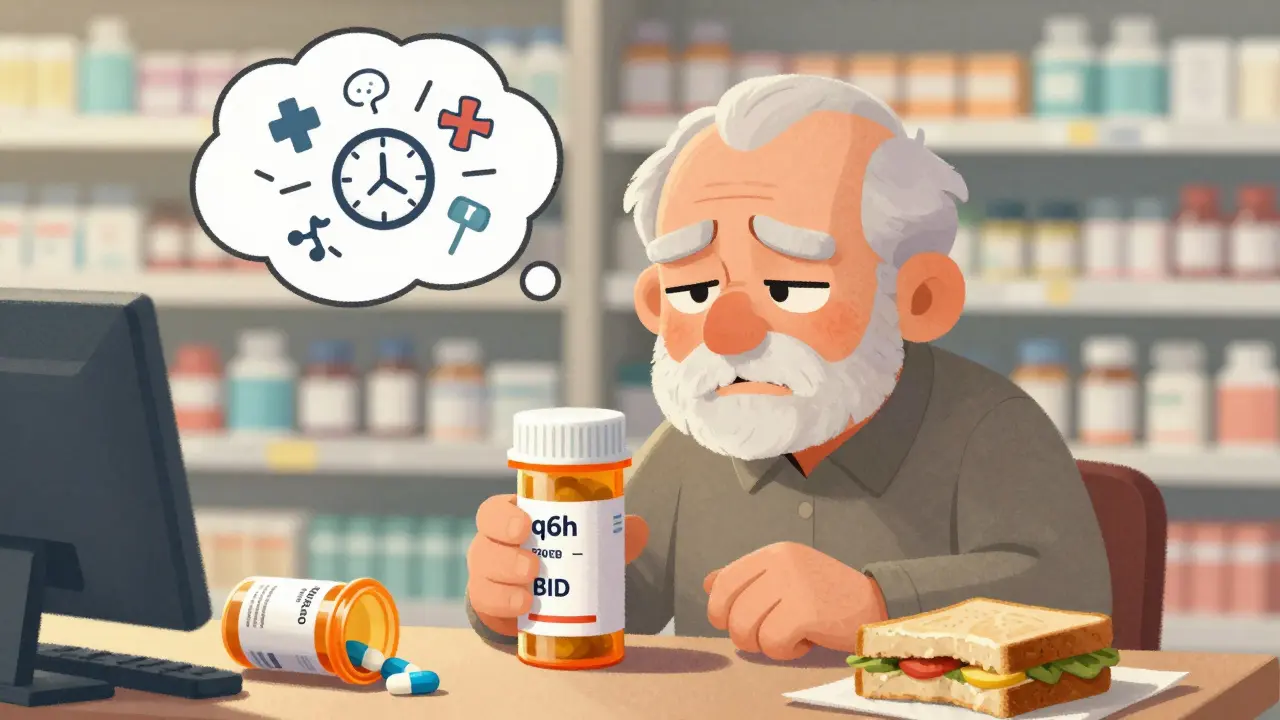
Every year, millions of people in the U.S. take their medicine wrong-not because they’re careless, but because the label on the bottle doesn’t make sense. You might think, "I read it clearly," but studies show nearly half of adults misunderstand basic instructions like "take twice daily" or "take with food." These aren’t small mistakes. They lead to ER visits, hospital stays, and even death. The problem isn’t you. It’s the label.
What You’re Really Seeing on Your Prescription Label
Pharmacy labels were never designed for real people. They use abbreviations like "q6h," "BID," or "PO"-words that sound like medical code. Even if you’re educated, you’re not trained to decode them. "q6h" means every six hours, not four times a day. But if you do the math (24 ÷ 6 = 4), you might take your antibiotic four times, thinking that’s right. That’s exactly what happened to one Reddit user who ended up in the ER with stomach bleeding. The language on labels is often written at an 8th-grade reading level or higher. But the average American reads at a 7th- to 8th-grade level, and for older adults or people with low health literacy, that’s too high. Labels that say "Take one tablet by mouth daily" are clear. But "Take one tablet PO q.d."? That’s confusing. And it’s still common.The Most Dangerous Misunderstandings
Some errors are so common, they’re almost predictable:- "Take once daily" vs. "Take once" - People think "take once" means take it one time total, not every day. That’s how someone stops their blood pressure med after one dose.
- "Twice daily" means every 12 hours, not every two hours - A 2022 Medicare survey found 39% of seniors skipped doses because they thought "twice daily" meant every two hours. That’s not how it works. Twice daily means morning and night.
- "Take with food" doesn’t mean "take instead of food" - Many people think they should eat right after taking the pill, not that the pill should be taken while eating. Some even take it on an empty stomach, risking stomach upset or reduced effectiveness.
- "As needed" is not "whenever you feel like it" - Painkillers, anti-anxiety meds, or sleep aids labeled "as needed" have limits. Taking one every two hours when you’re told to wait six? That’s how overdoses happen.
Why Icons and Symbols Don’t Help (And Sometimes Hurt)
You’ve seen them: a plate with a fork for "take with food," a glass of water for "take with water," a moon for "take at bedtime." These seem helpful. But here’s the truth: 68% of patients misinterpret the "take with food" icon. Why? Because there’s no standard. One pharmacy shows a sandwich. Another shows a salad. Another shows a spoon. Your brain doesn’t know which one to trust. The FDA tested over 1,000 people in 2021. Only 32% correctly understood the "take with food" symbol. That’s worse than random guessing. And if you speak Spanish, it’s even worse. Only 12% of U.S. pharmacies offer labels in Spanish-even though 41 million Americans do. Translated labels often use literal translations that make no sense in context. "Tome con comida" might be correct Spanish, but if the patient doesn’t know what "comida" means in a medical context, they’re still lost.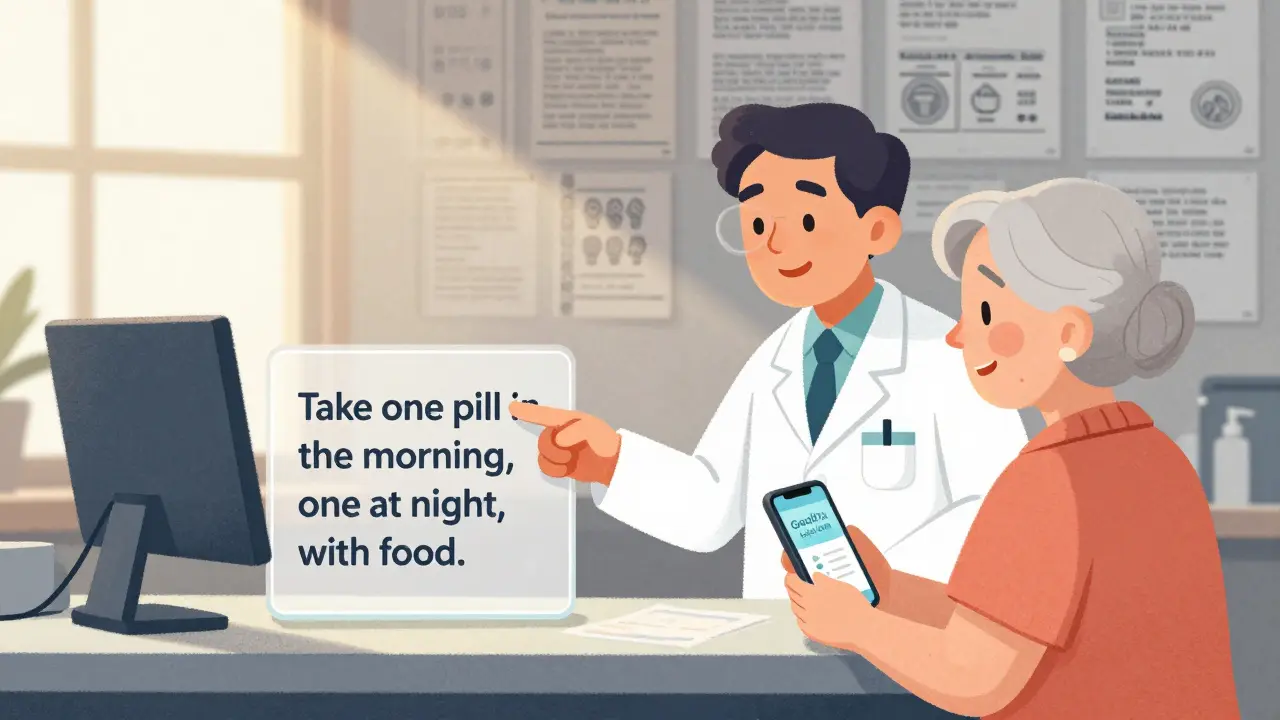
What Makes a Label Actually Clear?
There’s a better way. And it’s not expensive. The U.S. Pharmacopeia (USP) has clear standards called Chapter <17>. Labels that follow them cut misunderstanding by more than half. Here’s what they look like:- Full words, no abbreviations - "Take 2 tablets by mouth at bedtime," not "ii tab PO qHS."
- Clear timing - "Take one in the morning and one at night," not "BID."
- Font size 12pt or larger - Small text is a hazard, especially for older eyes.
- High contrast - Black text on white background. No light gray on cream.
- One instruction per line - No cramming. No run-on sentences.
- Standardized icons - Only use icons that have been tested and proven to be understood by 80%+ of people.
What You Can Do Right Now
You don’t have to wait for the system to fix itself. Here’s what you can do today:- Ask the pharmacist to read the label out loud - Don’t just take it and go. Say: "Can you please explain how to take this?"
- Use the "Teach-Back" method - After they explain, say: "So, to make sure I got it right-I take one pill in the morning and one at night, with food, right?" If they say yes, you’re safe.
- Request a large-print label - Nearly 90% of major pharmacies (CVS, Walgreens, Walmart) offer this for free. Just ask.
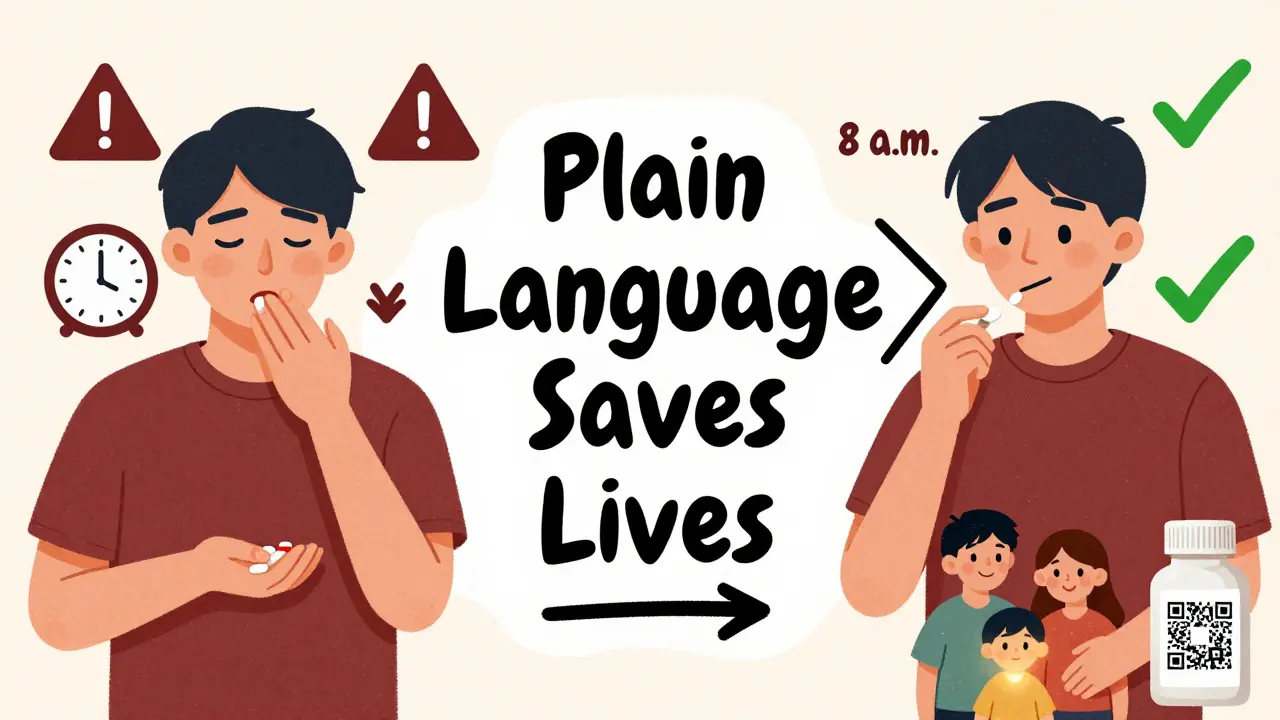
- Ask for a visual aid - Some pharmacies now include small clock icons showing 8 a.m. and 8 p.m. for twice-daily meds. If they don’t offer it, ask if they can add it.
- Take a photo of the label - Use your phone to snap a picture. Then use apps like GoodRx’s "Label Lens" to get a plain-English breakdown. It’s free, works offline, and has 89% accuracy.
What Pharmacies Should Be Doing
Pharmacists are on the front lines, but they’re rushed. A 2023 study found most counseling sessions last under 90 seconds. That’s not enough to explain anything. Pharmacies need to:- Train staff on health literacy-not just how to fill scripts, but how to communicate with people who struggle to read.
- Switch to USP Chapter <17> labels across the board.
- Offer multilingual labels, especially Spanish, and test them with native speakers before printing.
- Use QR codes on labels that link to short video instructions (new as of January 2025).
- Stop using abbreviations. Ever.
The Bigger Picture
This isn’t just about one pill. Medication errors cost the U.S. healthcare system over $500 billion a year. Label misunderstandings account for a third of those. That’s billions in avoidable hospital stays, ER visits, and lost workdays. The good news? Solutions exist. The bad news? They’re not everywhere. Chain pharmacies like CVS and Walgreens have mostly adopted better labels. But independent pharmacies? Only one in three have updated theirs. Why? Cost. Upgrading software and printing systems can run $2,500 to $5,000 per location. That’s a lot for a small business. But here’s the truth: the cost of not changing is higher. A single hospital admission from a medication error can cost $15,000. That’s six times the cost of upgrading a label system.What’s Coming Next
By 2025, federal rules could make clear labels mandatory. The FDA is pushing for it. The Biden administration has allocated $200 million to improve patient safety-including labeling. Amazon Pharmacy now offers voice-enabled labels: you scan the QR code and hear the instructions spoken aloud. Early tests show senior error rates dropped by 38%. Apps like GoodRx’s Label Lens are becoming mainstream. More pharmacies are testing QR codes that link to animated videos showing how to take the medicine. And if you’re a caregiver for an older adult, these tools are game-changers.Final Thought: You’re Not Alone
If you’ve ever looked at your prescription label and thought, "I don’t get this," you’re not dumb. You’re not lazy. You’re just dealing with a system that wasn’t built for you. Millions of people feel the same way. The fix isn’t complicated. It’s simple: use plain language. Use full words. Use pictures that make sense. And when in doubt, ask. The pharmacist is there to help-not just to hand you a bottle.Next time you pick up a prescription, don’t just walk out. Ask. Say it out loud. Make sure you know what to do. It could save your life.
SWAPNIL SIDAM
Man, I seen this in India too. Pharmacies give you a tiny slip with Hindi words you don’t know. No one explains. You just take it and hope. My grandma took her blood pressure pill once and thought she was done. She almost died. Simple words. Big difference.
Sally Dalton
OMG YES!!! I just had this happen last week with my dad’s new antibiotic. The label said ‘take BID’ and he thought it meant ‘take when you feel bad.’ I had to rush over and explain it’s morning AND night. I cried. Why is this still a thing?? We’re in 2025!!! 😭
Mohammed Rizvi
Let me guess-someone at the pharmacy got a bonus for printing labels with the smallest font possible. Like, is this a puzzle contest? ‘Can you read this without a magnifying glass and a PhD in Latin?’ I swear, if I see one more ‘q.d.’ I’m going to start handing out flashcards with ‘once a day’ written in crayon.
Faisal Mohamed
It’s not just about legibility-it’s semiotic collapse. The pharmaco-signifier has been decoupled from the lived experience of the patient. We’ve commodified health literacy into a binary of ‘compliant’ vs ‘noncompliant,’ when the real pathology is institutional epistemic violence. 🤔💊 #PharmaceuticalSemiotics
Curtis Younker
You guys are absolutely right-and here’s the beautiful part: change is already happening! Walgreens’ ClearView labels? Game-changer. Amazon’s voice labels? Mind-blowing. And guess what? You can ask for them TODAY. No waiting. No bureaucracy. Just walk in and say, ‘Can I get the big print with the clock icons?’ They’ll do it. Seriously. Try it. You’ll feel like a superhero. 💪❤️
Napoleon Huere
Think about it: we trust machines to fly planes, diagnose cancer, and recommend our next binge-watch-but we hand someone a piece of paper with Latin abbreviations and expect them to survive. It’s not incompetence. It’s arrogance. The system assumes you’re educated enough to decode its jargon. But health isn’t a privilege of literacy. It’s a human right. And the label should reflect that.
Aishah Bango
It’s disgusting. People die because pharmacies won’t spend $500 to upgrade a printer. Meanwhile, they spend thousands on fancy neon signs and loyalty apps. This isn’t about cost-it’s about who they think deserves to live. If your grandma can’t read, you don’t get to call her ‘noncompliant.’ You get to fix the label. That’s basic decency.
eric fert
Let’s be real-this isn’t a labeling problem. It’s a people problem. If you can’t understand ‘take twice daily,’ maybe you shouldn’t be managing your own meds. My uncle took his insulin ‘as needed’ because he ‘felt dizzy.’ He ended up in a coma. No one forced him to read the label. He just didn’t care. And now he’s on disability. So don’t pretend this is all about fonts and icons. Some people just don’t want to be responsible. And that’s on them.
Robin Van Emous
I’m from the U.S., but my mom’s from Mexico. She got her pills in Spanish-and the label said ‘tome con comida.’ She thought ‘comida’ meant ‘lunch.’ So she only took it at noon. She didn’t know it meant ‘with any meal.’ I had to draw her a picture of a plate with breakfast, lunch, and dinner. She cried. We’re not talking about education. We’re talking about dignity. Ask for a picture. Ask for a video. Ask for help. No shame. We all need help sometimes.