
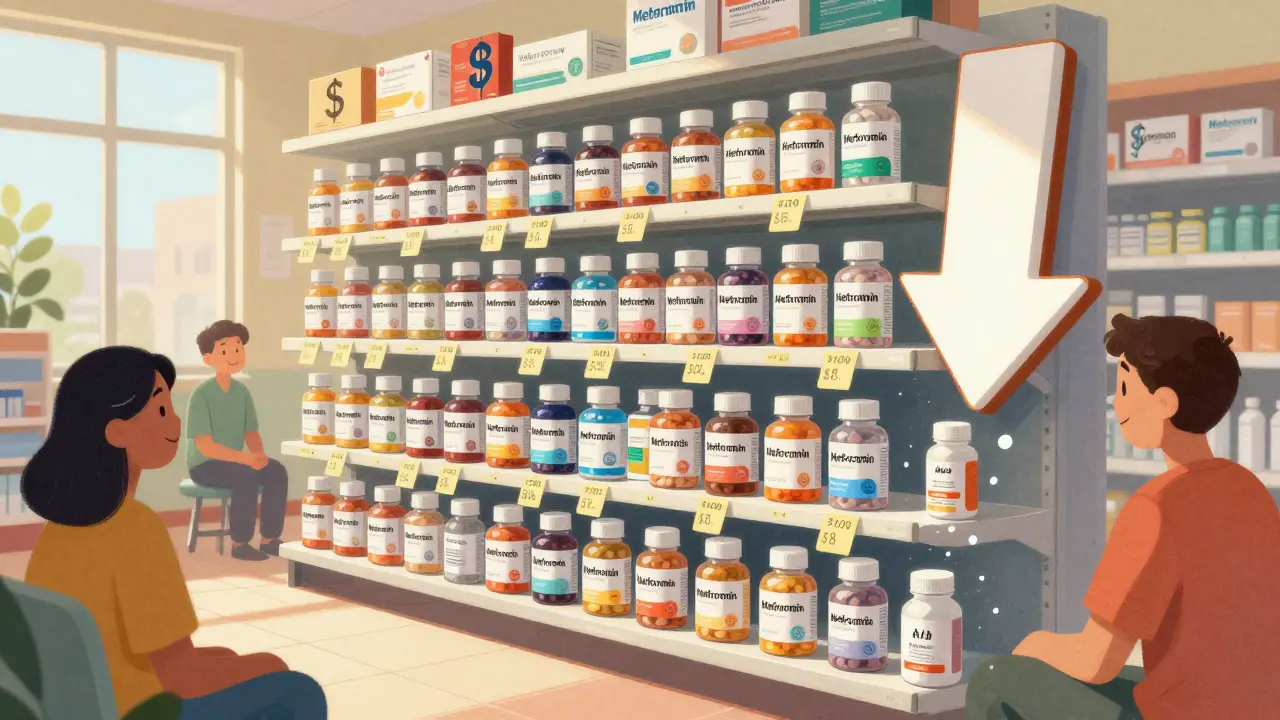
When you pick up a prescription for metformin, lisinopril, or levothyroxine, you probably don’t think about how many companies make it. But that’s exactly what keeps your copay low. The more generic manufacturers making the same drug, the lower the price drops. It’s simple economics: more sellers = less power for any one company to charge high prices.
Why multiple generic makers matter
Generic drugs aren’t just cheaper copies-they’re exact chemical twins of brand-name drugs, approved by the FDA to work the same way. But unlike brand drugs, which have patent protection, generics can be made by anyone once the patent expires. And that’s when the real price battle begins.When the first generic hits the market, prices usually drop by about 17%. That’s good. But when a second company joins, the price falls another 22%. By the time there are three manufacturers, you’re looking at a 52% drop from the original brand price. With four or more, it’s common to see prices fall by over 70%.
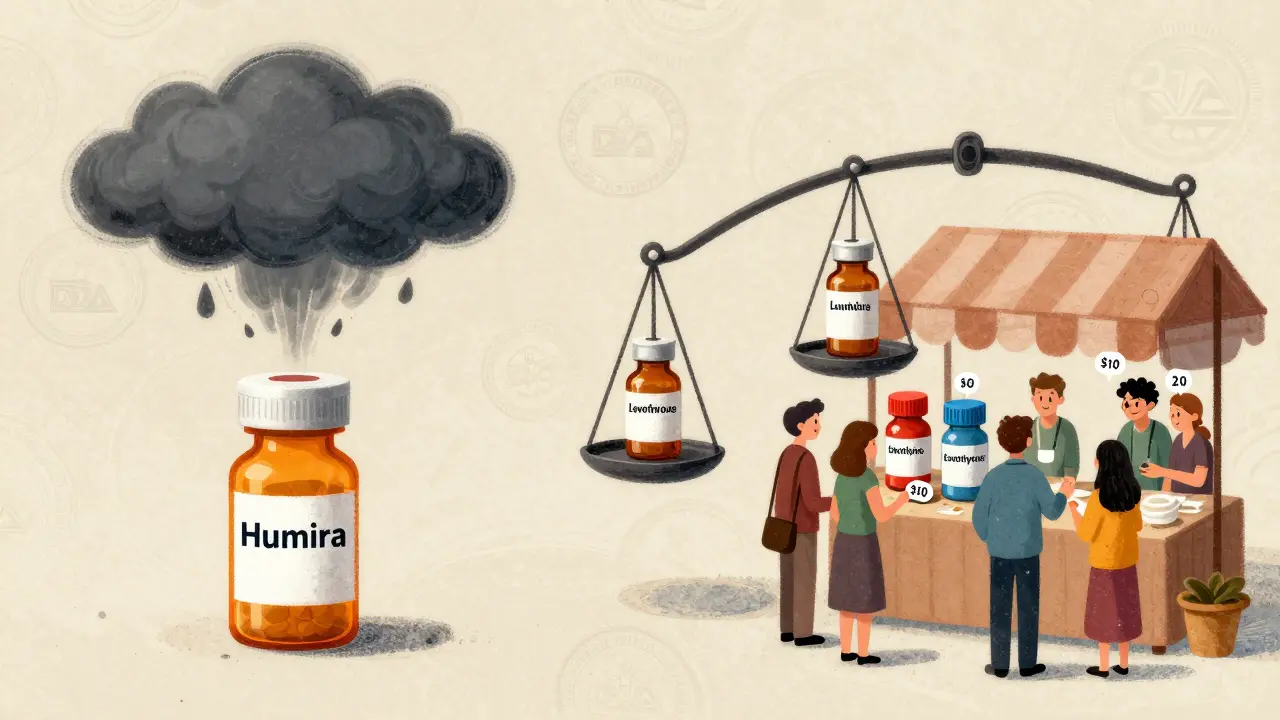
Take metformin, the most common diabetes drug. In 2024, at least eight different companies made it. That’s why you can get a 90-day supply for under $10 at many pharmacies. Compare that to a brand-name drug like Humira, which still has no true generic competitor after 20 years. Its price? Over $7,000 a month. The difference isn’t about quality-it’s about competition.
The numbers don’t lie
A 2021 study tracking 50 brand-name drugs and their generic versions found clear patterns:- 1 generic manufacturer: 17% price drop
- 2 generic manufacturers: 39.5% drop
- 3 generic manufacturers: 52.5% drop
- 4+ generic manufacturers: 70.2% drop
These numbers come from Medicare spending data between 2015 and 2019. The same trend holds for other drugs. The FDA estimated that generic drugs saved the U.S. healthcare system $1.7 trillion between 2010 and 2019. In 2022 alone, 742 new generic approvals were expected to save $14.5 billion in one year.
But here’s the catch: not all drugs have this kind of competition. Some drugs have only one or two makers. And when that happens, prices don’t drop-they spike.
When competition disappears
The problem isn’t too many generic makers-it’s too few. Over half of all generic drugs in the U.S. now have only one or two manufacturers. That’s up from just 20 years ago. Why? Because big companies have bought up smaller ones. Mergers have cut the number of players, and fewer players means less pressure to lower prices.When a drug has only one maker, prices can stay high-or even jump unexpectedly. In 2023, patients reported levetiracetam (an epilepsy drug) suddenly costing 300% more after two manufacturers quit the market. One pharmacy chain saw the price go from $15 to $60 for a 30-day supply. That’s not inflation. That’s monopoly pricing.
Some manufacturers leave because the profit margin is too thin. When five companies are fighting over a $0.10-per-pill drug, someone has to quit. But when only one remains, that company can raise prices without fear of losing customers.
Oral drugs vs. injected drugs
Not all generics are created equal. Oral pills-like antibiotics or blood pressure meds-see the strongest competition. They’re easy to make, cheap to produce, and simple to distribute. That’s why you’ll find 10+ makers for drugs like amoxicillin or atorvastatin.But injectable or infused generics? Not so much. These drugs are harder to manufacture. They need sterile environments, specialized equipment, and stricter quality controls. Fewer companies can make them. So even if a brand-name injectable loses its patent, you might still have only one or two generic options. That means prices stay high.
The same is true for biosimilars-generic versions of complex biologic drugs like insulin or rheumatoid arthritis treatments. Even though they’ve been approved, uptake is slow. Medicare patients paid nearly 27% more for biologics than they would have if biosimilars had been treated like regular generics.
Who controls the price?
You might think pharmacies set the price. They don’t. It’s the Pharmacy Benefit Managers (PBMs)-the middlemen between drug makers, insurers, and pharmacies-who negotiate bulk deals. PBMs have huge buying power, which can help keep prices down. But they also get kickbacks from drug makers, which can distort the system.Brand-name companies sometimes fight back by launching their own “authorized generics.” These are made by the original company but sold under a different label. The result? The brand price drops slightly, but the generic price doesn’t fall as much as it should. In fact, the FTC found that brand prices were 22% higher when the original company launched its own generic.
What you can do
You don’t need to be an economist to use this system to your advantage. Here’s how:- Ask your pharmacist: “How many companies make this generic?” If they say three or more, you’re likely getting the best price.
- Use GoodRx or SingleCare. These apps compare prices across pharmacies and show you which generic brand is cheapest.
- Check the FDA’s Orange Book. It lists which generics are rated “AB”-meaning they’re interchangeable with the brand. Avoid BX-rated drugs unless your doctor says it’s safe.
- If your drug has only one maker and the price jumps, ask your doctor about switching to a similar drug with more competition.
Some states allow pharmacists to swap one generic for another without telling you. That’s fine for most drugs-but not for ones with a narrow therapeutic index, like warfarin or thyroid meds. Always ask if your prescription was changed.
The future of generic competition
The FDA launched the Drug Competition Action Plan in 2017 to fix broken markets. The CREATES Act of 2019 tried to stop brand companies from blocking generic makers from getting samples they need to test their drugs. The FTC has started challenging mergers that would reduce competition.But the system is still fragile. If the trend of consolidation continues, we could see more drug shortages and sudden price spikes. The Congressional Budget Office predicts generics and biosimilars will save Medicare $158 billion by 2031-but only if enough companies stay in the game.
Right now, the system works best when there are many small players. But when a few big firms control the market, patients pay the price. The answer isn’t to stop generics-it’s to protect competition.
Why are some generic drugs more expensive than others?
It’s not about quality-it’s about competition. A generic drug with 8 manufacturers will cost far less than one made by just one. If only one company makes a drug, they can raise prices without fear of losing customers. Drugs like insulin or certain antibiotics have few makers, so prices stay high. Always check how many companies produce your generic before assuming it’s cheap.
Can I ask my pharmacist to switch to a cheaper generic?
Yes, and you should. Pharmacists are allowed to substitute generics that are rated “AB” by the FDA-meaning they’re therapeutically equivalent. But if your drug has a narrow therapeutic index (like seizure meds or blood thinners), your doctor must approve the switch. Always ask if your prescription was changed and why.
Why do generic drug prices suddenly go up?
When a manufacturer stops making a drug, the remaining companies can raise prices. This often happens when profit margins get too thin, or if a company faces quality issues or supply chain problems. Patients have seen prices jump 300-500% after just one maker exits. If your price spikes, ask your doctor if there’s another drug with more competition.
Are generic drugs as safe as brand-name drugs?
Yes. The FDA requires generics to have the same active ingredient, strength, dosage form, and route of administration as the brand. They must also meet the same strict manufacturing standards. The only differences are in inactive ingredients like fillers or dyes-which rarely affect how the drug works. Safety issues are almost always tied to manufacturing problems, not the fact that it’s generic.
What’s the difference between AB and BX ratings in the FDA’s Orange Book?
AB-rated generics are considered fully interchangeable with the brand-name drug. They’ve passed all FDA tests for bioequivalence. BX-rated drugs haven’t been proven equivalent, so pharmacists can’t swap them without your doctor’s approval. If you’re on a drug like levothyroxine or warfarin, always check the rating. Never let a BX-rated generic be substituted without talking to your doctor first.
Sarah Mailloux
Just got my metformin for $8 at CVS using GoodRx. Wild how a drug that used to cost $50 a month is now cheaper than a bag of chips. No magic, just competition.
Amy Ehinger
I’ve been on levothyroxine for 12 years and never realized how much the price swings depending on who makes it. Last month my pharmacy switched me to a different generic and my copay dropped from $18 to $4. I didn’t even notice until I got the receipt. Turns out, the FDA’s Orange Book is basically a cheat code for saving money on meds.
Nilesh Khedekar
Oh wow, so it’s not greed… it’s just that five companies decided to stop making cheap pills because they’re too poor to afford their own rent? That’s why we have 300% price spikes? Brilliant. The FDA approves these drugs, but the real villains are the corporate mergers that turned generics into a monopoly game. And you wonder why India makes 40% of the world’s generics? Because we don’t let pharma giants strangle competition like y’all do.
Jami Reynolds
This is all a distraction. The real issue is that the FDA is compromised by pharma lobbying. Did you know that some generic manufacturers get their approval samples from the brand-name company? And those companies can legally delay sending them for months? That’s not competition-it’s sabotage. The FTC is asleep at the wheel, and Congress is bought and paid for. This isn’t economics-it’s a controlled demolition of the public’s access to medicine.
Ayush Pareek
My uncle in Delhi pays $1.50 for a month’s supply of lisinopril. Here in the U.S., I pay $12-even with insurance. The system isn’t broken, it’s designed this way. We’ve got the tech, the science, the capacity-but we’ve chosen profit over people. And it’s not just about drugs. It’s about what kind of society we want to live in.
RUTH DE OLIVEIRA ALVES
It is imperative to recognize that the regulatory framework governing generic pharmaceuticals is predicated upon the principle of bioequivalence, as stipulated by the Food and Drug Administration. The presence of multiple manufacturers inherently fosters a competitive market dynamic, which, in turn, exerts downward pressure on pricing. This phenomenon is not merely anecdotal; it is empirically substantiated through longitudinal analyses of Medicare expenditure data. Furthermore, the consolidation of market participants constitutes a systemic risk to pharmaceutical affordability, which warrants urgent policy intervention.
Diane Hendriks
Generic drugs are a socialist plot. Why should the government allow cheap copies of American innovation? The brand-name companies spent billions on R&D-now they’re being punished. And you’re celebrating when some factory in China makes a pill that looks like the real thing? This isn’t competition-it’s theft. And don’t even get me started on how these generics are shipped through ports that don’t even check for contaminants. You think your $10 metformin is safe? Wake up.
ellen adamina
I never thought about how many companies make my blood pressure med until I saw this post. I just assumed it was always cheap. But now I check the label every time I refill. Turns out, my pharmacy switches me between generics all the time. I used to think that was weird-now I know it’s saving me money. Thanks for making me pay attention.
Nicholas Urmaza
If you want lower drug prices stop blaming manufacturers and start fixing the PBM system. These middlemen are the real price manipulators. They get rebates from big pharma to favor certain generics-even when they’re more expensive. That’s why your $10 bottle suddenly becomes $15. It’s not about how many companies make it-it’s about who’s getting paid behind the scenes
Crystel Ann
I used to think generics were just ‘the cheap version’ until my mom had a seizure because her thyroid med got switched to a BX-rated one without her knowing. Now I check the Orange Book religiously. It’s not just about saving money-it’s about not dying because someone thought ‘close enough’ was good enough.
Nat Young
Everyone’s acting like more generic makers = automatic savings. But what if the real problem is that the FDA approves too many generics too fast? Half of them are made in plants with bad sanitation. You think your $5 amoxicillin is safe? It’s probably sitting on a shelf in a warehouse in Mumbai that doesn’t have AC. And you’re cheering because it’s cheap? Maybe the price isn’t low because of competition-it’s low because no one cares if it works.