
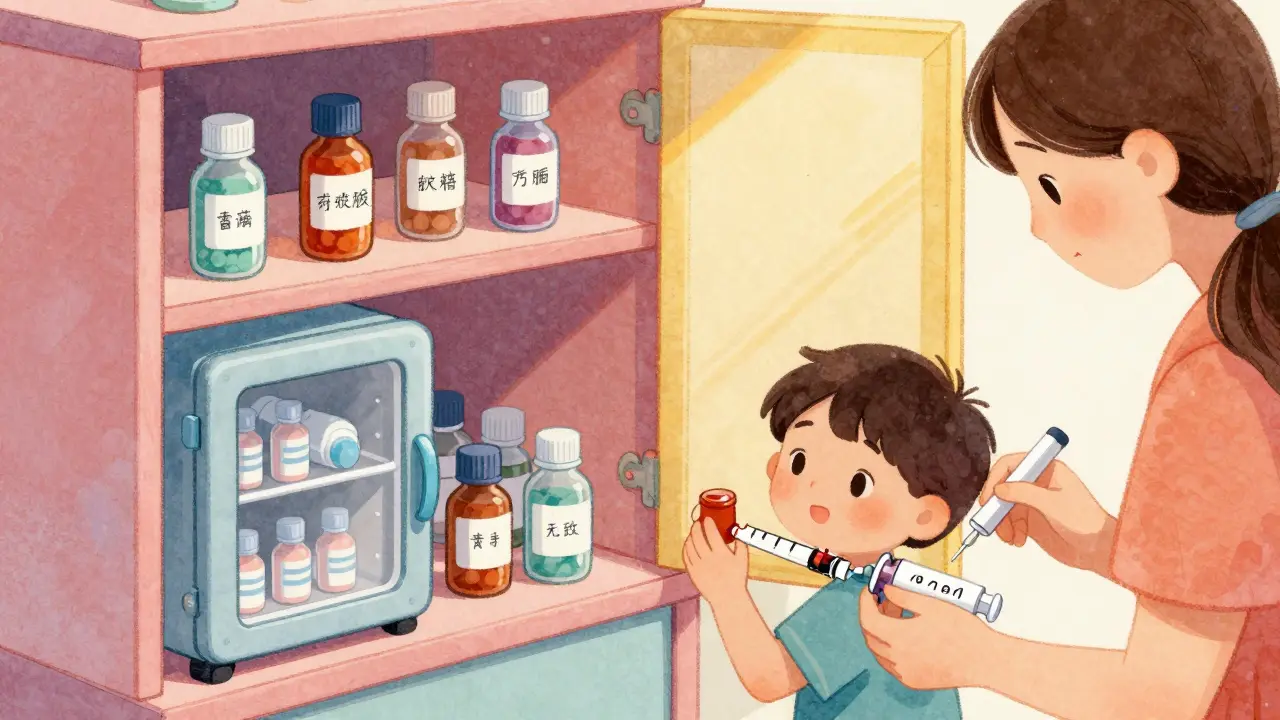
Storing liquid antibiotics the right way isn’t just a suggestion-it can mean the difference between an infection clearing up and it coming back worse. If you’ve ever had to mix a powder into a syrup for your child’s ear infection, you know how easy it is to forget the details after the pharmacist hands you the bottle. But here’s the truth: liquid antibiotics don’t last forever once they’re mixed, and where you keep them matters more than you think.
Not All Liquid Antibiotics Need the Fridge
A lot of people assume if it’s a liquid, it needs to be cold. That’s not true. Some antibiotics actually break down faster in the fridge. For example, amoxicillin suspension can be stored at room temperature between 20°C and 25°C (68°F-77°F) without losing strength. The Cleveland Clinic confirms this: if you don’t have fridge space, it’s okay. But if you do have it, refrigerating amoxicillin can make it taste better-and that helps kids take it without a fight. On the other hand, amoxicillin-clavulanate (Augmentin) is a different story. While some sources say it can last 10 days refrigerated, others say 14 days. The key? Always check the label. The clavulanate part of this combo is more sensitive than the amoxicillin. Studies show it degrades faster, especially at room temperature. If you’re unsure, keep it cold. But don’t freeze it. Freezing can ruin the structure of the suspension, making it ineffective.How Long Do Reconstituted Suspensions Last?
Once you mix the powder with water, the clock starts ticking. There’s no universal expiration date-it depends on the drug.- Amoxicillin: Use within 14 days, whether refrigerated or not. Some manufacturers say 10 days, but the FDA allows up to 14 if stored properly.
- Amoxicillin-clavulanate: Discard after 10 days if refrigerated. If left at room temperature, throw it out after 5 days. A 2013 study showed the clavulanate component lost potency fast after that.
- Cephalexin: Stable for 14 days at room temperature. No need to refrigerate.
- Azithromycin: Can last up to 10 days at room temperature. Refrigeration isn’t required.
What Happens If You Store Them Wrong?
Improper storage doesn’t just mean your medicine won’t work as well. It can make infections worse. When antibiotics lose potency, bacteria don’t die. They survive, adapt, and become stronger. That’s how antibiotic resistance starts. Baystate Health warns that improperly stored antibiotics are a silent contributor to lingering infections. You give your child the full course, but because the medicine was left on the counter in the sun, it only worked at 60% strength. The infection doesn’t go away. It comes back. And next time, the same antibiotic might not work at all. Heat, light, and humidity are the enemies. Leaving a bottle on a windowsill, in a hot car, or in a bathroom cabinet above the sink (where steam rises) can break down the active ingredients. The FDA says expiration dates are based on stability testing under controlled conditions. If your medicine was stored at 35°C in a garage for two weeks before you bought it? That expiration date doesn’t apply anymore.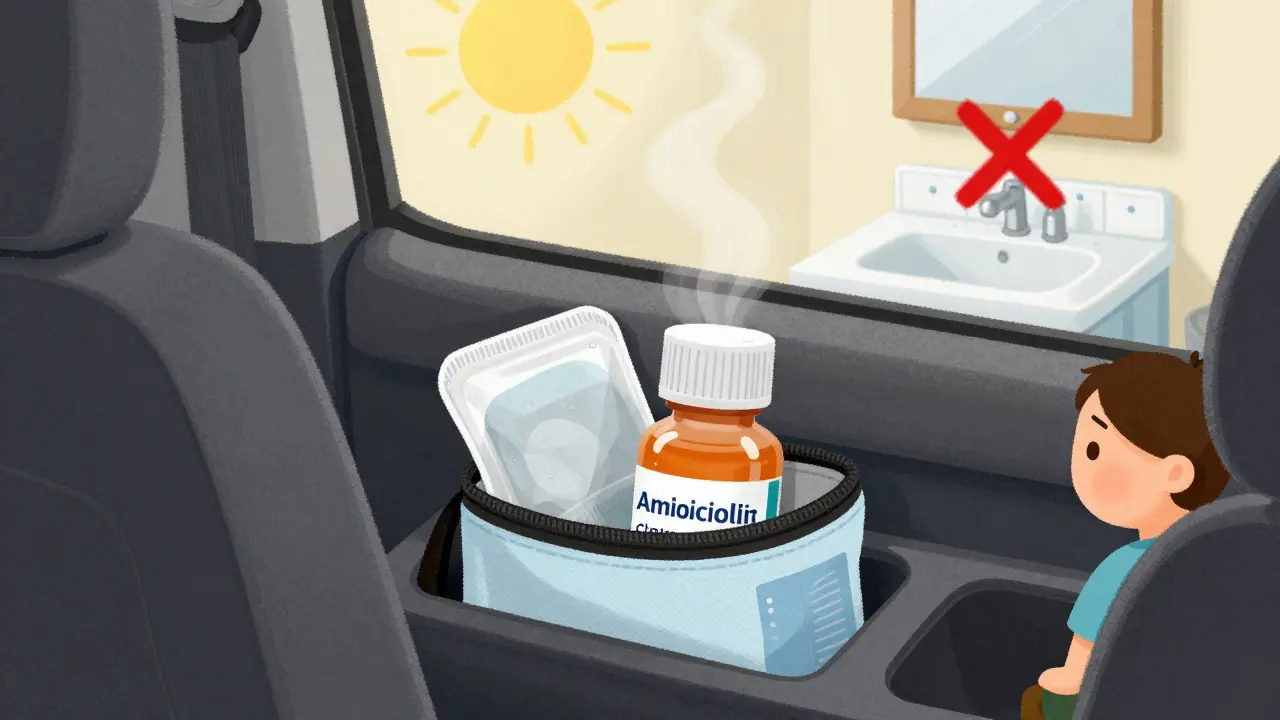
How to Store Them Right
Follow these simple rules to keep your antibiotics effective:- Read the label. Every bottle has storage instructions. If it says “refrigerate,” do it. If it says “store at room temperature,” don’t put it in the fridge.
- Keep it dark. Store in a cupboard away from sunlight. Not the bathroom. Not the kitchen counter. A drawer in a cool room is ideal.
- Don’t freeze. Even if it’s cold outside, don’t leave it in the car. Freezing can separate the suspension and ruin the dose.
- Use the right measuring tool. Never use a kitchen spoon. Use the oral syringe, dropper, or dosing cup that came with it. Household spoons vary too much-your child might get half the dose.
- Shake well before each use. The particles settle. If you don’t shake, you’re giving uneven doses. Some days too little, other days too much.
- Keep it out of reach. Kids think medicine is candy. Lock it up if you have to.
Traveling with Liquid Antibiotics
If you’re flying or driving long-distance with a reconstituted suspension:- Use a small insulated bag with a cold pack if refrigeration is required.
- If it’s room temperature stable, keep it in your carry-on. Don’t check it-baggage holds can get too hot or too cold.
- Ask your pharmacist for a travel letter if you’re crossing borders. Some countries ask for proof it’s a prescribed medication.
What to Do With Leftover Medicine
Never flush antibiotics down the toilet or toss them in the trash. They can pollute water and harm wildlife. And if someone else finds them, they might take them without a prescription-dangerous. The safest way? Take unused antibiotics to a pharmacy drop-off program. Most pharmacies in Ireland, the UK, and the US have take-back bins. If that’s not available, mix the liquid with something unappetizing-like coffee grounds or cat litter-pour it into a sealed container, and throw it in the trash. Remove the label first to protect privacy.
Why This Matters More Than You Think
About 15-20% of all pediatric antibiotic prescriptions in the U.S. are for liquid suspensions, according to the American Academy of Pediatrics. That’s millions of bottles a year. And in homes without reliable refrigeration, or in places with power outages, the risk of improper storage is even higher. The FDA requires manufacturers to test stability under real-world conditions before approval. But once the bottle leaves the pharmacy, control is gone. That’s why your actions matter. You’re the last line of defense between a child getting better and a preventable relapse.When in Doubt, Ask
Pharmacists aren’t just there to fill prescriptions. They’re your best resource for storage questions. Call them. Text them. Ask when you pick up the medicine: “Should this be refrigerated? How long does it last after mixing?” Don’t rely on memory. Don’t guess. Don’t follow what worked last time. Every antibiotic is different. Even two versions of amoxicillin from different brands can have different storage rules.Can I store liquid antibiotics in the freezer to make them last longer?
No. Freezing can damage the chemical structure of liquid antibiotics, especially suspensions. It can cause the particles to clump or separate, making the dose uneven or ineffective. Always follow the storage instructions on the label-never freeze unless explicitly told to do so.
What if I left my child’s amoxicillin on the counter for a week?
If it’s plain amoxicillin and the room stayed between 20°C and 25°C (68°F-77°F), it’s probably still safe to use for up to 14 days. But if it’s amoxicillin-clavulanate, or if the room was hotter than 25°C, it’s best to discard it. When in doubt, throw it out. The risk of an incomplete treatment is greater than the cost of a new bottle.
Do I need to refrigerate azithromycin suspension?
No. Azithromycin suspension is stable at room temperature for up to 10 days after mixing. Refrigeration isn’t required, but if you prefer it colder, it won’t hurt. Just don’t freeze it.
Why does the label say to shake well before each use?
Liquid antibiotics are suspensions, meaning the active ingredient is suspended in liquid-not fully dissolved. Over time, the particles sink to the bottom. If you don’t shake, you might give your child a dose with too little medicine. Shaking ensures each spoonful has the right amount.
Can I use a regular kitchen spoon to measure the dose?
No. A kitchen spoon varies in size and can hold anywhere from 3 to 15 milliliters. Medical dosing requires precision. Always use the syringe, dropper, or dosing cup that came with the medicine. If you lost it, ask your pharmacy for a replacement-they’ll give you one for free.
Is it okay to mix antibiotics with juice or milk to make them taste better?
Some can be mixed, but not all. Amoxicillin can be mixed with juice or milk without losing effectiveness. But tetracycline and doxycycline bind to calcium in milk and become inactive. Always check with your pharmacist before mixing. If you’re unsure, give the medicine straight, then follow with a drink of water or juice.
Ryan Riesterer
Amoxicillin suspension stability data from the FDA's 2021 Pharmaceutical Stability Guidelines confirms that the 14-day window at 20–25°C is validated via accelerated degradation modeling under ICH Q1A(R2) protocols. Refrigeration reduces microbial growth but doesn't significantly alter chemical half-life. The clavulanate component, however, exhibits first-order degradation kinetics with an activation energy of ~65 kJ/mol, making thermal sensitivity non-negligible.
Akriti Jain
lol so now the government wants us to be pharmacists too 🤡 next they'll make us check the pH of the water we mix it with. also who's monitoring the pharmacy's storage before it got to you? 🤔 maybe the real problem is Big Pharma selling unstable meds 🧪💀
Mike P
Y'all are overcomplicating this. If you're in the US and you're not refrigerating every damn antibiotic, you're doing it wrong. We got refrigerators for a reason. My kid got sick last year because I trusted some ‘room temp’ BS and now we got a superbug in the house. Don't be that guy. Refrigerate everything. Always. It's not hard. And if you're too lazy, don't have kids. Simple.
Jasmine Bryant
Wait-so azithromycin doesn't need to be refrigerated? I thought it did… I think I left mine on the counter for 8 days. Is that okay? I'm pretty sure it was the Z-Pak, but I'm not 100% sure. Also, I used a kitchen spoon once, oops. 😅 Anybody know if that’s gonna mess up the whole course?
Liberty C
How quaint. You all treat medicine like a grocery list. Let me guess-you also store insulin in the glove compartment? Or maybe you think ‘shake well’ means ‘wiggle it a little’? This isn’t cooking. It’s precision pharmacology. If you don’t treat antibiotics like surgical instruments, you’re not a parent-you’re a liability. And yes, I’ve seen what happens when you don’t. I work in ER. I’ve seen the results. You’re not saving money. You’re saving a trip to the hospital.
shivani acharya
Okay but have you ever thought about how the pharmaceutical companies design these suspensions to be unstable on purpose? I mean, think about it-why else would they make you throw it out after 10 days? It’s a racket. They want you to buy more. And the ‘refrigerate’ thing? That’s just so you’ll buy a mini-fridge for the nursery. I read a blog once that said the FDA gets funding from Big Pharma and they tweak the guidelines to keep sales up. My cousin’s friend’s neighbor works at a compounding lab and says they’re told to make the clavulanate degrade faster. It’s not science-it’s capitalism. And now my kid’s got a yeast infection from the antibiotics. Coincidence? I think not.
Sarvesh CK
It is fascinating how the epistemology of pharmaceutical storage intersects with socio-economic realities. In many households, refrigeration is not a given, yet the medical imperative remains absolute. The ethical tension between idealized guidelines and lived conditions is profound. Perhaps we ought to consider decentralized, community-based storage solutions-cool, dark, dry cabinets in schools or clinics-as a pragmatic adaptation rather than a failure of individual compliance. The burden should not rest solely on the parent who works two jobs and has no fridge space. Systemic change is required, not just individual vigilance.
Hilary Miller
In Japan, they give you a little cooler bag with ice packs for liquid antibiotics. Smart. No guesswork. Just pop it in your bag and go. We should do this here too.
Margaret Khaemba
Wait, so if I mix it and it’s been 12 days but I didn’t refrigerate it, is it still okay? I’m just asking because I’m a little scared I messed up. Also, I didn’t know you weren’t supposed to use kitchen spoons-I’ve been doing that for years. 😬
Malik Ronquillo
Just throw it out after 10 days. Seriously. Who cares if it’s ‘technically’ good for 14? You don’t want to be the guy who gave his kid a weak dose and then had to go back to the ER. I’ve been there. It’s not fun. Don’t risk it. Throw it out. Buy a new one. It’s cheaper than a hospital bill. End of story.
Brenda King
Shake well before each use is so important I can’t even. I used to forget and my daughter would get sick again. Now I mark the bottle with a Sharpie and shake it like I’m making a cocktail 🍸. Also, I mix azithromycin with apple juice and she drinks it like it’s candy. Works every time. Just don’t mix tetracycline with milk. Learned that the hard way.
Keith Helm
Per FDA 21 CFR 211.137, storage conditions must be maintained in accordance with labeled specifications. Deviation constitutes misbranding. The responsibility for adherence rests with the dispenser and the end-user. Non-compliance may result in therapeutic failure and public health risk.