
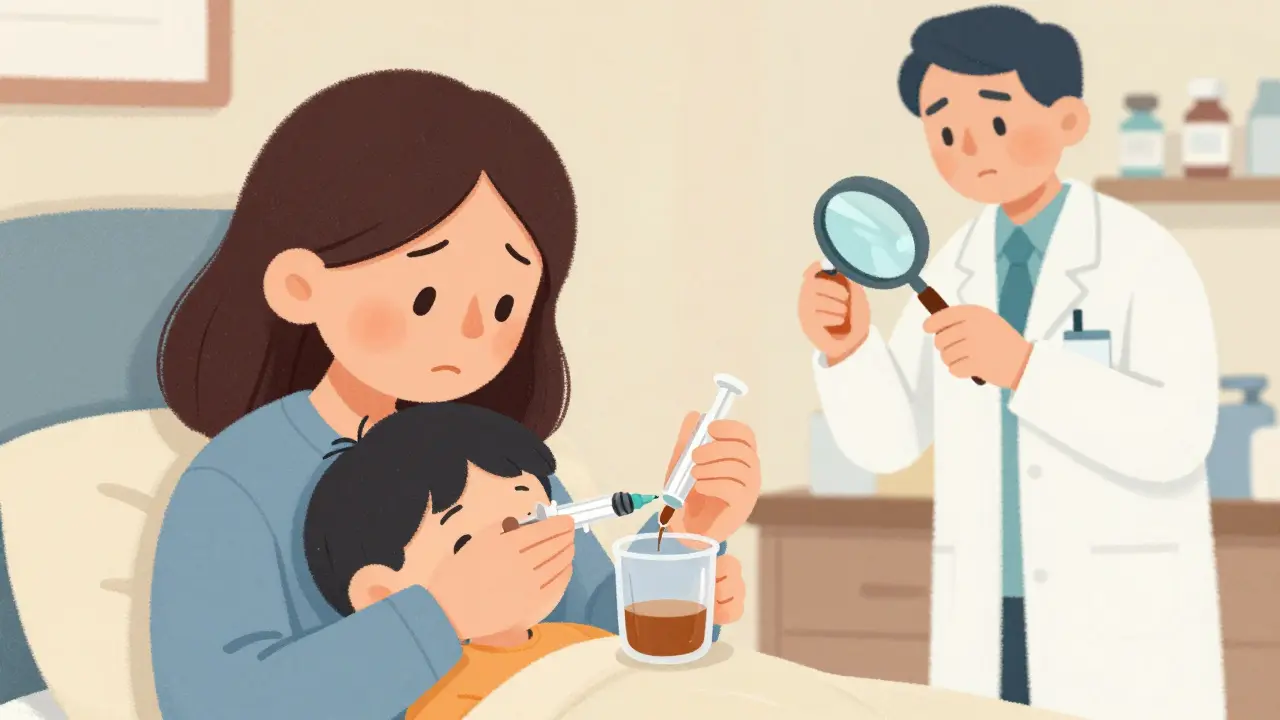
When your child needs a medicine that isn’t available in a store-bought bottle-maybe they can’t swallow pills, have severe allergies, or need a dose too small for commercial products-compounded medications can feel like a lifeline. But here’s the truth: compounded medications are not FDA-approved. That means no government agency has checked their safety, strength, or purity before they reach your child. And for kids, that gap can be deadly.
Why Compounded Medications Are Used for Children
Compounded medications are made by pharmacists to fit a child’s exact needs. Common reasons include:- Turning a pill into a liquid so a toddler can take it
- Removing dyes, alcohol, or sugar that trigger allergic reactions
- Flavoring bitter drugs like antibiotics to make them palatable
- Creating tiny doses for premature babies or infants who weigh under 5 pounds
- Preparing injectable drugs without preservatives like benzyl alcohol, which can harm newborns
The Hidden Dangers: What Goes Wrong
Most parents assume if a pharmacist makes it, it’s safe. That’s not true. Here’s what can go wrong:- Wrong concentration: A liquid might be labeled as 5 mg/mL, but actually contains 20 mg/mL. One teaspoon could be four times the dose.
- Contamination: In 2012, a compounding pharmacy’s spinal injections caused a fungal meningitis outbreak that killed 64 people. The same risks exist today.
- Under-potency: One parent reported their 8-year-old ended up in the ER after a compounded levothyroxine was 40% weaker than prescribed. Symptoms mimicked untreated hypothyroidism.
- Wrong ingredients: Some compounding pharmacies use low-grade chemicals or skip purity tests to cut costs.
When You Should Avoid Compounded Medications
Compounded drugs should be a last resort. The FDA says clearly: “Unnecessary use of compounded drugs may expose patients to potentially serious health risks.” Ask your doctor: “Is there an FDA-approved version that works?” For many pediatric needs, there is.- For antibiotics: Many liquid forms are already available with child-friendly flavors.
- For pain relief: Liquid acetaminophen and ibuprofen come in precise doses.
- For thyroid meds: FDA-approved levothyroxine liquids exist for infants.
- For IV meds: Premixed, single-dose syringes are safer than hand-mixed IV bags.
How to Spot a Safe Compounding Pharmacy
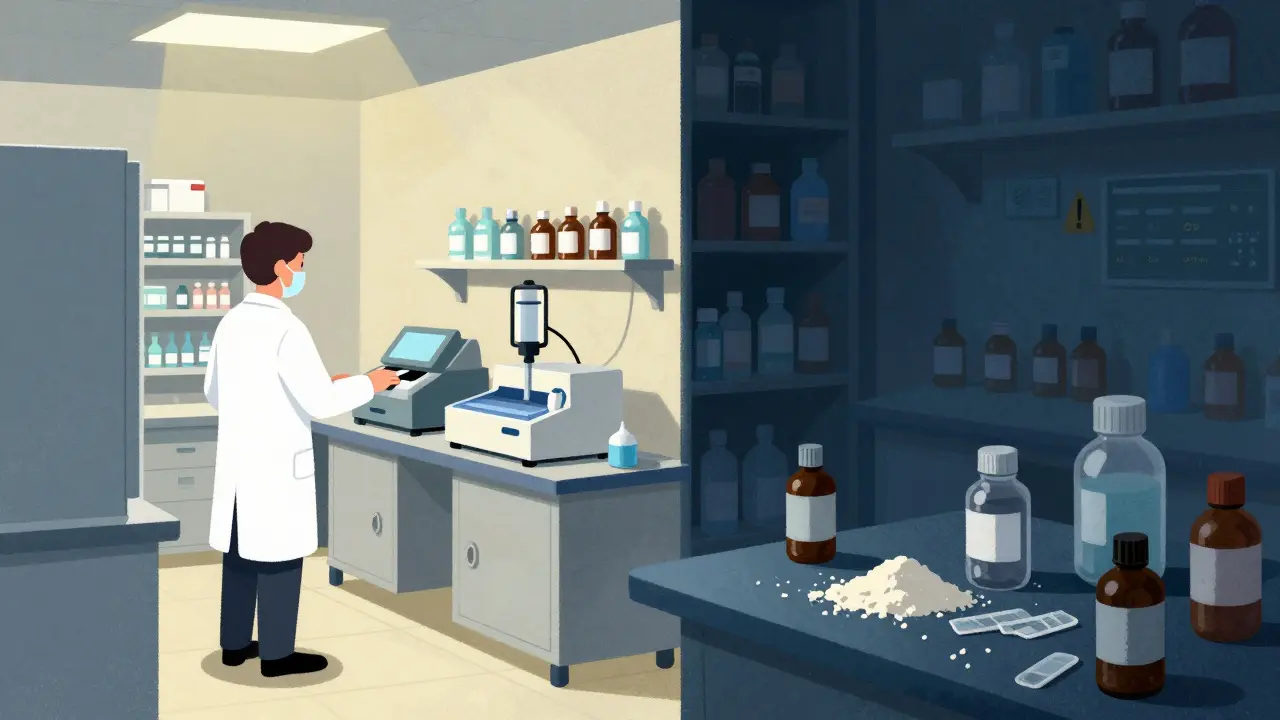
Not all compounding pharmacies are equal. Here’s how to vet one:- Check accreditation: Look for PCAB (Pharmacy Compounding Accreditation Board) or NABP (National Association of Boards of Pharmacy) accreditation. Only about 1,400 of the 7,200 compounding pharmacies in the U.S. have this.
- Ask for documentation: Request the pharmacy’s license and proof of state board registration. All compounding pharmacies must be licensed, but not all follow safety rules.
- Ask about technology: Do they use gravimetric analysis for sterile preparations? Do they test potency and sterility? If they say no, walk away.
- Look for USP compliance: The pharmacy should follow USP Chapter <797> for sterile compounding. That means clean rooms, trained staff, and strict procedures.
What Parents Must Do Before Giving the Medication
Even if the pharmacy is accredited, mistakes can still happen. Here’s your safety checklist:- Confirm the concentration: Ask: “What’s the exact strength? Is it mg/mL or mg/tsp?” Write it down. 68% of pediatric compounding errors come from confusion over units.
- Double-check the dose: Calculate it yourself. If the prescription says 0.5 mL of a 10 mg/mL solution, that’s 5 mg total. Use a syringe, not a spoon.
- Verify with two professionals: Ask your doctor and the pharmacist to confirm the dose together. Don’t rely on one person.
- Check the label: Does it say “For External Use Only”? Is there an expiration date? Is the color or smell different from last time?
- Store it right: Some compounded meds need refrigeration. Others degrade in light. Ask how to store it-and throw it out if it’s past the date.
What to Do If Something Goes Wrong
If your child has a reaction-vomiting, rash, lethargy, rapid breathing, or unusual drowsiness-stop the medication immediately. Call your doctor. Then call poison control (1-800-222-1222 in the U.S.). Report the incident to the FDA’s MedWatch program. You can do it online or by phone. These reports help the FDA track dangerous compounding practices. Also, keep the bottle, the prescription, and any paperwork. If you need to file a complaint or seek legal help, you’ll need proof.
The Bigger Picture: Why This Problem Keeps Growing
The compounded medication market hit $11.3 billion in 2024. Pediatric compounding makes up only 8.2% of that-but it’s the most dangerous segment. Why? Because kids’ bodies are tiny. A 0.1 mL error can be life-threatening. Pharmacies are under pressure. Drug shortages are common. Some compounding pharmacies are exploiting those shortages to mass-produce drugs that should be made by big manufacturers. The FDA says this is against the rules, but enforcement is slow. Meanwhile, safety technology like gravimetric analysis is proven. Hospitals that use it see a 75% drop in dosing errors. But it costs $25,000 to $50,000 per station. Many small pharmacies can’t afford it. Advocates like the Emily Jerry Foundation are pushing for “Emily’s Law”-legislation requiring gravimetric verification for all pediatric compounded sterile drugs. As of April 2025, 28 states have introduced it.Your Role in Keeping Your Child Safe
You are your child’s last line of defense. No pharmacist, doctor, or regulator can be with you when you give the medicine. That’s why your questions matter. Ask:- “Is this the only option?”
- “Can you show me the accreditation?”
- “How do you test the strength?”
- “What happens if I give too much?”
Final Thought
Compounded medications aren’t inherently bad. They’ve helped children who had no other options. But they’re not a shortcut. They’re a high-stakes gamble-and your child is the one risking everything. The safest choice? Use FDA-approved drugs whenever possible. When you must use a compounded medicine, treat it like a surgical procedure: verify every step, question every detail, and never assume it’s safe just because a pharmacist made it.Are compounded medications FDA-approved?
No. Compounded medications are not FDA-approved. The FDA does not review their safety, effectiveness, or quality before they’re sold. This is different from regular prescription drugs, which go through strict testing. Always assume compounded meds carry unknown risks.
Can I give my child a compounded medicine without checking the dose?
Never. Dosing errors are the most common cause of harm. Always confirm the concentration (e.g., mg/mL), calculate the dose yourself, and use a syringe-not a spoon. Ask your pharmacist to show you how to measure it correctly.
How do I know if my child’s compounding pharmacy is safe?
Look for PCAB or NABP accreditation. Call your state pharmacy board to check for complaints. Ask if they use gravimetric analysis for sterile preparations and if they test potency and sterility. If they can’t answer clearly, find another pharmacy.
What should I do if my child has a bad reaction?
Stop the medication immediately. Call your doctor and poison control (1-800-222-1222). Save the bottle, prescription, and any labels. Report the reaction to the FDA’s MedWatch program. These reports help protect other children.
Is there a safer alternative to compounded medications for kids?
Yes, often. Many FDA-approved liquid medications exist for children, with flavors, precise doses, and no allergens. Ask your doctor: “Is there an approved version that works?” Don’t assume compounding is the only option-it’s usually the riskiest one.
Jarrod Flesch
I've seen this firsthand with my niece. Compounded meds saved her life when nothing else worked, but we triple-checked everything. Always use a syringe, never a spoon. 🙏
michelle Brownsea
This post is absolutely essential reading. The FDA’s lack of oversight on compounded medications is a national scandal. We’re not just talking about ‘mistakes’-we’re talking about preventable deaths. Parents need to be armed with this knowledge. And yes, I’m talking to YOU, the one who just googled ‘cheap compounding pharmacy’.
Stephen Rock
Pharmacies are just cashing in on drug shortages. The FDA’s asleep at the wheel. I’d rather see my kid suffer than risk a compounded med. No thanks.
Ashok Sakra
I dont care what you say!! My cousin's baby died from a compounded med and now I hate all pharmacists!! They dont care!! Its all about money!!
Uju Megafu
This is why I don’t trust Western medicine. Big Pharma and compounding pharmacies are in cahoots. Why do you think they push these drugs? They want your kids dependent. Look at the stats-they’re hiding more deaths than this.
Andrew Rinaldi
It’s a balancing act. On one hand, we have real, life-saving needs for kids who can’t take standard meds. On the other, the system is dangerously unregulated. Maybe the answer isn’t to ban it, but to fund and mandate gravimetric analysis everywhere. It’s not expensive compared to an ER visit-or a funeral.
Kelly McRainey Moore
I’m so glad someone wrote this. My daughter had a reaction to a compounded antibiotic. We didn’t catch it until she turned purple. Please, please, please-always double-check the concentration. I still get nightmares.
Melanie Pearson
The fact that only 7.7% of U.S. hospitals use gravimetric analysis is an indictment of American healthcare priorities. We spend billions on marketing and executive bonuses but balk at $50,000 per machine to prevent pediatric deaths. This is not incompetence. It’s negligence.
Amber Lane
Ask your doctor if there’s an FDA-approved alternative. Always.
Gerard Jordan
My kid’s on a compounded med right now. We used a PCAB pharmacy, asked for batch testing reports, and used a syringe. 🤝❤️ You can do this safely if you’re diligent. Don’t panic-just be smart.
Roisin Kelly
I bet this whole thing is a scare tactic. The FDA just wants you to buy their overpriced branded drugs. My cousin’s kid got better on a compounded version. Who are you to say it’s unsafe?
lokesh prasanth
I think this is overblown. Compounded meds are fine if you just dont mess up the dosing. People are too lazy to read labels. Its not the pharmacies fault.