
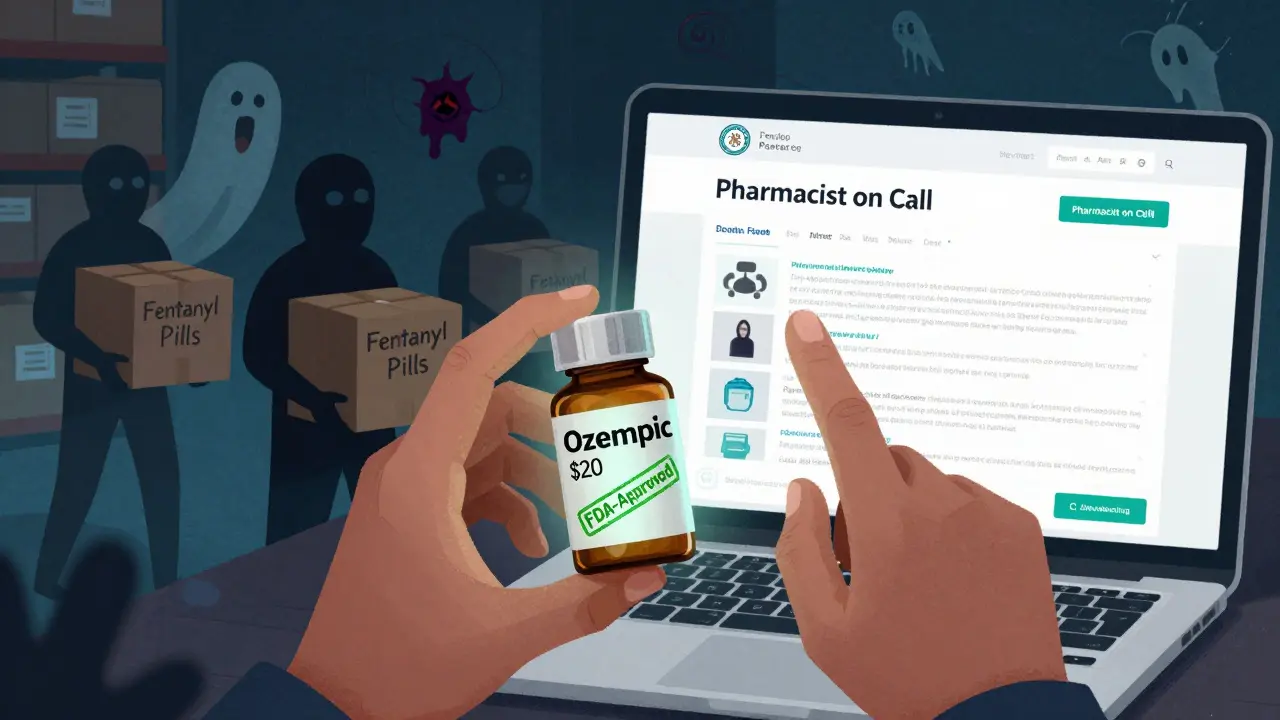
Every year, millions of people search online for cheaper medications - whether it's weight loss pills like Ozempic, painkillers, or even Botox. What they don’t realize is that nearly every website offering these drugs without a prescription is a scam. And the drugs they receive? They might be laced with fentanyl, filled with chalk, or completely empty. This isn’t a rare glitch - it’s the norm.
How Bad Is the Problem?
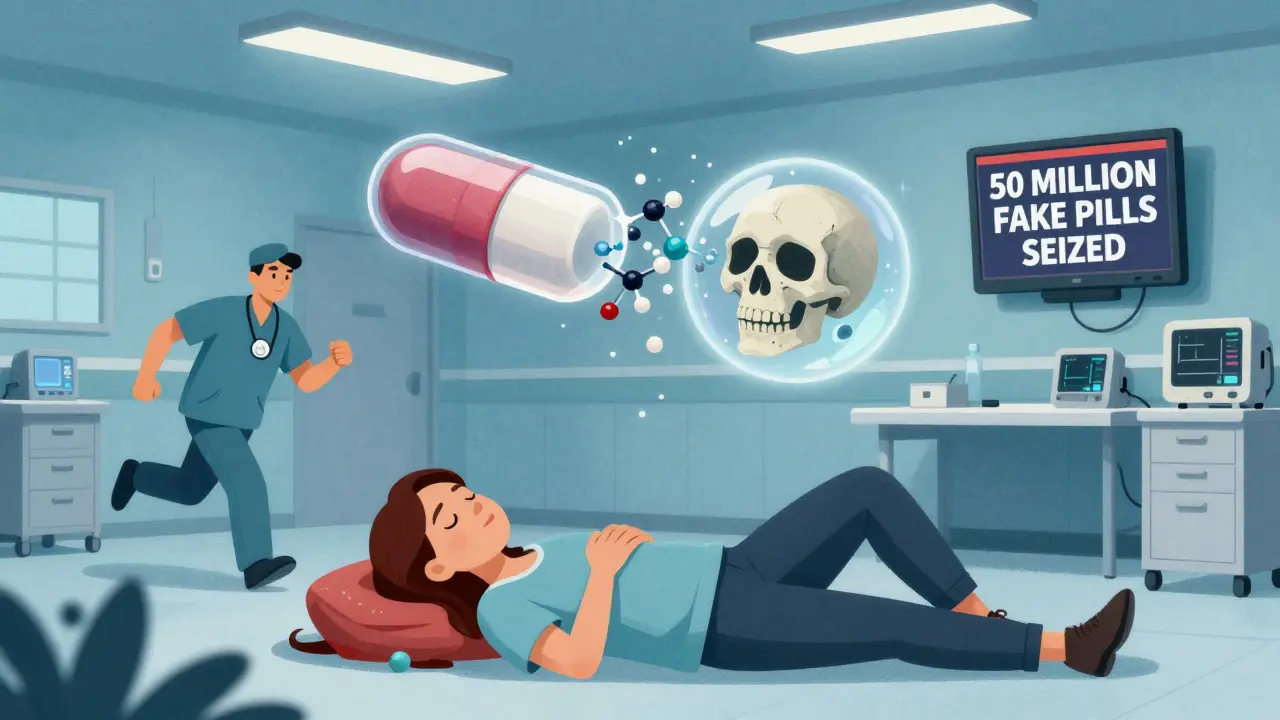
More than 95% of online pharmacies selling prescription drugs operate illegally. That’s not a guess - it’s from the National Association of Boards of Pharmacy and confirmed by the CDC. In 2025, Interpol shut down 13,000 websites, arrested 769 people, and seized over 50 million doses of fake pills. These aren’t small-time operations. They’re organized crime rings with fake websites, professional logos, and even customer service chatbots that sound real.
The U.S. Drug Enforcement Administration seized over 60 million fake pills in 2024 alone - most of them designed to look like oxycodone or Xanax, but actually packed with fentanyl. One pill can kill. And these aren’t just found in dark web markets. They’re on Instagram, Facebook, and Google-searched sites that look like legitimate pharmacies.
What Kind of Fake Drugs Are Out There?
Counterfeiters don’t just copy one drug. They target the most popular ones because they’re profitable. Here’s what’s been found recently:
- Ozempic (semaglutide) - Sold as a weight-loss drug, but many online versions contain no active ingredient, or worse, toxic chemicals like methamphetamine.
- Botox - Fake injections have been found in multiple states. Patients reported facial paralysis, vision problems, and even hospitalization after using counterfeit vials.
- alli (orlistat) - A weight-loss supplement sold over-the-counter. Counterfeit versions were found to contain rat poison and industrial solvents.
- Antibiotics and diabetes meds - These are often diluted or replaced with cheap fillers. Someone taking fake insulin could go into a diabetic coma.
- Anti-malarial drugs - In some cases, these fake pills contain no active ingredient at all. People die from malaria because they thought they were protected.
The FDA has issued public warnings on all of these. But the websites keep coming back. New ones pop up every day.
Why Do People Buy From These Sites?
Price is the biggest lure. A real prescription for Ozempic can cost $1,000 a month in the U.S. Some fake sites offer it for $20. No prescription needed. Free shipping. “FDA-approved” labels. It’s too good to be true - and it is.
People also think they’re safe because the site looks professional. They have secure checkout, customer reviews, and even a “pharmacist on call.” But none of that matters if the pharmacy isn’t licensed. Legitimate pharmacies are required to:
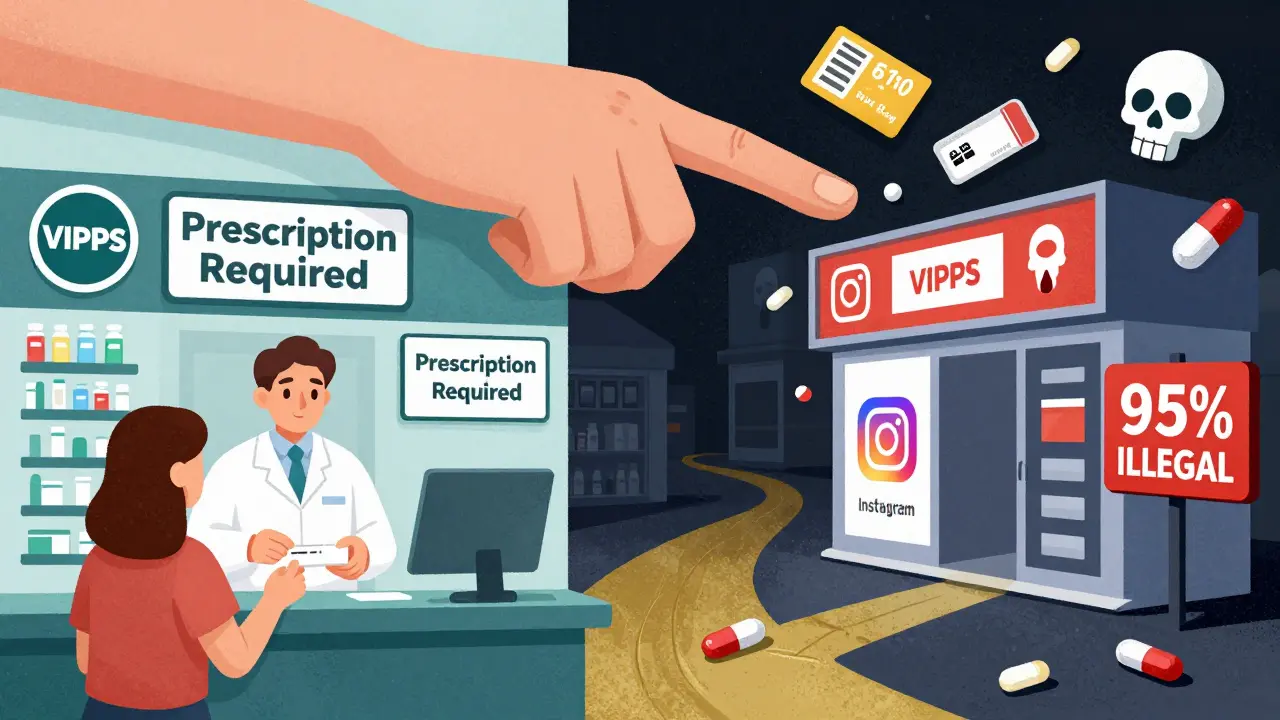
- Require a valid prescription from a licensed doctor
- Be licensed by their state board of pharmacy
- Have a physical address and phone number you can verify
- Be certified by VIPPS (Verified Internet Pharmacy Practice Sites)
Less than 5% of online pharmacies meet these standards. The rest? They’re operating from warehouses in China, India, or Eastern Europe - with no oversight, no quality control, and no accountability.
What Happens When You Take Fake Medicine?
It’s not just about wasting money. It’s about risking your life.
Counterfeit drugs can:
- Contain too much or too little of the active ingredient - leading to overdose or treatment failure
- Have toxic chemicals like lead, rat poison, or antifreeze
- Be contaminated with bacteria or mold
- Have no active ingredient at all - leaving chronic conditions untreated
- Include deadly synthetic opioids like fentanyl - often in doses 50 times stronger than heroin
The CDC warns that people who buy prescription drugs online are at risk for overdose - even if they’ve taken the same drug safely before. Why? Because the fake version isn’t the same drug. It’s a completely different chemical.
One woman in Ohio bought “Ozempic” online for $35. She took it for three weeks, lost 10 pounds, and felt great. Then she collapsed. The hospital found fentanyl in her system. She didn’t know she was taking a deadly opioid.
How to Spot a Fake Online Pharmacy
You don’t need to be an expert. Just follow these three rules:
- Check for a prescription requirement - If they sell you a prescription drug without one, walk away.
- Look for the VIPPS seal - Go to the National Association of Boards of Pharmacy website and search for the pharmacy. If it’s not listed, it’s not safe.
- Verify the address and phone number - Call the number. Go to the address. If it’s a PO box, a residential street, or a warehouse in another country - it’s fake.
Also, avoid sites that:
- Offer “miracle cures” or “guaranteed results”
- Use too-good-to-be-true discounts (e.g., “80% off”)
- Don’t have a licensed pharmacist available to answer questions
- Ship from countries with no drug safety laws
What Should You Do If You’ve Already Bought Something?
If you’ve taken a drug from an unverified online source:
- Stop using it immediately
- Call your doctor or go to the ER - even if you feel fine
- Report it to the FDA’s MedWatch program: [email protected] or call 1-800-FDA-1088
- Keep the packaging and pills - they may help investigators track the source
Don’t wait until you feel sick. Fake drugs can cause long-term damage without immediate symptoms.
Legitimate Alternatives to Save Money
You don’t have to risk your life to save money. Here’s how to get real drugs at real prices:
- Use prescription discount cards (like GoodRx or SingleCare) - they work with licensed pharmacies
- Ask your doctor about generic versions - they’re often 80% cheaper
- Check if your insurance covers mail-order pharmacies - many offer 90-day supplies at lower cost
- Visit community health clinics - they often provide medications at low or no cost
There’s no shortcut to safety. If it’s not through a licensed pharmacy, it’s not worth the risk.
Global Impact - This Isn’t Just an American Problem
The World Health Organization says at least 1 in 10 medicines in low- and middle-income countries are fake. But the problem is global. U.S. companies lose $30.5 billion a year to counterfeit drugs. Criminal networks target American consumers because they pay more. The same fake Ozempic sold for $20 in the U.S. might sell for $5 in another country - but it’s the same toxic product.
Interpol, the FDA, and the DEA are working together to shut these operations down. But until consumers stop buying from them, the cycle continues.
Final Warning
Buying medicine online without a prescription isn’t a risk - it’s a gamble with your life. Fake drugs aren’t just ineffective. They’re deadly. Fentanyl doesn’t care if you thought you were buying weight loss pills. It just kills.
There are safe, legal ways to save money on medication. Use them. Don’t let a website with a pretty logo trick you into poisoning yourself.
Agbogla Bischof
Let me be clear: buying prescription drugs online without a verified pharmacy is like playing Russian roulette with your organs.
The FDA’s data is unambiguous-over 60 million fake pills seized in 2024 alone. Most are fentanyl-laced, disguised as Xanax or oxycodone. People think they’re saving money, but they’re funding organized crime and risking death.
And yet, the same people who warn their kids about stranger danger online will click on a Google ad for $20 Ozempic. The cognitive dissonance is staggering.
Legitimate pharmacies require prescriptions. They’re licensed. They have physical addresses. They’re audited. If a site doesn’t meet these basic standards, it’s not a pharmacy-it’s a trap.
GoodRx and SingleCare exist for a reason. They lower prices at licensed pharmacies. No risk. No guesswork. Just savings.
Don’t confuse convenience with safety. The internet is full of beautifully designed lies.
Pat Fur
My cousin took fake Botox from a Facebook ad. She ended up in the ER with double vision and drooping eyelids for three months.
She thought it was ‘just a cosmetic thing.’ It wasn’t.
Now she’s on a strict regimen of physical therapy and can’t even blink properly without help.
Don’t gamble with your body.
Elaine Parra
It’s not just about fake drugs-it’s about American gullibility.
We’ve been conditioned to believe ‘fast,’ ‘cheap,’ and ‘easy’ are virtues.
But medicine isn’t Amazon Prime.
When you bypass the system, you’re not cutting out the middleman-you’re cutting out safety.
And now we’re paying with lives.
Stop romanticizing risk.
Stop glorifying ‘hustle culture’ when it kills.
It’s not innovation-it’s negligence.
Anil Arekar
While the U.S. focuses on domestic counterfeit markets, the global scale of this crisis is even more alarming.
In Southeast Asia and Sub-Saharan Africa, over 30% of antimalarials and antibiotics are falsified.
These aren’t just economic losses-they are public health catastrophes.
WHO estimates that counterfeit drugs contribute to over 100,000 deaths annually in low-income nations.
Yet, Western consumers continue to fund these networks by purchasing from unregulated sites.
The same chemical cocktail that kills in Lagos kills in Ohio.
Global health equity begins with consumer accountability.
It is not enough to condemn the criminals-we must stop enabling them.
Caroline Bonner
I just want to say-this whole issue hits so close to home for me.
Last year, my mom was struggling with high blood pressure meds, and her insurance wouldn’t cover the brand-name version.
She started Googling and found a site that offered it for $15 a bottle-‘FDA-approved,’ they said.
She took it for two weeks.
Then she collapsed.
Turns out, the pills had no active ingredient.
She ended up in the hospital with a stroke.
They had to re-prescribe everything.
And now she’s terrified of even trying to refill anything online.
I told her about GoodRx.
She got her real meds for $12.
Same pharmacy.
Same doctor.
Just… a real one.
Please, if you’re reading this and thinking about saving a few bucks-don’t.
Your life isn’t a bargain.
Chris Crosson
Let’s be real: the real problem isn’t the fake pharmacies-it’s the U.S. healthcare system.
If Ozempic cost $200 instead of $1,000, would people be risking their lives?
Probably not.
So yes, the sites are evil.
But so is a system that makes life-saving drugs unaffordable.
Until we fix that, this will keep happening.
Shaming people for buying fake meds doesn’t solve anything.
Solving drug pricing does.
Stephen Alabi
While I appreciate the general sentiment of this post, I must correct several factual inaccuracies.
The National Association of Boards of Pharmacy does not claim that 95% of online pharmacies operate illegally-that figure refers specifically to websites that claim to sell prescription drugs without a valid prescription.
Moreover, Interpol’s 2025 operation did not seize 50 million doses; that number was from a 2022 operation.
Additionally, the claim that counterfeit Ozempic contains methamphetamine is not substantiated by FDA data-most contain inert fillers or low-dose semaglutide.
It is critical that public health messaging remain accurate; exaggeration undermines credibility.
And while I agree that unregulated pharmacies are dangerous, we must not conflate all online pharmaceutical sales with criminal activity.
There are legitimate, licensed international pharmacies that serve patients in countries with restricted access.
Generalizations are dangerous.
They lead to policy errors.
And policy errors cost lives.
Chris Farley
Oh, here we go again-the fearmongering.
‘One pill can kill!’
So can a banana if you’re allergic.
Do we ban bananas?
Should we outlaw all online shopping because someone once got scammed on eBay?
This isn’t about safety.
This is about control.
The government and Big Pharma want you dependent.
They want you to pay $1,000 for a pill.
They want you to beg your doctor for a prescription.
They want you to trust the system.
But the system is rigged.
So yes, I’ll take my $20 Ozempic.
And if I die? At least I died free.
Linda Foster
Thank you for this comprehensive, well-researched post.
The data presented is not only accurate but critically necessary for public awareness.
It is deeply concerning that such a profound threat to public health remains under-discussed in mainstream media.
The emphasis on verification through VIPPS certification is especially prudent.
I have shared this with my professional network in healthcare administration.
Education, not fear, is the most effective deterrent.
Well done.
Kevin Siewe
I’ve worked in pharmacy for over 20 years.
Every week, someone walks in with a bottle from an online site.
They’re usually polite.
They say, ‘I didn’t know it was fake.’
They say, ‘It worked for me.’
They say, ‘It was cheaper.’
But they never say, ‘I knew the risks.’
And that’s the tragedy.
You don’t need to be a doctor to know: if it’s not from a licensed pharmacy, it’s not medicine.
It’s a gamble.
And nobody wins.
Check the seal.
Call the number.
Ask for the pharmacist.
It’s not hard.
It’s just not sexy.
Darlene Gomez
There’s a quiet epidemic here that no one talks about: the shame.
People don’t admit they bought fake meds because they feel stupid.
They feel guilty.
They think, ‘I should’ve known better.’
But here’s the truth: the websites are engineered to look real.
They have testimonials.
They have live chat.
They have SSL certificates.
They mimic real pharmacies better than some real pharmacies mimic trust.
So don’t shame yourself.
Don’t shame others.
Just stop.
And then-get help.
And then-tell someone.
Because silence lets the predators keep winning.
Katie Putbrese
I’m sorry, but this is just another way for the government to control what we can buy.
You want us to pay $1,000 for Ozempic?
Then why not just give it to us for free?
Why not fix the system instead of scaring people into submission?
This isn’t about safety-it’s about power.
They don’t want us to have options.
They want us to be dependent.
And they use fear to keep us obedient.
Well, I’m not afraid.
I’ll take my chances.
At least I’m not a slave to Big Pharma.
Natasha Rodríguez Lara
I’m from Mexico, and I’ve seen this firsthand.
My aunt bought fake diabetes meds online.
She didn’t die.
But she lost her vision.
Now she can’t read her grandchildren’s letters.
That’s not a risk.
That’s a theft.
They stole her sight.
And they sold it for $18.
It’s not about price.
It’s about dignity.
Don’t let them take that from you.