
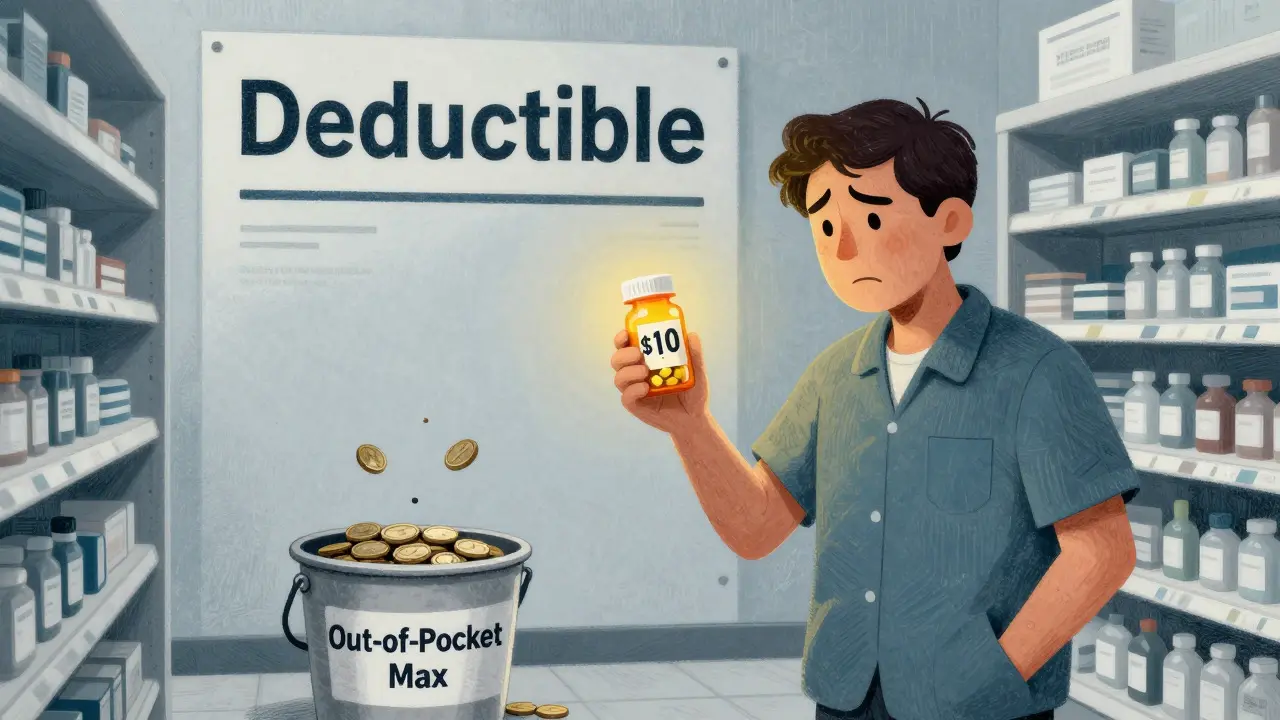
Imagine paying $10 every month for your blood pressure medication. Over a year, that adds up to $120. You might assume those payments help you meet your annual deductible, getting you closer to free care. But in most standard health plans, they don't. This disconnect is one of the biggest sources of frustration for people managing chronic conditions. It’s not just bad luck; it’s how the system is designed.
The confusion stems from the difference between two critical numbers in your insurance plan: the deductible and the out-of-pocket maximum. Understanding how generic copays interact with these figures can save you hundreds-or even thousands-of dollars. Let’s break down exactly what counts toward what, so you aren’t caught off guard by surprise bills.
What Is an Out-of-Pocket Maximum?
Your out-of-pocket maximum (OOP max) is the safety net in your health insurance policy. It represents the absolute most you will pay for covered services in a single plan year. Once you hit this limit, your insurance company pays 100% of covered medical costs for the rest of the year.
This rule was created by the Affordable Care Act (ACA), signed into law in 2010 and fully implemented in 2014. Before the ACA, many plans allowed insurers to charge copays that never counted toward any limit. If you had a serious illness requiring frequent prescriptions and doctor visits, you could theoretically pay forever without reaching a cap. The ACA changed that. Now, almost all non-grandfathered plans must include an OOP max.
However, knowing your cap isn’t enough. You need to know which payments push you toward that ceiling. That brings us to the tricky part: deductibles versus copays.
Do Generic Copays Count Toward Your Deductible?
Here is the short answer: usually, no. In most traditional health plans, the money you pay as a copay for a generic drug does not go toward meeting your deductible.
A deductible is the amount you pay for covered health care services before your insurance starts to pay. Think of it as a threshold. Until you cross that line, you pay the full negotiated rate for services like MRIs or specialist visits. But copays work differently. They are fixed amounts you pay at the time of service, regardless of whether you’ve met your deductible.
For example, if you have a $1,500 deductible and a $10 copay for generic medications, you pay that $10 every time you fill a prescription. That $10 does not reduce your $1,500 deductible balance. You still owe the full $1,500 for other medical services before your coinsurance kicks in.
This creates a "two-tier" system. You are paying for drugs via copays while simultaneously paying for medical services toward your deductible. It feels unfair because you’re spending money but not progressing toward the point where insurance covers more. However, there is good news: those copays do count toward something else.
How Copays Count Toward the Out-of-Pocket Maximum
While generic copays typically skip the deductible, they almost always count toward your out-of-pocket maximum. This is the crucial distinction that protects you from financial ruin.
Every dollar you spend on in-network cost-sharing-including your $10 generic copays, your $30 specialist visit copays, and any coinsurance after you meet your deductible-adds up toward your OOP max.
Let’s look at a real-world scenario:
- Plan Details: $1,500 deductible, $6,000 out-of-pocket maximum, $10 generic copay.
- January - June: You fill a generic prescription twice a month. Total paid: $120. Your deductible remains at $1,500 unpaid. Your OOP max progress is $120.
- July: You break your leg. The ER visit and surgery cost $8,000 in covered charges. Since you haven’t met your deductible, you pay the first $1,500. Your remaining deductible is $0.
- Post-Deductible: After the $1,500, you might owe 20% coinsurance on the rest. Let’s say that’s $1,280.
- Total Paid: $120 (drugs) + $1,500 (deductible) + $1,280 (coinsurance) = $1,900.
In this case, you haven’t hit your $6,000 OOP max yet. But if you had more surgeries or higher-cost drugs, those initial $10 copays would have been part of the total sum pushing you toward that $6,000 limit. Once you hit $6,000, your next generic prescription is free.

Types of Plan Structures That Change the Rules
Not all insurance plans are built the same way. The interaction between copays and deductibles depends heavily on your specific plan design. There are three common models you should know about.
| Plan Type | Deductible Structure | Generic Copay Behavior | Prevalence |
|---|---|---|---|
| Single Deductible | One combined deductible for medical and pharmacy | Copays often don't exist; drugs subject to deductible then coinsurance | ~27% of employer plans |
| Separate Deductibles | Medical deductible and Prescription deductible run parallel | Pay full cost until Rx deductible met, then copays count toward OOP max | ~37% of employer plans |
| Copay-Only / No Rx Deductible | Medical deductible only; no deductible for prescriptions | Pay copay immediately; counts toward OOP max, not medical deductible | ~36% of employer plans |
Single Deductible Plans: In these plans, there is no separate category for drugs. Everything falls under one big bucket. You pay for everything until you hit the deductible. Afterward, you pay coinsurance. Copays are rare here. If you have this plan, your generic drug costs do count toward your deductible because there is no exception.
Separate Deductibles: This is where things get complicated. Some plans have a $1,000 medical deductible and a $500 prescription deductible. You must pay full price for drugs until you hit that $500. Only then do you start paying copays. Those subsequent copays count toward your overall out-of-pocket maximum but not your medical deductible.
Copay-Only Plans: Many high-deductible health plans (HDHPs) or PPOs offer a flat copay for generics from day one. As mentioned earlier, these copays bypass the medical deductible but contribute to the OOP max. This is the most common structure causing confusion today.
Why Does This Distinction Matter?
You might wonder why insurers bother separating copays from deductibles. The primary reason is cost control. By keeping copays low and separate, insurers encourage patients to take necessary maintenance medications (like statins or blood pressure pills) without worrying about hitting a massive deductible first. If every pill required paying toward a $2,000 deductible, many people would skip doses to save money, leading to worse health outcomes and higher emergency room costs later.
However, experts argue this complexity hurts consumers. Dr. Karen Pollitz from the Kaiser Family Foundation notes that maintaining deductibles separate from copayments creates ongoing confusion. A 2023 survey found that 68% of consumers incorrectly believe their prescription copays count toward their deductible. This misunderstanding leads to poor financial planning.
Furthermore, the Congressional Budget Office has noted that plans with separate medical and prescription deductibles account for a significant portion of employer-sponsored plans. This fragmentation means you have to track two different balances instead of one, increasing the cognitive load on patients already dealing with illness.
Recent Changes and Future Trends
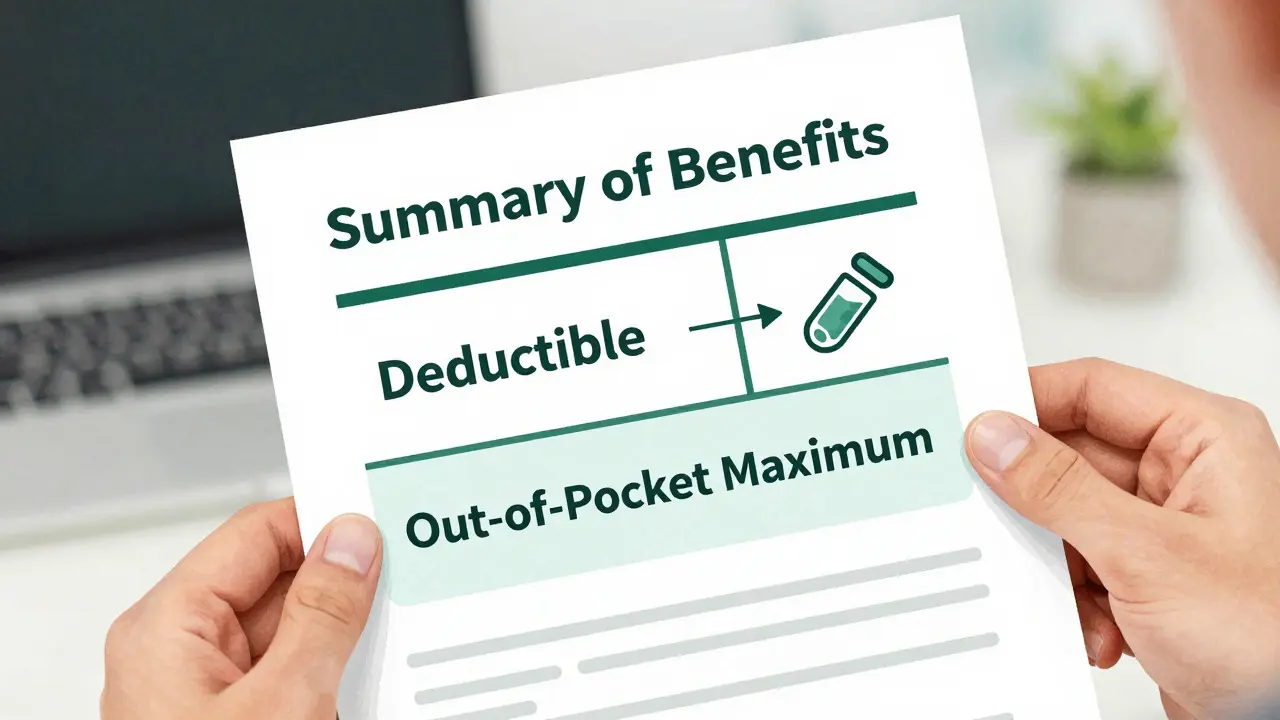
The landscape is shifting. Recognizing the confusion, the Department of Health and Human Services announced new rules in April 2024 mandating clearer communication about how prescription costs count toward deductibles and out-of-pocket maximums. These changes aim to make Summary of Benefits and Coverage documents easier to read.
Additionally, the Centers for Medicare & Medicaid Services (CMS) is testing "Integrated Deductible" models in several states. In these pilot programs, prescription costs-including copays-count toward a single, unified deductible. Early results show a 28% increase in medication adherence among chronic disease patients. This suggests that simplifying the math helps people stay healthier.
Industry analysts predict that by 2027, a majority of major insurers will offer at least one plan design where generic prescription copays count toward the deductible. The tension lies in affordability: removing the distinction could raise premiums by 3-5%, according to the American Hospital Association. Insurers must balance simplicity with keeping monthly costs down.
How to Check Your Specific Plan
Don’t guess. Your plan documents hold the answers. During open enrollment or when reviewing your current coverage, follow these steps:
- Locate the Summary of Benefits and Coverage (SBC): This is a standardized document required by the ACA. Look for the column labeled "You Pay."
- Check the Footnotes: Often, the SBC will have small print stating "Copays do not count toward deductible." If it says nothing, assume they don’t unless specified otherwise.
- Review the Explanation of Benefits (EOB): After a claim is processed, your EOB will show how much was applied to your deductible and how much to your out-of-pocket maximum. Track this over a few months to see the pattern.
- Contact Member Services: Call the number on your insurance card. Ask specifically: "Does my $10 generic copay count toward my medical deductible?" Write down the representative’s name and the date for future reference.
Understanding these mechanics empowers you to budget better. If you know your copays won’t lower your deductible, you can set aside funds separately for unexpected medical events rather than assuming your pharmacy visits are covering that base.
Do generic copays count toward my deductible in 2026?
In most standard health plans, no. Generic copays typically count toward your out-of-pocket maximum but not your medical deductible. However, if you have a plan with a single combined deductible, all costs may count toward that one figure. Always check your Summary of Benefits and Coverage.
What is the out-of-pocket maximum for 2026?
For 2026, the federal limit for individual Marketplace plans is $10,600. For family plans, the limit is $21,200. Employer-sponsored plans may have different limits but cannot exceed these federal caps for non-grandfathered plans.
Why don't copays count toward the deductible?
Insurers separate copays from deductibles to encourage consistent use of maintenance medications. If patients had to pay full price toward a high deductible, they might skip essential drugs, leading to worse health outcomes and higher long-term costs.
Do preventive care copays count toward the deductible?
No. Under the ACA, preventive services (like annual physicals and vaccines) must be covered at 100% with no cost-sharing. Therefore, there is usually no copay or deductible involved for these specific services.
Can I appeal if my copays didn't count toward my deductible?
Generally, no. If your plan document states that copays do not count toward the deductible, this is a structural feature of the contract, not an error. Appeals are typically reserved for denied claims or incorrect coding, not plan design features.