

Imagine your skin feeling tight, like a second layer that’s slowly shrinking. For people with Scleroderma, also known as systemic sclerosis, this is not just a metaphor-it is the daily reality of living with a progressive autoimmune connective tissue disease. Your body mistakenly attacks its own healthy cells, triggering an overproduction of collagen. This leads to hardening and tightening of the skin and, in many cases, damage to internal organs. It is a complex condition that affects roughly 300 out of every million people globally, striking mostly women between the ages of 30 and 50.
What Exactly Is Scleroderma?
To understand scleroderma, you have to look at what happens under the surface. In a healthy body, collagen provides structure and support. In scleroderma, the immune system goes into overdrive, causing fibroblasts (cells that make collagen) to produce too much of it. This excess collagen accumulates, turning flexible tissue into stiff, scar-like material. The American College of Rheumatology defines this as a rare, chronic condition where the hallmark sign is this fibrotic process.
The disease does not present itself in just one way. Doctors classify it into two main types, which drastically change how you manage your health:
- Localized Scleroderma (Morphea): This form stays on the skin. It creates patches of hardened tissue but usually does not affect internal organs. While it can be disfiguring or painful, it is generally less life-threatening.
- Systemic Scleroderma: This is the more serious variant. It affects the skin plus vital organs like the lungs, heart, kidneys, and digestive tract. About 90% of patients with systemic sclerosis experience gastrointestinal issues, and up to 80% face lung complications.
Within systemic sclerosis, there are two subtypes: limited cutaneous (skin changes confined to hands, feet, and face) and diffuse cutaneous (rapid skin thickening across larger areas). Diffuse cases tend to progress faster, often within the first three to five years, while limited cases may evolve slowly over a decade or more.
Early Warning Signs and Common Symptoms
Catching scleroderma early is tricky because the symptoms often mimic other conditions. However, there are clear red flags. The most common starting point is Raynaud's phenomenon. If your fingers turn white, then blue, then red when exposed to cold or stress, this is a major warning sign. In fact, about 90% of scleroderma patients experience this before any other symptom appears, sometimes even five to ten years before diagnosis.
As the disease progresses, you might notice:
- Skin Tightening: Known as sclerodactyly, this affects 95% of systemic patients. The skin on your fingers becomes shiny and tight, making it hard to bend your joints.
- Digital Ulcers: Small sores on the fingertips that are slow to heal due to poor blood flow.
- Gastrointestinal Issues: Heartburn, bloating, and difficulty swallowing are common because the esophagus muscles weaken or tighten.
- Fatigue: A deep, unrelenting tiredness that impacts work and daily life, reported by 70% of patients.
- Lung Problems: Shortness of breath caused by pulmonary fibrosis (scarring) or pulmonary arterial hypertension (high blood pressure in lung arteries).
If you have these symptoms, do not ignore them. Early intervention can help protect your organs from irreversible damage.

How Is Scleroderma Diagnosed?
Diagnosing scleroderma is rarely straightforward. Patients typically see an average of 3.2 different doctors over 18 months before getting the correct label. Why? Because the initial symptoms are vague. A rheumatologist will likely start with a physical exam, looking for skin thickening and checking your capillaries using a special microscope called a nailfold capillaroscopy.
Blood tests are crucial. They look for specific autoantibodies that act as markers for the disease:
| Antibody Type | Prevalence | Associated Risk |
|---|---|---|
| Anti-Scl-70 (Topoisomerase I) | 30-40% of diffuse cases | Higher risk of pulmonary fibrosis |
| Anti-Centromere (ACA) | 20-40% of limited cases | Lower organ risk, higher PAH risk |
| Anti-RNA Polymerase III | 15-25% of cases | Rapid skin progression, cancer risk |
| Antinuclear Antibodies (ANA) | 95% of systemic patients | General marker for autoimmune activity |
Imaging tests like high-resolution CT scans for the lungs and echocardiograms for the heart are standard to check for hidden damage. These tests help determine if you have interstitial lung disease or pulmonary arterial hypertension, which are leading causes of mortality in scleroderma patients.
Managing Scleroderma: Treatment and Care
Here is the hard truth: there is no cure for scleroderma, and no FDA-approved drug specifically targets the root cause of the disease yet. Current treatments focus on managing symptoms and slowing progression. You will likely need a multidisciplinary team-a rheumatologist, pulmonologist, cardiologist, and gastroenterologist-working together.
Treatment strategies vary by symptom:
- For Raynaud's: Calcium channel blockers (like nifedipine) help relax blood vessels. Keeping warm and avoiding smoking are essential lifestyle steps.
- For Skin Thickening: Methotrexate or mycophenolate mofetil may be prescribed to reduce inflammation and slow fibrosis. Physical therapy helps maintain joint mobility.
- For Lung Disease: Tocilizumab was approved in 2021 for scleroderma-associated interstitial lung disease. Other drugs like nintedanib are used to slow lung scarring.
- For High Blood Pressure: ACE inhibitors are critical for preventing kidney crisis, a sudden and severe complication in diffuse scleroderma.
- For Digestive Issues: Proton pump inhibitors (PPIs) control acid reflux, and antibiotics may treat bacterial overgrowth in the gut.
In severe cases, autologous hematopoietic stem cell transplantation has shown promise, with some trials reporting significant improvements in skin scores after several years. However, this is an aggressive treatment reserved for specific candidates.
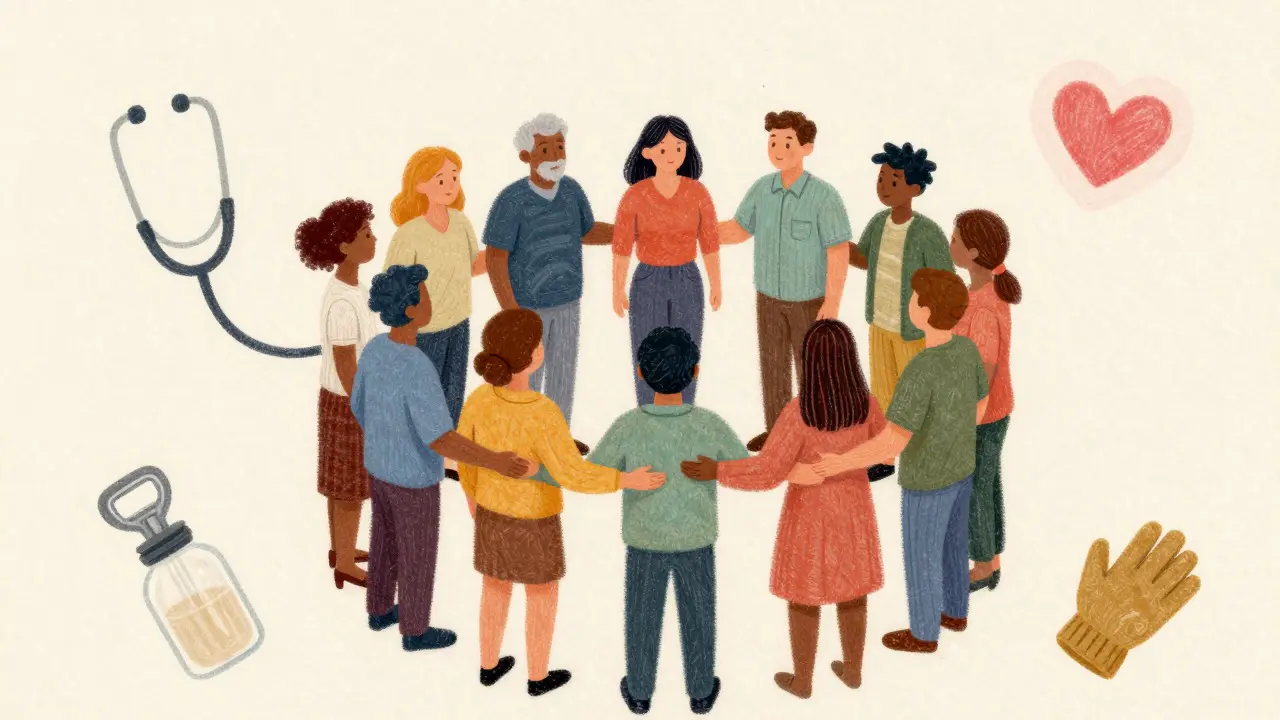
Living with Scleroderma: Practical Tips
Living with scleroderma requires adaptation. Many patients report difficulty with daily tasks like buttoning shirts or opening jars due to hand contractures. Here is how to cope:
- Use Adaptive Devices: Jar openers, button hooks, and ergonomic tools can save your energy and prevent injury.
- Monitor Your Health: Keep a diary of Raynaud's episodes, skin changes, and medication side effects. The modified Rodnan skin score is a tool your doctor uses to track skin thickness.
- Stay Warm: Layer clothing, wear gloves outdoors, and use heated seats in winter to trigger fewer Raynaud's attacks.
- Eat Small, Frequent Meals: If you have GI issues, large meals worsen reflux. Eating smaller portions reduces strain on your digestive system.
- Join a Support Network: Organizations like the Scleroderma Foundation provide resources and community. Sharing experiences with others who understand the struggle can reduce isolation.
Remember, scleroderma is highly individual. What works for one person might not work for another. Regular check-ups-at least quarterly at a specialized center-are vital to catch complications early.
The Future of Scleroderma Research
There is hope on the horizon. The global market for scleroderma therapeutics is growing, with increased investment in clinical trials targeting fibrosis pathways. Researchers are exploring B-cell depletion therapies and tyrosine kinase inhibitors. New biomarkers, such as serum CXCL4, may allow for earlier diagnosis in the coming years. As survival rates improve, we are seeing an aging population of scleroderma patients, which brings new challenges but also validates the progress made in care.
Is scleroderma genetic?
While scleroderma is not directly inherited like eye color, genetics play a role. Having a family member with the disease slightly increases your risk. However, environmental triggers-such as exposure to silica dust, certain solvents, or viral infections-are believed to activate the disease in genetically predisposed individuals.
Can scleroderma be cured?
Currently, there is no cure for scleroderma. Treatments aim to manage symptoms, slow disease progression, and prevent organ damage. With proper care, many people live full lives, though the disease remains chronic and lifelong.
What is the life expectancy for someone with scleroderma?
Life expectancy varies significantly by subtype. For limited cutaneous systemic sclerosis, the 10-year survival rate is 75-85%. For diffuse cutaneous systemic sclerosis, it is lower, around 55-70%, primarily due to lung and heart complications. Early detection and specialized care improve outcomes.
How does scleroderma differ from lupus or rheumatoid arthritis?
All three are autoimmune diseases, but they affect the body differently. Lupus often involves rashes and kidney inflammation. Rheumatoid arthritis primarily causes symmetric joint pain and swelling. Scleroderma is unique because of its fibrotic process-excessive collagen production leading to skin hardening and organ scarring, along with vascular issues like Raynaud's.
What should I do if I suspect I have scleroderma?
See a rheumatologist immediately. Bring a list of all your symptoms, including any history of Raynaud's phenomenon, skin changes, or digestive issues. Ask for specific antibody testing (ANA, anti-Scl-70, etc.) and imaging studies to assess organ involvement. Early diagnosis is key to preserving organ function.