

Mycophenolate GI Management Assistant
Symptom Assessment
Select your symptoms and details to receive personalized management tips.
Imagine you just had a life-saving kidney transplant. You’re thrilled to be healthy again, but then the daily pill routine starts causing your stomach to rebel. This is the reality for nearly half of all patients taking Mycophenolate, specifically known by brand names like CellCept or Myfortic. It is an essential immunosuppressant that prevents organ rejection, but it comes with a heavy price tag in terms of gastrointestinal distress.
If you are dealing with constant nausea, cramping, or diarrhea, you aren't alone, and you don't have to just "push through" it. Unmanaged gut issues can lead to dehydration, poor nutrition, and even non-adherence to your medication-which puts your new organ at risk. The good news? There are proven strategies to manage these symptoms without compromising your health.
Why Mycophenolate Hits Your Gut Hard
To fix the problem, we first need to understand why it happens. Mycophenolate works by blocking an enzyme called inosine monophosphate dehydrogenase (IMPDH). This stops immune cells from multiplying, which keeps your body from attacking the transplanted organ. However, this drug isn’t perfectly selective. It also affects the rapidly dividing cells lining your digestive tract.
Think of your gut lining as a high-turnover factory. When mycophenolate slows down cell production there, the barrier weakens, leading to inflammation and irritation. According to data from the American Journal of Transplantation, up to 49% of patients experience significant GI toxicity. Nausea affects about 31% of users, while diarrhea hits nearly 30%. These aren't minor inconveniences; they are direct results of how the drug interacts with your biology.
| Symptom | Prevalence Rate | Typical Onset |
|---|---|---|
| Nausea | 31.2% | Within first few weeks |
| Diarrhea | 29.8% | Variable, often early |
| Abdominal Pain | 21.5% | Intermittent |
| Vomiting | 15.7% | Less common |
Immediate Steps to Manage Nausea
Nausea is often the first sign that your system is struggling with the dose. Before you consider stopping the drug, try adjusting how you take it. Timing matters more than you might think.
The Cleveland Clinic recommends taking mycophenolate on an empty stomach-specifically, one hour before or two hours after food-to ensure maximum absorption. However, if an empty stomach makes you feel sick, this creates a catch-22. Here is the workaround: split the difference. Take the pill with a very small amount of bland food, like a few crackers or a spoonful of applesauce. Patient reports suggest that applesauce, in particular, helps buffer the stomach acid without significantly interfering with the drug's bioavailability.
Another effective tactic is dose splitting. Instead of taking the full dose twice a day, ask your doctor if you can divide it into three or four smaller doses throughout the day. This keeps the concentration of the drug in your bloodstream steadier and reduces the sudden shock to your gut lining. A study from Johns Hopkins University showed that even modest adjustments in dosing schedules can lead to symptom resolution within 48 to 72 hours for many patients.
Tackling Diarrhea and Gut Inflammation
Diarrhea is trickier because it can lead to dangerous dehydration and electrolyte imbalances. If you are experiencing loose stools, start by checking your diet. Avoid high-fiber foods, dairy products, and spicy meals until things settle down. Stick to the BRAT diet (Bananas, Rice, Applesauce, Toast) which is gentle on the inflamed intestinal wall.
Probiotics might help, but choose wisely. Some patients report success with Lactobacillus GG, a specific strain shown in studies to support gut health during antibiotic or immunosuppressive therapy. However, always clear probiotic use with your transplant team, as live cultures carry a tiny risk of infection in severely immunocompromised individuals.
If simple dietary changes don't work within a week, it’s time to escalate. Persistent diarrhea could indicate mycophenolate-induced colitis, a condition where the colon becomes inflamed. This occurs in about 1.9% of renal transplant recipients. Symptoms include bloody diarrhea and severe cramping. If this sounds like you, do not wait. You need a colonoscopy to rule out infections like Cytomegalovirus (CMV) or Clostridioides difficile, which are common in transplant patients but require different treatments.
When to Switch Formulations
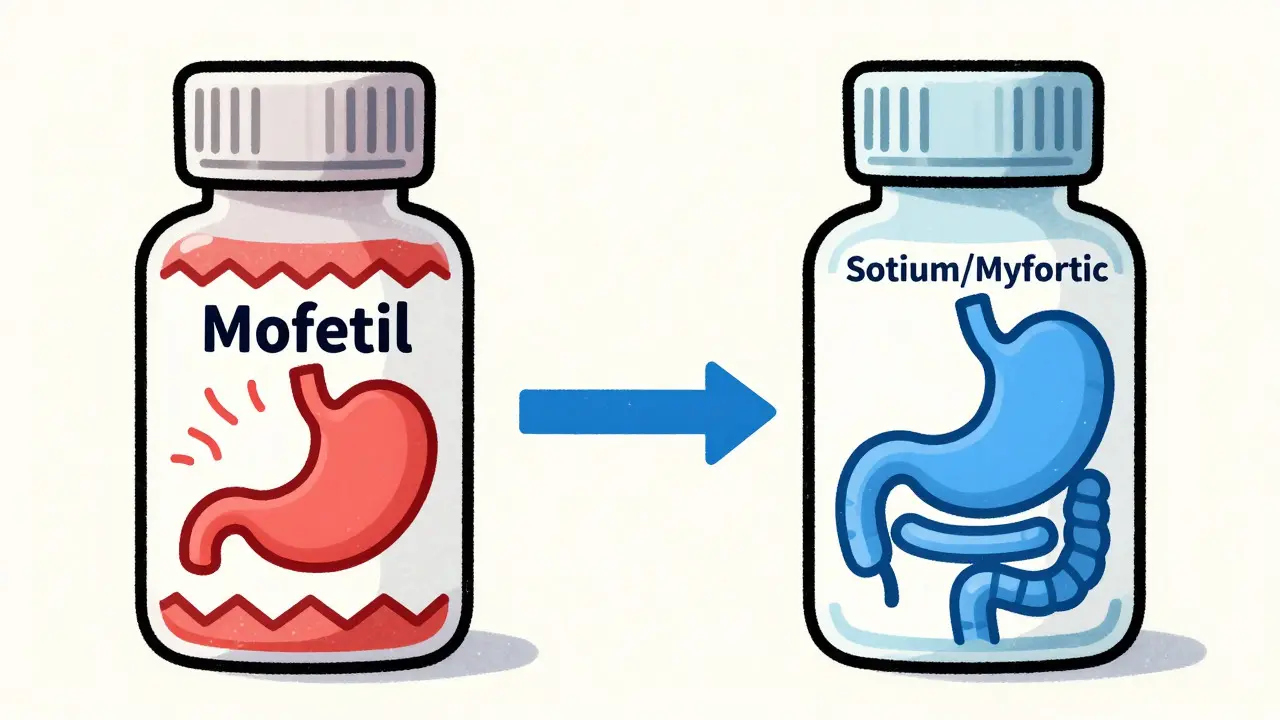
Not all mycophenolate is created equal. There are two main forms: mycophenolate mofetil (CellCept) and mycophenolate sodium (Myfortic). Both deliver the same active ingredient, mycophenolic acid (MPA), but they behave differently in your body.
Myfortic has an enteric coating designed to dissolve lower in the digestive tract, sparing the stomach from immediate irritation. A 2022 randomized controlled trial involving 120 kidney transplant recipients found that switching from CellCept to Myfortic resolved GI issues in 65% of cases. If you are currently on the mofetil version and suffering, ask your doctor about making the switch. It’s not a guaranteed fix for everyone, but it’s a low-risk change that offers significant relief for many.
There is also newer technology on the horizon. In 2023, the FDA approved an extended-release formulation (MPA-ER) that showed a 37% lower incidence of diarrhea in Phase III trials compared to the standard immediate-release version. While availability may vary depending on your insurance and region, it represents a promising option for those who cannot tolerate older formulations.
Dose Reduction and Therapeutic Drug Monitoring
Sometimes, the dose is simply too high for your body to handle comfortably. The European Renal Association notes that GI side effects are dose-dependent in 68% of cases. High trough levels of the drug in your blood correlate strongly with diarrhea.
Your doctor might order therapeutic drug monitoring (TDM) to check your MPA levels. Ideally, trough levels should stay between 1 and 3.5 μg/mL. If your levels are above 3.5 μg/mL, your risk of diarrhea skyrockets. In such cases, a temporary 33% dose reduction can allow your gut to heal while still maintaining enough immunosuppression to protect the organ. Once symptoms resolve, doctors may slowly titrate the dose back up or maintain the lower level if rejection risk remains low.
Keep in mind that TDM is controversial. Some experts argue that measuring the area-under-the-curve (total exposure over time) is more accurate than a single trough level. However, practical challenges limit widespread adoption. For now, working closely with a pharmacist who specializes in transplantation can help interpret these numbers correctly.

Red Flags: When to Seek Emergency Care
While some discomfort is normal, certain symptoms signal serious complications. Contact your healthcare provider immediately if you experience:
- Bloody or black, tarry stools
- Severe abdominal pain that doesn’t go away
- Fever over 100.4°F (38°C)
- Signs of dehydration (dark urine, dizziness, dry mouth)
- Persistent vomiting preventing you from keeping fluids down
These could be signs of infectious colitis, perforation, or severe rejection. Don’t assume it’s “just the meds.” Better safe than sorry when your immune system is suppressed.
Long-Term Strategies and Adherence
Managing mycophenolate side effects is a marathon, not a sprint. Dr. Sarah G. Kim from Massachusetts General Hospital highlights that unmanaged GI toxicity is the leading cause of non-adherence in transplant recipients. Skipping doses due to sickness leads to acute rejection in over 12% of late-stage cases.
To stay on track, keep a symptom diary. Note when you take your meds, what you ate, and any GI issues. This data helps your doctor pinpoint triggers and adjust your regimen effectively. Also, stay hydrated. Sip water throughout the day rather than chugging large amounts at once, which can trigger nausea.
If all else fails, alternatives exist. Azathioprine is an older antimetabolite used in about 8% of new transplants. Leflunomide is another option showing promise for patients intolerant to mycophenolate. While mycophenolate remains the gold standard due to its superior efficacy in preventing rejection, your quality of life matters too. Open communication with your care team ensures you find the right balance between protecting your organ and living comfortably.
How long does it take for mycophenolate side effects to go away?
For mild nausea or diarrhea, symptoms often improve within 48 to 72 hours after dose adjustment or switching formulations. However, chronic issues like colitis may take several weeks to resolve fully with medical intervention. Most patients adapt within the first 3 to 6 months of starting therapy.
Can I take antacids with mycophenolate?
Yes, but timing is crucial. Antacids containing aluminum or magnesium can bind to mycophenolate and reduce its absorption. Take antacids at least 2 hours apart from your mycophenolate dose to avoid interactions.
Is mycophenolate-induced colitis permanent?
No, it is usually reversible. With dose reduction or discontinuation, the intestinal lining typically heals. However, re-challenging with the drug after recovery carries a 42% recurrence rate, so careful monitoring is essential.
Should I stop taking mycophenolate if I have diarrhea?
Never stop abruptly without consulting your doctor. Sudden cessation increases the risk of organ rejection. Instead, contact your transplant team for guidance on dose adjustment or symptomatic treatment.
What foods should I avoid while on mycophenolate?
During flare-ups, avoid high-fiber foods, dairy, spicy dishes, and fatty meals. Stick to bland, easy-to-digest options like bananas, white rice, applesauce, and toast. Gradually reintroduce other foods as your tolerance improves.