
You take a pill every morning. It’s cheap, accessible, and likely labeled as a "generic." But have you ever stopped to wonder what’s actually inside that tablet? While generics save the U.S. healthcare system billions annually-accounting for 90% of all prescriptions dispensed-they aren’t immune to quality issues. In fact, contamination risks are real, specific, and often hidden from view until a recall hits the news.
Contamination isn’t just about finding a bug in your medicine cabinet. It involves chemical impurities, microbial growth, or cross-contamination from other drugs processed on the same equipment. With 80% of active pharmaceutical ingredients (APIs) manufactured overseas, primarily in India and China, the supply chain is long and complex. The FDA reports that contamination-related issues accounted for 22% of all drug recalls in 2022. If you’re relying on generics for chronic conditions like hypertension or diabetes, understanding these risks helps you make smarter choices about your health.
What Counts as Contamination?
The FDA defines cross-contamination as the undesired introduction of impurities-chemical, microbiological, or foreign matter-into a drug product. This can happen during manufacturing, packaging, or even storage. Think of it less as "dirt" and more as unintended substances altering the drug’s purity.
Cross-contamination is the transfer of residual drug substances or particles between products during manufacturing processes. For example, if a facility makes both blood thinners and antibiotics on the same line without adequate cleaning, traces of one could end up in the other.
There are three main types of contamination threats:
- Chemical Impurities: These include nitrosamines (like NDMA), which became famous during the valsartan crisis. They form when certain chemicals react under heat or pressure.
- Microbial Contamination: Bacteria, yeast, or mold growing in non-sterile products. USP <61> sets strict limits: no more than 1,000 colony-forming units (CFU) per gram for total aerobic microbes in oral dosage forms.
- Physical Particulates: Glass shards from broken ampules, metal fragments from machinery, or human skin cells shed by workers.
Why Generics Face Higher Risks
Generics must meet the same rigorous standards as brand-name drugs. However, economics play a role. Generic manufacturers operate with thinner profit margins-averaging 20-25% compared to 60-70% for innovator brands. This financial pressure can sometimes lead to cost-cutting in quality control investments, though not always.
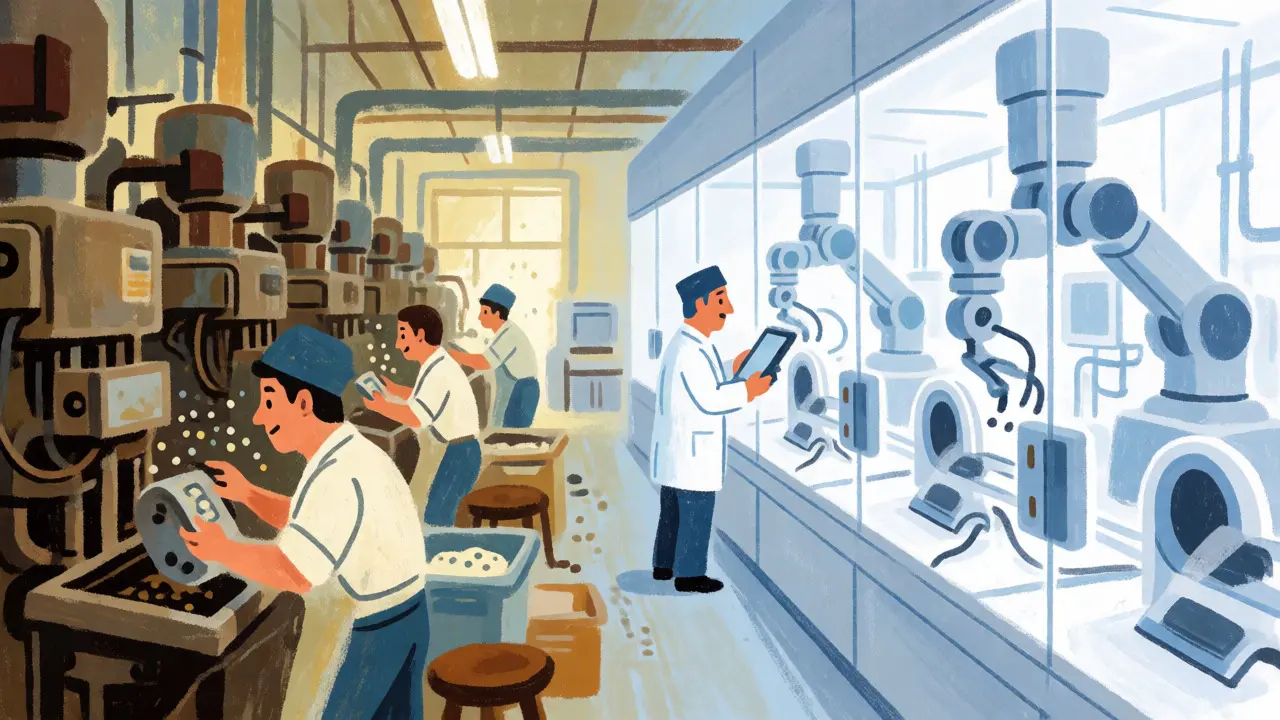
Facility age matters too. Plants built before 2000 show a 34% higher risk of contamination incidents because they lack modern closed-system designs. Older facilities rely more on open processing, where airborne particles and operator errors introduce variables. Newer plants use isolators and restricted access barrier systems (RABS) to keep humans out of the critical zone.
Geography also influences risk profiles. FDA inspection data from 2022 showed that Indian generic manufacturers received contamination-related observations at nearly double the rate of U.S.-based facilities (12.7% vs. 6.4%). This doesn’t mean all imported drugs are bad; many top-tier Indian companies maintain world-class standards. But the variability across suppliers requires stricter oversight.
The Human Factor: Personnel and Processes
You might think machines cause most problems, but people are the biggest source of particulate matter. A stationary person sheds approximately 40,000 skin cells per minute. In a cleanroom, this means generating 100,000 particles larger than 0.3 microns just by standing still.
Specific manual tasks create significant hazards:
- Piercing Vial Septa: Documented in 62% of hazardous drug contamination incidents. Needles can push rubber fragments into the solution.
- Withdrawing Needles: Accounts for 41% of incidents, often due to improper technique causing aerosolization.
- Breaking Ampules: Responsible for 28% of incidents, releasing glass dust into the air and onto surfaces.
Gowning procedures are critical but often flawed. OSHA surveys found inadequate engineering controls in 63% of compounding pharmacies. Even with guidelines, cyclophosphamide-a potent chemotherapy drug-was found on 85% of pharmacists’ work surfaces in some studies, indicating poor containment.
Prevention Strategies That Work
Good Manufacturing Practices (GMP) are the baseline. Compliance isn’t optional; it’s law under 21 CFR 211. But beyond basic compliance, successful manufacturers adopt advanced strategies.
| Measure | Impact | Cost Estimate | Effectiveness |
|---|---|---|---|
| Closed Isolator Systems | Reduces human contact by 90% | $500k - $2M per line | High |
| Rapid Microbiological Methods | Cuts detection time from 7 days to 4 hours | Variable (tech-dependent) | Medium-High |
| Real-Time Particle Monitoring | Identifies deviations instantly | $100k - $300k per facility | High |
| Enhanced Gowning Training | Reduces personnel shedding | Low (training costs) | Medium |
Cleaning validation is another cornerstone. Manufacturers must prove that their cleaning process removes at least 10 parts per million (ppm) of previous product residue. This isn’t just a guess; it requires swab testing with 95% confidence intervals over three consecutive cycles. For highly potent drugs, however, the 10 ppm limit may be too loose. Former FDA Director Michael Kopcha argues that product-specific acceptance criteria based on toxicology are safer.
Teva Pharmaceuticals offers a success story. Their Bologna, Italy facility reduced cross-contamination incidents by 78% between 2018 and 2022. How? By switching to closed manufacturing systems and implementing rigorous environmental monitoring. Similarly, Mylan’s Morgantown plant cut incidents by 82% using real-time particle counters and stricter gowning protocols.
How to Respond When Things Go Wrong
If you suspect your medication is contaminated, don’t panic-but do act. The FDA’s MedWatch system is the primary channel for reporting adverse events or product quality complaints. Between 2020 and 2022, 1,247 reports flagged potential generic drug contamination, with 387 citing actual adverse events.
Here’s your response checklist:
- Visual Inspection: Look for discoloration, spots, or unusual texture. One Reddit user reported metronidazole tablets with blue specks that tested positive for copper contamination.
- Check Recall Lists: Visit the FDA website regularly. Recalls are categorized by risk: Class I (serious harm), Class II (temporary/reversible harm), and Class III (unlikely to cause harm).
- Contact Your Pharmacist: Independent pharmacists often spot issues first. In 2022, 28% of hospital pharmacists reported encountering potentially contaminated generics.
- Report It: Use MedWatch online or call 1-800-FDA-1088. Your report helps track patterns.
Recall procedures follow 21 CFR Part 7. Manufacturers must notify distributors and patients within 24 hours of discovering a serious defect. For nitrosamine-containing drugs, the FDA now mandates testing for all sartan-class medications as of January 2023.
The Future of Quality Control
Technology is changing the game. The FDA’s PREDICT system now flags 37% more potentially contaminated imports than its predecessor. AI-powered environmental monitoring is set to roll out broadly by 2024, analyzing over 15,000 data points per facility to predict risks with 89% accuracy.
Rapid microbiological methods are becoming standard among top manufacturers. Instead of waiting seven days for culture results, labs can detect contaminants in four hours. This speed allows for quicker batch release and faster reaction times if something goes wrong.
However, challenges remain. Supply chain complexity continues to grow. Vertical integration-where companies control their own API production-reduces contamination incidents by 22%. Yet, most generics rely on third-party suppliers. As globalization deepens, regulatory harmonization between the FDA, EMA, and other agencies becomes crucial. Currently, facilities supplying both EU and US markets face 42% higher contamination-related observations due to conflicting regulatory expectations.
Frequently Asked Questions
Are generic drugs less safe than brand-name drugs?
No, they must meet identical FDA quality standards. However, economic pressures and older facilities can sometimes lead to higher rates of contamination-related inspection findings. Recent data shows 8.3% of generic facilities receive Form 483 observations for contamination control versus 5.1% for innovator facilities.
What are nitrosamines and why are they a concern?
Nitrosamines are chemical impurities classified as probable human carcinogens. They emerged as a major issue during the 2018-2019 valsartan crisis, affecting 22 manufacturers and leading to 2,317 recalls. The FDA now requires mandatory testing for sartan-class drugs.
How does the FDA inspect foreign drug facilities?
The FDA inspects only about 1% of imported drug products for impurities directly. They rely heavily on remote audits, supplier certifications, and the PREDICT system to target high-risk shipments. Indian facilities currently show higher observation rates for contamination issues compared to U.S. sites.
Can I test my own medication for contamination?
Generally, no. Independent testing requires specialized lab equipment like HPLC or mass spectrometry. 63% of independent pharmacists lack resources for this. Visual inspection is your best tool; if a pill looks different (color, shape, texture), consult your pharmacist.
What should I do if my drug is recalled?
Stop taking the medication immediately if it’s a Class I recall (serious harm). Return it to the pharmacy for a replacement or refund. Check the FDA’s recall list for specifics. Do not flush it unless instructed, as some drugs require special disposal to avoid environmental contamination.
Pearl Richardson
It is absolutely terrifying to realize that the very pills meant to heal us are potentially laced with carcinogens due to corporate greed and lax oversight. 🤢 The fact that 80% of APIs come from regions where regulatory enforcement is often a mere suggestion rather than a law makes me question every single prescription I take. We are essentially guinea pigs in a global experiment where profit margins matter more than our lives. 😱
Tobi Oyewole
We must approach this with nuance. While the risks are real, dismissing all generics ignores the massive benefit of accessibility for millions. The solution isn't to abandon them but to demand better supply chain transparency.
Stuart Lorne
oh please spare me the drama pearl. if you cant afford brand name dont complain about the generic. its simple economics not a conspiracy. people are just too stupid to read labels these days.
Rose Boerner
I am appalled by the sheer negligence displayed in the manufacturing sector. It is morally indefensible that companies cut corners on quality control to pad their bottom lines while patients suffer the consequences. We deserve purity and safety, not excuses about thin margins! The FDA needs to stop patting themselves on the back and start actually policing these foreign facilities with the rigor they claim to uphold.
Vivek Chaturvedi
india has world class pharma manufacturers like sun and dr reddys
the issue is with small unregulated factories
blaming all indian drugs is lazy thinking
us fda inspections are biased anyway
Crystal Torres
This is such an important topic! I had no idea that skin cells were such a major contaminant source. It really highlights how complex pharmaceutical manufacturing is. I’m going to be much more diligent about checking recall lists now. Thank you for sharing these detailed statistics!
Sarah Kinch
honestly its all garbage.
who cares about ppm limits when half the staff doesnt even wash hands properly?
its a broken system designed to fail so they can sell us supplements instead.
lazy analysis typical of mainstream media.
fred eden
Hey everyone, hope you're all doing well! 💖 Just wanted to say that it's okay to feel anxious about this stuff. Your health matters, and being informed is the first step to feeling safe again. Don't let the stats scare you into stopping your meds without talking to your doc first! 🌟🙏
larry williams
While the data presented here is indeed concerning and warrants a serious discussion regarding the integrity of our pharmaceutical supply chains, we must also remember that the vast majority of generic medications perform exactly as intended without incident. It is crucial that we maintain perspective; panicking over potential contamination risks might lead some individuals to discontinue life-saving treatments prematurely, which poses its own set of significant health dangers. Therefore, I encourage everyone to stay vigilant, report any anomalies to their healthcare providers, and trust in the evolving systems of quality control that are gradually becoming more robust and transparent year after year.
Kimberly Thomas
The post conveniently glosses over the fact that independent pharmacies have zero leverage against big manufacturers. You’re telling consumers to 'check recall lists' as if that’s a viable safety net when recalls happen months after distribution. It’s reactive, not proactive. The entire framework is broken because profit dictates production speed, not safety checks.
Venkatesan V.K.
The argument regarding facility age is flawed. Modern equipment does not guarantee competence if the human element remains unchecked. Furthermore, attributing higher contamination rates solely to geography ignores the economic pressures faced by manufacturers globally. One must consider that stricter regulations often correlate with higher prices, which is precisely what generics aim to avoid. Thus, the risk profile is inherent to the business model itself, not merely a result of location or infrastructure.
Marc-David Mayer
Great info! 👍 Definitely worth keeping an eye on those MedWatch reports. Stay healthy folks! 💪🥗
Anderson Miller
Sure, sure... let's pretend that "enhanced gowning training" fixes everything. Because clearly, the problem was never systemic underfunding or rushed approvals, right? No, it was just some guy forgetting his hairnet. How convenient. The irony here is thick enough to spread on toast. We are told to trust the process, yet the process is riddled with holes that require a PhD in toxicology to spot. Bravo to the industry for making us feel safe while selling us lottery tickets in pill form.