
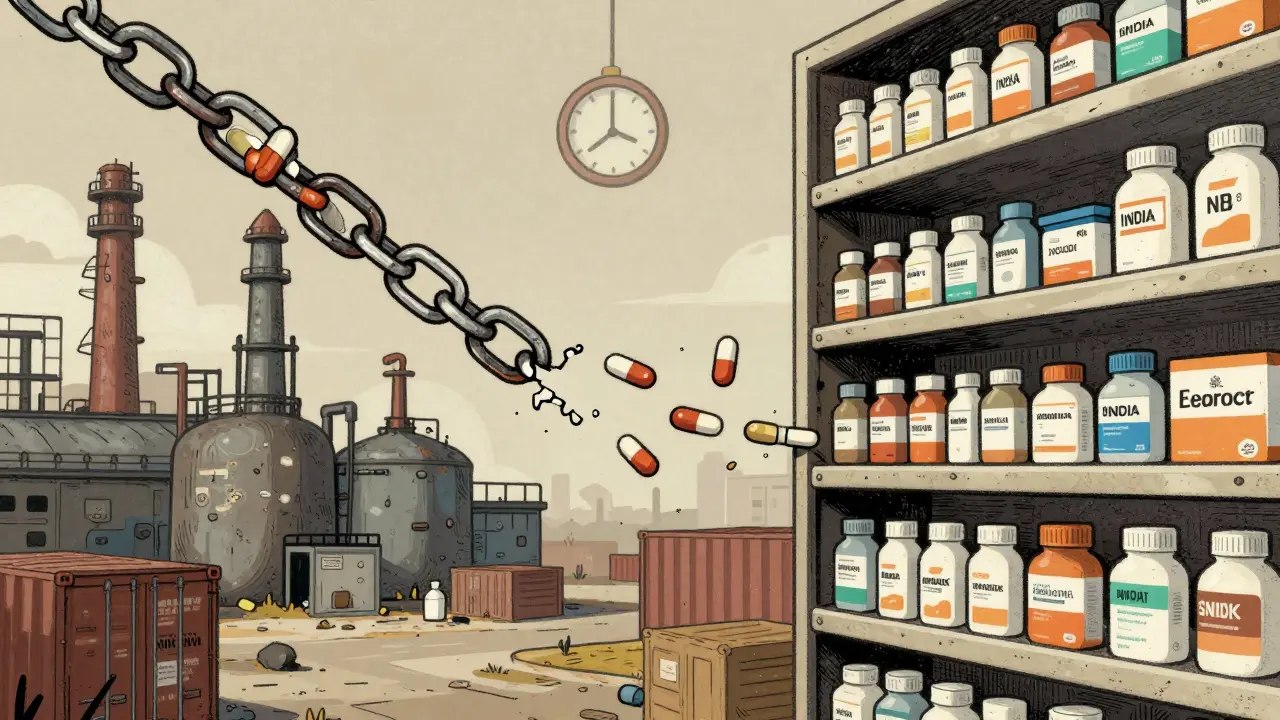
When you pick up a generic pill at your pharmacy, you probably don’t think about the complex network that got it there. But behind every cheap, effective medication is a high-stakes game of cost, risk, and precision. The economics of generic drug distribution isn’t just about lowering prices-it’s about keeping the entire system from collapsing under its own weight. With profit margins squeezed to around 8%, and 80% of active ingredients coming from just three countries, a single factory shutdown or shipping delay can leave thousands without their medicine. This isn’t a hypothetical risk. In 2022, over 200 generic drugs faced shortages in the U.S. alone, and most of them were the cheapest ones on the shelf.
Why Cheap Drugs Are the Riskiest
Generic drugs are designed to be affordable. That’s the whole point. But the pressure to cut prices has created a dangerous trade-off: the lower the price, the more fragile the supply chain. When a manufacturer can only make a few cents per pill, there’s no room for error. No extra inventory. No backup suppliers. No room to absorb a delay. That’s why drugs priced below $0.10 per unit are 73% more likely to run out than those costing $0.50 or more. It’s the affordability paradox: the very thing that makes generics valuable-their low cost-also makes them the most vulnerable.Think of it like a grocery store that only stocks one can of tomato soup. If the supplier misses a delivery, you’re out of luck. That’s what’s happening with many generic drugs. Sixty-five percent of essential generics are now made by only one or two factories globally. One power outage. One regulatory inspection. One shipping backlog. And the medicine disappears from shelves for weeks-even months.
The Numbers That Matter
Efficiency in generic distribution isn’t about feeling good. It’s about hitting hard targets. Top performers track three key metrics:- Overall Equipment Effectiveness (OEE): Measures how well a manufacturing line runs. Top distributors hit above 85%. The average? Just 70%. That 15-point gap means fewer delays, less waste, and more pills out the door.
- Perfect Order Percentage: This is the percentage of orders that arrive on time, complete, undamaged, and correctly documented. Leading companies hit 98%+. Most lag at 85%. Every missed point here adds cost, delays, and patient risk.
- Inventory Turnover: How often stock is sold and replaced in a year. The industry average is 8.3 times. The best? 12.7 times. That’s 50% more efficient use of capital.
These aren’t just office metrics. They’re survival tools. A distributor with 92% perfect order rates and 11x inventory turnover doesn’t just save money-they win contracts, keep patients covered, and stay in business.
How Efficiency Actually Works
The old way of running a drug supply chain was simple: order in bulk, store it, ship it out. But that model is broken. The new way is data-driven. Here’s what works:- EOQ Formula: Economic Order Quantity. It’s a math equation-Q = √(2KD/G)-that tells you exactly how much to order to balance ordering costs against storage costs. Companies using this cut stockouts by 30-45%. No guesswork. Just math.
- AI Forecasting: Old forecasts used last year’s sales. That’s like driving with your eyes closed. New systems use real-time data: hospital admissions, doctor prescriptions, even social media trends. One distributor reduced forecast errors by 37% in just six months.
- IoT Sensors: Nearly half of all generic drugs need temperature control. Sensors on shipping containers send alerts if a truck gets too hot or cold. One company cut spoilage by 60% after installing them.
- Cloud ERP Systems: Real-time visibility across warehouses, factories, and delivery trucks. One manager from Cardinal Health said it gave them "immediate data access from anywhere." That’s the difference between reacting to a problem and preventing it.
These aren’t luxury upgrades. They’re necessities. A distributor without AI forecasting is flying blind. One without IoT sensors is gambling with patient safety.
The Two Models: Just-in-Time vs. Just-in-Case
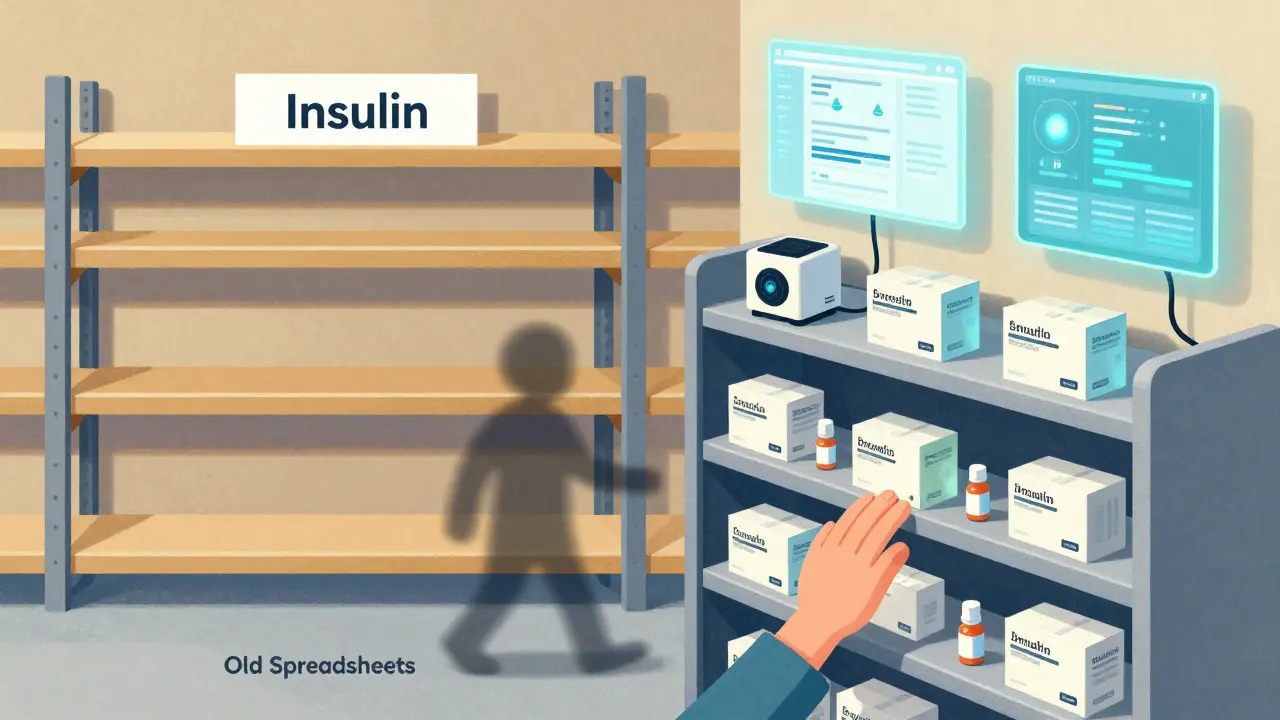
There are two ways to handle inventory in generic distribution-and they’re opposites.Just-in-Time (JIT) keeps inventory as low as possible. It cuts storage costs by 22-35%. Sounds great, right? But it also increases stockout risk by 15-20% during disruptions. Many distributors tried this to save money. Then came the shortages. In 2022, 68% of companies that eliminated all safety stock suffered severe shortages.
Just-in-Case (JIC) keeps extra stock on hand. It raises holding costs by 18-28%, but cuts stockouts by 40-60%. The smartest players now use a hybrid: minimal buffer for low-risk drugs, 15-20% extra for critical ones like insulin, antibiotics, or seizure meds.
There’s no one-size-fits-all. But ignoring buffer stock? That’s how you end up with empty shelves when patients need help the most.
Who’s Winning-and Why
Three companies control 85% of U.S. generic drug distribution: McKesson, AmerisourceBergen, and Cardinal Health. But not all are equal.Cardinal Health invested $150 million in AI-driven forecasting in 2022. Result? A 3.2% market share gain in one year. McKesson launched "DemandSignal," an AI platform that cut forecast errors by 37%. Teva Pharmaceutical spent $28 million and 14 months restructuring its supply chain. They cut inventory costs by 32%.
Meanwhile, smaller distributors still rely on spreadsheets and phone calls. Their adoption of AI tools? Just 15%. The gap is widening. Top performers now hit 9.2% EBITA margins. The rest? 6.8%. That 2.4-point difference isn’t just profit-it’s survival. In a market where margins are 8% on average, that’s a 35% edge.
The Hidden Costs of Inefficiency
It’s easy to blame manufacturers for shortages. But the real problem is systemic. Here’s what happens when efficiency lags:- Expedited Shipments: Delays in approvals cause 22% more emergency air freight. That costs 5-8x more than regular shipping.
- Regulatory Burden: The FDA’s Drug Supply Chain Security Act requires full digital tracking. Compliance adds 5-8% to costs. Miss it? You can’t sell.
- Lost Trust: When a hospital can’t get a routine drug, they switch brands-or worse, switch suppliers. Once you lose a contract, you rarely get it back.
And then there’s the human cost. A patient who can’t get their blood pressure medication doesn’t just miss a dose-they risk a stroke. A diabetic without insulin? That’s a hospital visit. Efficiency isn’t about profit. It’s about keeping people alive.
What’s Next? The Road to 2027
The future isn’t just better software. It’s digital twins-virtual copies of your entire supply chain. By 2027, top distributors will run simulations to predict disruptions before they happen. Imagine knowing a factory in India will shut down for two weeks… and automatically rerouting production to a backup site in Poland. That’s not sci-fi. It’s what MIT predicts will be standard by then.Right now, only 42% of top distributors use AI forecasting. By 2025, that number will be over 80%. Those who don’t adapt? They’ll lose 15-20% of their market share. The consolidation is already happening. Smaller players without the capital to invest in tech won’t survive.
The message is clear: efficiency isn’t optional. It’s the only way to keep generic drugs affordable, available, and reliable. The math doesn’t lie. The data doesn’t lie. And patients certainly don’t.
Why are generic drug shortages getting worse even though prices are lower?
Because lower prices force manufacturers to cut every possible cost-including safety stock, backup suppliers, and redundant production lines. With profit margins under 8%, companies can’t afford to overproduce. But when a single factory shuts down-which happens often due to regulatory issues or natural disasters-there’s no backup. This creates a "fragility loop": the cheaper the drug, the more likely it is to run out.
What’s the biggest mistake distributors make in generic supply chains?
Relying on historical sales data to forecast demand. Generic drug demand doesn’t follow trends-it spikes suddenly due to hospital outbreaks, new prescribing guidelines, or even media coverage. One study found that traditional forecasting methods failed to predict 70% of demand surges. The fix? Real-time data from electronic health records, pharmacy sales, and even social media trends powered by AI.
Can small distributors compete with giants like McKesson and Cardinal Health?
It’s extremely difficult. The giants spend millions on AI, IoT, and cloud systems that reduce inventory costs by 30% and cut forecast errors by 40%. Small distributors often lack the capital to invest. Without tech, they’re stuck with slow, reactive systems. Some survive by specializing in niche drugs or forming alliances, but most will be bought out or forced out over the next five years.
How important is inventory buffer stock for generic drugs?
Critical-for the right drugs. Eliminating all buffer stock to save money caused 68% of distributors to face severe shortages in 2022. The smart approach: keep 15-20% extra on high-risk generics (like insulin, antibiotics, or heart meds) and minimize buffers for low-risk ones. It’s not about holding more inventory-it’s about holding the right inventory.
What role does regulation play in supply chain efficiency?
Regulations like the FDA’s DSCSA and EU’s Falsified Medicines Directive force full digital traceability from factory to pharmacy. That’s expensive-adding 5-8% to costs-but it also forces modernization. Distributors who resisted digital tracking are now being left behind. Compliance isn’t just about avoiding fines-it’s about gaining the data infrastructure needed to become efficient.
Is blockchain technology worth the investment for generic distributors?
For most, no. Blockchain systems cost $2.5-4 million to implement and take 6-9 months to integrate with legacy systems. The ROI isn’t clear yet. Most distributors get better results from cloud-based ERP systems and IoT sensors that are cheaper, faster, and proven. Blockchain might matter for high-value drugs or export markets, but for standard generics, it’s overkill.
Matt Alexander
Generic drugs aren't cheap because they're bad. They're cheap because the system is built to squeeze every penny out. That's fine until a single factory in India goes dark and suddenly your blood pressure med vanishes. No backup. No buffer. Just silence. Efficiency isn't a buzzword here-it's life or death.
Gretchen Rivas
That 85% OEE stat stuck with me. Most factories run at 70%. That 15-point gap? It's 15% fewer pills on the shelf. It's not magic. It's maintenance schedules, training, and not letting a sensor go ignored for weeks.
Ivan Viktor
So we're saying the solution to medicine shortages is more data and less compassion? Brilliant. Next you'll tell me to optimize my insulin dosage with a spreadsheet.
Mike Dubes
AI forecasting is a game changer but dont sleep on the little guys. I know a small distributor in Ohio who uses WhatsApp groups with pharmacists to track demand spikes. No fancy software. Just people talking. They rarely run out.
Sharon Lammas
It's strange how we talk about efficiency like it's a neutral force. But behind every algorithm, every sensor, every just-in-time model is a person-maybe a single mom-waiting for her pill. Efficiency without humanity is just a faster way to fail.
Helen Brown
Did you know the FDA doesn't inspect most foreign factories? They rely on paperwork. Paperwork that's often forged. The real shortage? Trust. Not pills. They're just hiding behind math while the system rots.
John Cyrus
Blockchain is overkill but cloud ERP is non negotiable if you want to survive. I've seen distributors with spreadsheets go under in 18 months. No excuses. If you're not digital you're dead
John Smith
Let me tell you what's really going on. Big Pharma owns the regulators. They want small players gone so they can corner the market. The shortages? Not accidents. They're strategic. The system was designed to fail so we'd beg for consolidation
marjorie arsenault
You're not alone if this feels overwhelming. The system is broken but change starts small. Talk to your pharmacist. Ask them what they see. Share what you learn. One voice at a time builds pressure. You're not powerless.
Shivam Pawa
Inventory turnover 12.7x vs 8.3x means 50% less capital locked. That's not just efficiency. That's leverage. In emerging markets we use this to bootstrap distribution networks. Tech isn't the answer-it's the enabler.
Stephen Vassilev
Wait-so you're telling me that the U.S. government, through the FDA, has allowed 80% of active pharmaceutical ingredients to be manufactured in just three countries-two of which are authoritarian regimes with no transparency? And you call this a supply chain? This is national security failure. We are one cyberattack away from a nationwide crisis. Where is the oversight? Where is the accountability? Who authorized this? Who signed off? Who is responsible? Who? WHO?!
Matt Alexander
Stephen, you're not wrong. But screaming into the void doesn't fix the warehouse. The real answer? Push for public-private partnerships. Fund backup production in the U.S. and EU. It costs more upfront but saves lives. The math still holds.