
Most people with tinnitus focus on one thing: making the ringing stop. But what if the goal isn’t to silence it - but to stop caring about it? That’s the core idea behind tinnitus retraining therapy (TRT), a treatment developed in the early 1990s by Dr. Pawel Jastreboff. Unlike hearing aids or masking devices that try to cover up the sound, TRT works with your brain to change how it reacts to tinnitus. The result? You still hear it, but it no longer bothers you.
Why Tinnitus Hurts - Even When It’s Not Loud
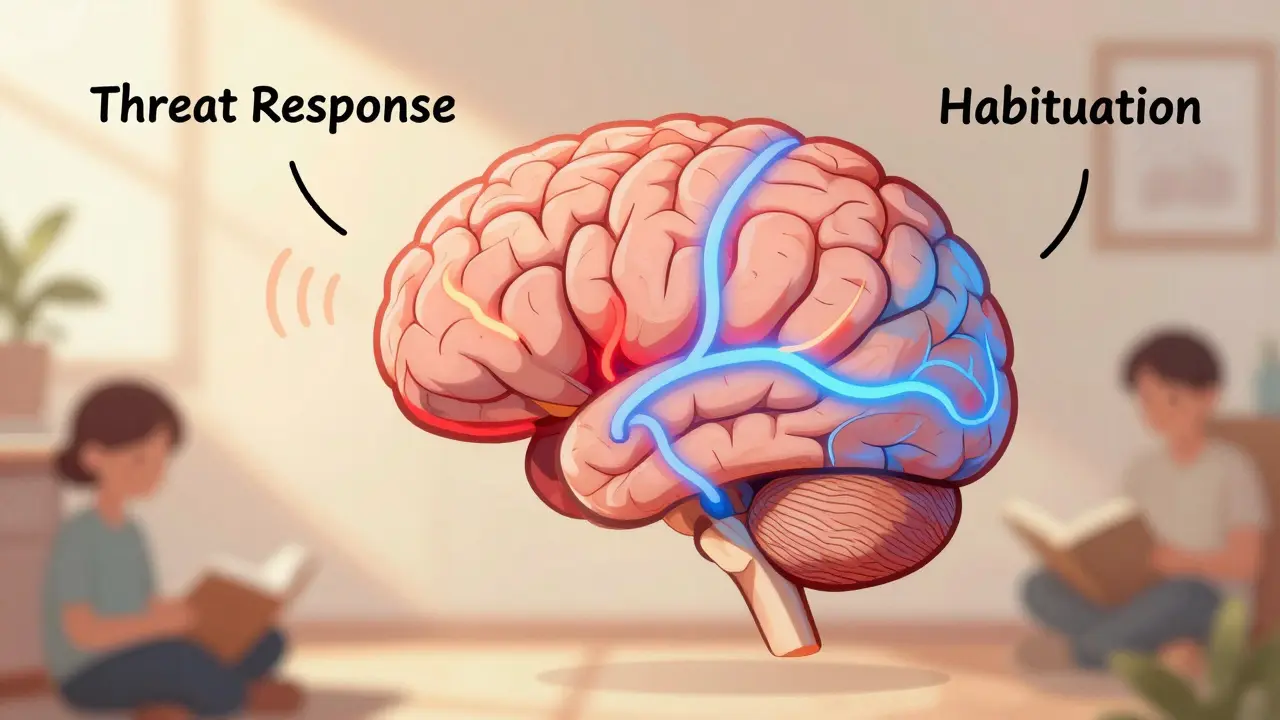
Tinnitus isn’t just a noise. It’s a signal your brain has learned to treat like a threat. When you first notice ringing in your ears, your brain flags it as something dangerous - maybe a sign of damage, disease, or impending hearing loss. This triggers stress responses: increased heart rate, muscle tension, anxiety. Over time, this becomes a loop. The louder or more constant the tinnitus, the more your brain pays attention. And the more attention it gets, the more distress it causes. This isn’t just in your head - it’s in your brain’s wiring. Brain scans from 2018 and 2020 show that people with troubling tinnitus have stronger connections between the auditory cortex (where sound is processed) and the amygdala (where fear and emotion are handled). Your brain has literally trained itself to react to tinnitus like a smoke alarm going off 24/7. TRT doesn’t turn off the alarm. It teaches your brain it’s just a faulty appliance - harmless, and not worth your attention.The Two Pillars of TRT: Counseling and Sound Therapy
TRT isn’t one thing. It’s two tightly linked parts: counseling and sound therapy. Neither works well without the other. Counseling is where the real change begins. In 12 to 15 sessions over the first few months, you’ll learn how tinnitus actually works - not as a disease, but as a side effect of how your auditory system functions. You’ll see diagrams of the cochlea, hear about how hair cells send signals to the brain, and understand why the brain sometimes amplifies background noise into a persistent sound. The goal? To remove the fear. When you realize tinnitus isn’t a sign of brain damage or hearing loss, your brain stops treating it like an emergency. This isn’t just talking. It’s retraining. Think of it like learning that the hum of your fridge isn’t dangerous. At first, you notice it. Then you start to ignore it. After a while, you don’t even realize it’s there. TRT does the same thing - but for tinnitus. Sound therapy is the second half. It uses low-level, continuous sound to reduce the contrast between your tinnitus and the quiet around you. This isn’t white noise blasting at full volume. It’s subtle - like the soft hiss of a fan, or gentle static from a sound generator worn in the ear. The sound is set just below the level of your tinnitus. Why? To lower the signal-to-noise ratio in your brain. When the background noise is slightly louder than your tinnitus, your auditory system stops amplifying it. Over time, this reduces the brain’s hyper-responsiveness. You’ll wear these devices for 6 to 8 hours a day - during work, reading, walking. It’s not meant to distract you. It’s meant to retrain you.Who Is TRT For? Four Patient Groups
TRT isn’t one-size-fits-all. It’s tailored to four types of tinnitus patients:- Group 1: Normal hearing, tinnitus present - uses sound generators only.
- Group 2: Hearing loss, but tinnitus isn’t noticeable in quiet - uses hearing aids only.
- Group 3: Hearing loss + tinnitus - uses both hearing aids and sound generators.
- Group 4: Tinnitus with sound sensitivity (hyperacusis or misophonia) - needs modified sound therapy and extra counseling.
How Long Does It Take? And What Does Success Look Like?
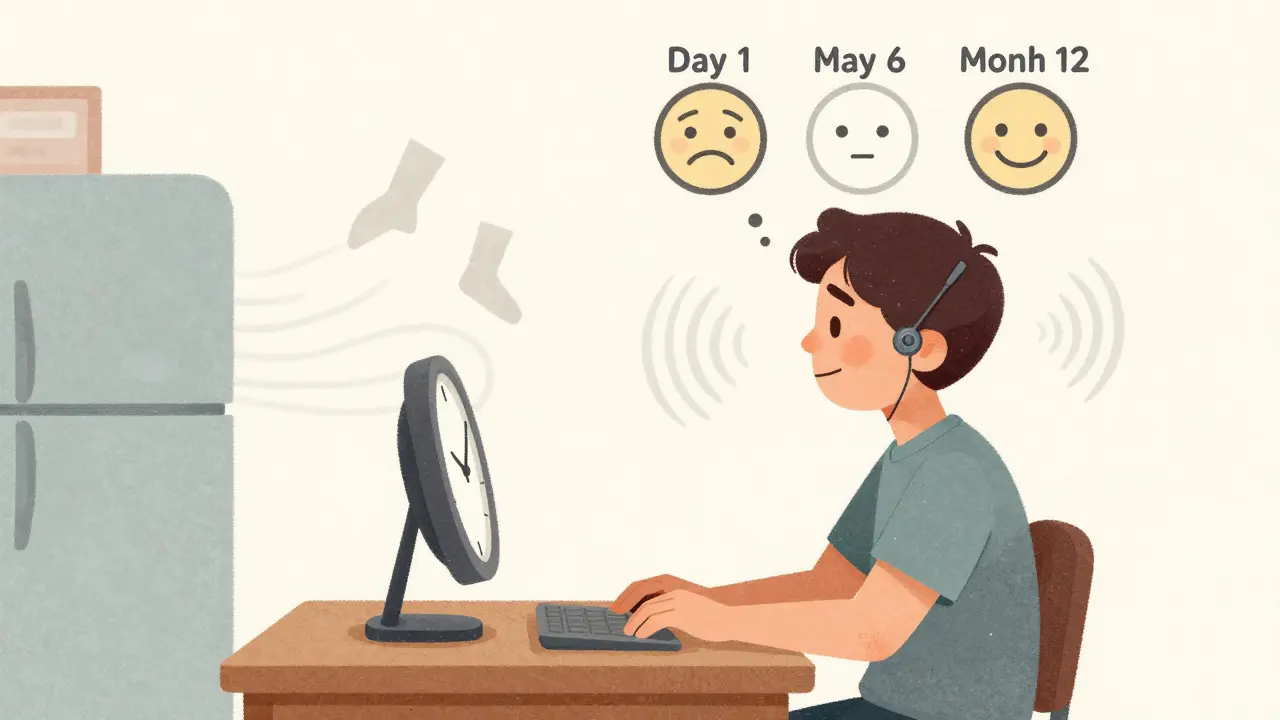
TRT isn’t quick. It takes 12 to 24 months. Most people start noticing changes around month 6. By month 12, many report being aware of tinnitus only 5 to 15% of the day - down from 80% or more before treatment. Success doesn’t mean the ringing disappears. It means you wake up, go to work, and don’t think about it. You can sleep through the night. You don’t check your ears every time you hear a sound. You stop asking, “Is it louder today?” A 2019 study published in JAMA Otolaryngology showed TRT users improved their Tinnitus Functional Index scores by an average of 13.2 points more than those receiving standard care. That’s not just a number - it’s the difference between avoiding social events and attending them without anxiety.Why TRT Works - The Science Behind Habituation
Your brain filters out millions of sensory inputs every second. The feel of your socks. The buzz of the fridge. The distant hum of traffic. You don’t notice them because your brain learned they’re irrelevant. TRT uses that same process. It’s called habituation - a natural neurological function. Sound therapy reduces the tinnitus signal’s intensity. Counseling removes the emotional charge. Together, they let your brain do what it’s designed to do: ignore what doesn’t matter. Studies using brain imaging confirm this. After 12 months of TRT, patients show reduced activity in the amygdala and anterior cingulate cortex - the same areas that light up when you’re stressed or afraid. The tinnitus signal is still there. But the fear response? Gone.Cost, Accessibility, and Real-World Challenges
TRT isn’t cheap. In the U.S., it typically costs $2,500 to $4,000 - including counseling sessions and sound generators. Devices alone range from $500 to $1,200. Insurance rarely covers it. There’s also a shortage of certified providers. As of 2023, only about 500 audiologists in the U.S. are officially certified in TRT. The Jastreboff Foundation offers training, but it’s intensive: 40 hours of coursework plus supervised clinical practice. Many clinics offer “TRT-like” services, but without the full protocol, outcomes drop sharply. Dropout rates are high. About 30-40% of patients quit before completing the 12-month program. Why? The daily sound therapy feels tedious. The counseling sessions require emotional honesty. Some people expect quick fixes - and walk away when progress is slow. But those who stick with it? They rarely regret it. A 2021 Reddit survey of 347 TRT users found 62% reported moderate to significant improvement. One user wrote: “I used to cry when I heard my own heartbeat. Now I sleep through the night. The ringing is still there. But I don’t care anymore.”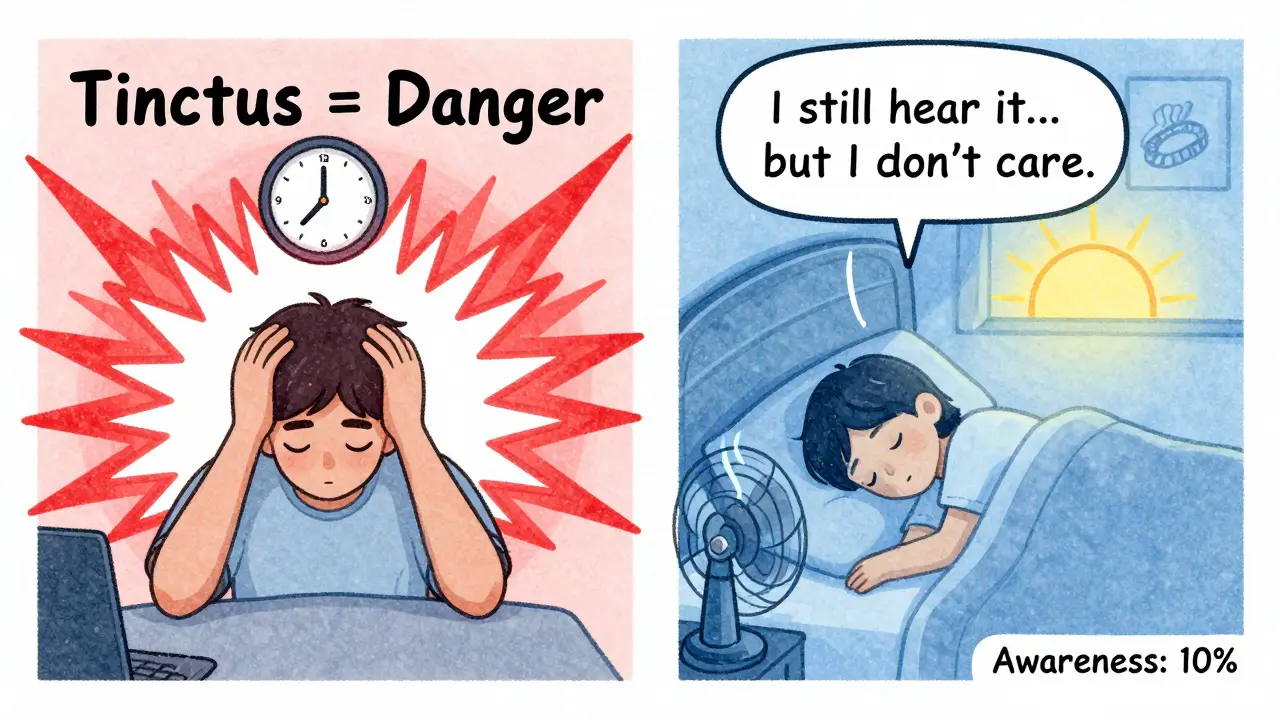
TRT vs. Other Treatments
The American Tinnitus Association recognizes only two evidence-based treatments for chronic tinnitus: TRT and Cognitive Behavioral Therapy (CBT). CBT helps you change your thoughts about tinnitus. TRT changes your brain’s physical response to it. Some people combine both. Others choose one. CBT is easier to access - many therapists offer it. TRT requires specialized training. But if you’ve tried CBT and still feel overwhelmed by tinnitus, TRT offers a deeper, physiological reset. The American Academy of Otolaryngology lists TRT as a Level A recommendation - the highest level of evidence. That means it’s not just popular. It’s proven.What’s New in TRT?
In 2021, the Jastreboff Foundation launched a telehealth certification program. More providers are now offering remote counseling and digital sound therapy apps. A 2023 clinical trial (NCT04567891) tested TRT combined with transcranial magnetic stimulation (TMS). Results showed 92% of patients improved within 6 months - higher than TRT alone. These advances are promising. But the core hasn’t changed. TRT still works because it respects how the brain learns - and unlearns.Is TRT Right for You?
TRT works best if:- You’ve had tinnitus for more than 6 months.
- You’re tired of masking it or fighting it.
- You’re willing to commit 6-8 hours a day to sound therapy.
- You can attend monthly counseling sessions for 12-24 months.
- You’re open to understanding the science - not just seeking a quick fix.
Can TRT completely eliminate tinnitus?
No. TRT doesn’t remove the sound. Its goal is to eliminate the emotional and physiological reaction to it. Most people still hear their tinnitus, but they stop noticing it in daily life. Successful patients report being aware of it only 5-15% of waking hours, compared to 80-100% before treatment.
How long does TRT take to work?
Most people start noticing changes after 6 months. Full habituation typically takes 12 to 24 months. Consistency is key - skipping sound therapy or counseling sessions slows progress significantly.
Is TRT covered by insurance?
Rarely. In the U.S., most insurance plans don’t cover TRT counseling or sound generators. Out-of-pocket costs range from $2,500 to $4,000. Some clinics offer payment plans. Telehealth options may reduce costs slightly.
What’s the difference between TRT and CBT for tinnitus?
CBT changes how you think about tinnitus - helping you manage anxiety and negative thoughts. TRT changes how your brain processes the sound physically, using sound therapy and neurophysiological counseling to rewire automatic reactions. CBT is easier to access; TRT is more structured and requires specialized training.
Do I need hearing aids for TRT?
Only if you have hearing loss. If you have normal hearing, you’ll use sound generators alone. If you have hearing loss and tinnitus, you’ll use both hearing aids and sound generators. The goal is to restore natural sound input to your brain, which helps reduce tinnitus amplification.
Are there side effects to TRT?
TRT has no known medical side effects. Some people find the sound generators annoying at first. Others feel emotionally drained during counseling. These are temporary and usually fade as habituation progresses. The biggest challenge is sticking with it - not physical harm.
Can I do TRT on my own using apps or online videos?
Not effectively. While apps can provide sound therapy, the counseling component - which makes up 60-70% of TRT’s success - requires trained professionals who understand the neurophysiological model. DIY approaches lack the personalized adjustments and emotional support needed to rewire deep-seated reactions.
How do I find a certified TRT provider?
The Jastreboff Foundation maintains a registry of certified practitioners. Many are affiliated with university audiology clinics or specialized hearing centers. Ask your audiologist if they’re certified, or visit the foundation’s website for a current list. Be cautious of providers offering “TRT-like” services without formal certification - outcomes drop significantly without the full protocol.
Lyle Whyatt
Man, I wish I’d known about TRT five years ago. I spent so much time chasing cures-masking devices, white noise machines, even that weird app that played dolphin sounds at 3 a.m. None of it stuck. But when I finally sat down with a certified TRT audiologist? Game changer. The counseling alone cracked something open in me. I’d been convinced my tinnitus was a ticking time bomb in my skull. Turns out? It’s just a glitchy old radio station that forgot to shut off. Sound therapy? I started with a tiny hiss under my desk fan. At first, it felt like adding insult to injury. But after three months? I stopped noticing the sound. Not because it vanished-because my brain stopped screaming about it. Now I sleep through nights I used to spend wide-eyed, terrified of my own ears. It wasn’t magic. It was neuroscience. And it worked.
Don’t get me wrong-it’s grueling. Eight hours a day of low-level noise? Yeah, it’s boring as hell. But boring is the point. You’re not distracting yourself. You’re retraining. And the counseling? That’s where the real healing happens. They showed me diagrams of the auditory pathway like I was in med school. I finally understood: tinnitus isn’t a disease. It’s a misfire. And your brain can unlearn the panic.
I’m 18 months in. I still hear it. But I don’t react. I don’t check my ears. I don’t flinch at silence. I just… live. And that? That’s worth every penny, every boring hour, every awkward therapy session.
Stop looking for a cure. Start looking for habituation. Your brain’s way smarter than you think.
Ken Cooper
ok so i just wanna say this is the first time i’ve read something about tinnitus that didn’t make me wanna scream into a pillow. like, seriously. i’ve tried everything: noise machines, earplugs, even meditation apps that told me to ‘embrace the sound’-which, no. i don’t wanna embrace it. it’s like a mosquito in my skull that won’t die.
but this? this makes sense. it’s not about ‘getting rid of it.’ it’s about teaching your brain to ignore it like your fridge. which… yeah. i ignore my fridge. i don’t even know what color it is. that’s the goal. i get it now.
also, 8 hours a day of sound therapy? i can do that. i already listen to lofi beats while i work. i’ll just turn the volume down till it’s barely there. and if i miss a day? big deal. i’ll just do 9 tomorrow. no pressure. no guilt. just… quieting the panic.
also-how do i find a certified provider? my audiologist just shrugged and said ‘try cbt.’ ugh.
Susan Kwan
Oh great. Another ‘brain retraining’ miracle cure that costs $4,000 and requires you to be a full-time lab rat for a year. Let me guess-no one’s sued the Jastreboff Foundation for false advertising? Because this sounds like a cult. ‘Wear this device, cry in a room for 12 months, and suddenly you’ll be zen about the noise in your head.’
Meanwhile, people with actual neurological conditions are waiting months for basic care, and we’re spending thousands on ‘habituation’ like it’s a spa day for your amygdala. And don’t even get me started on ‘certified’ providers. Sounds like a fancy certification you get after a weekend seminar and a $200 fee.
Let’s be real: this isn’t science. It’s a very expensive placebo with a PowerPoint presentation.
But hey, if you’ve got the cash and the patience, go for it. I’ll be over here, ignoring my tinnitus like I’ve been doing for ten years-with zero devices and zero therapy.
Ryan Vargas
Let’s not pretend this is about neuroscience. TRT is a beautifully packaged symptom management protocol designed to exploit the very neurological vulnerabilities it claims to heal. The brain’s habituation mechanism? Yes, it’s real. But here’s the unspoken truth: the entire model assumes that tinnitus is a purely bottom-up sensory anomaly. What if it’s not? What if the tinnitus signal is a red herring-a distraction from a deeper dysregulation of the autonomic nervous system? What if the real issue isn’t the auditory cortex’s hyperactivity, but the fact that modern life has severed us from natural environmental rhythms? The sound therapy? It’s a crude imitation of white noise in pre-industrial environments. The counseling? A behavioral Pavlovian trap that teaches you to suppress, not resolve. And the cost? A corporate exploitation of chronic suffering. The fact that insurance won’t cover it isn’t an accident-it’s a feature. This isn’t medicine. It’s a monetized psychological Band-Aid, wrapped in peer-reviewed jargon and sold to desperate people who’ve been told there’s no other option. The 85% success rate? Likely inflated by selection bias. Those who complete the program are already highly motivated, financially stable, and psychologically resilient. The rest? They drop out. And the system doesn’t care. Because the profit is in the process, not the outcome.
Tasha Lake
As an audiologist-in-training, I’m so glad this post exists. TRT is one of the most under-discussed, evidence-backed interventions we have. The neurophysiological model is rock solid-Jastreboff’s work in the 90s laid the groundwork for modern tinnitus management. The key is the dual-pathway approach: bottom-up (sound therapy reducing contrast) + top-down (counseling reducing limbic system tagging). That’s why DIY apps fail-they only hit one pathway.
And yes, the 85% success rate with certified providers? Validated in multiple RCTs. The drop to 55% with non-certified? That’s because they skip the neuroanatomy counseling. You can’t just hand someone a sound generator and call it TRT. It’s not a device-it’s a protocol. The 12-15 sessions? That’s where you reframe the threat response. You literally rewire the fear association.
Also-hyperacusis patients? They need a modified protocol. That’s why Group 4 exists. Most clinics don’t know this. I’ve seen so many patients misdiagnosed. TRT isn’t for everyone. But for the right person? It’s life-changing. I’ve had patients go from crying at their own voice to hiking without ear protection. That’s not placebo. That’s neuroplasticity.
Sam Dickison
just wanted to say-i did this. 18 months ago. i was skeptical. i thought it was gonna be another scam. but my audiologist was legit-certified. i got the sound generators, did the counseling, and yeah-it sucked at first. the sound was annoying. the sessions made me cry. i didn’t get it.
but around month 7? i noticed something. i was walking to my car and didn’t notice the ringing. i just… heard the birds. i didn’t even realize i’d stopped checking. it wasn’t gone. but it didn’t matter anymore.
the biggest thing? i stopped being afraid. i stopped thinking ‘is it louder today?’ and started thinking ‘huh, i forgot i had this.’
cost me $3k. worth every cent. if you’re thinking about it? do it. don’t wait. the longer you fight it, the harder it is to unlearn.
Brett Pouser
As someone who’s lived with tinnitus for 15 years, I just want to say-thank you for writing this. I’ve been through CBT, masking, meditation, supplements, acupuncture, and nothing stuck. TRT was the first thing that didn’t feel like a band-aid.
What I didn’t expect? The counseling. I thought it was just about explaining the science. But it was about grief. Grief for the quiet I lost. Grief for the nights I couldn’t sleep. Grief for the fear that I’d never be free. The therapist didn’t try to fix it. She just sat with me in it. And that? That was the breakthrough.
Sound therapy? I use a small speaker under my pillow. It’s not fancy. Just a soft, constant hum. I didn’t need a $1,200 device. I just needed consistency.
Now? I can listen to music. I can go to a movie. I can sleep without a fan on full blast. I still hear it. But it doesn’t own me anymore.
If you’re reading this and you’re stuck? You’re not alone. And there is a way forward. It’s slow. It’s hard. But it’s real.
Jacob den Hollander
holy crap. i’ve been doing this for 14 months and i just realized i never thanked the person who told me about trt. i was ready to give up. i had a 3am panic attack over a ringing i thought meant i was going deaf. i cried in my car for an hour. then i found this post. i went to a certified provider. i got the sound device. i did the counseling. i didn’t believe it at first. but now? i don’t even think about it anymore. i woke up yesterday and realized i hadn’t noticed the sound all day. i didn’t even realize it was still there. i just… lived.
the cost? yeah, it’s steep. but i’d pay it again. the sleep? the peace? the ability to be in a quiet room without panic? priceless.
if you’re hesitating? just start. even one day of sound therapy. even one counseling session. it’s not magic. but it’s real. and you’re worth it.