
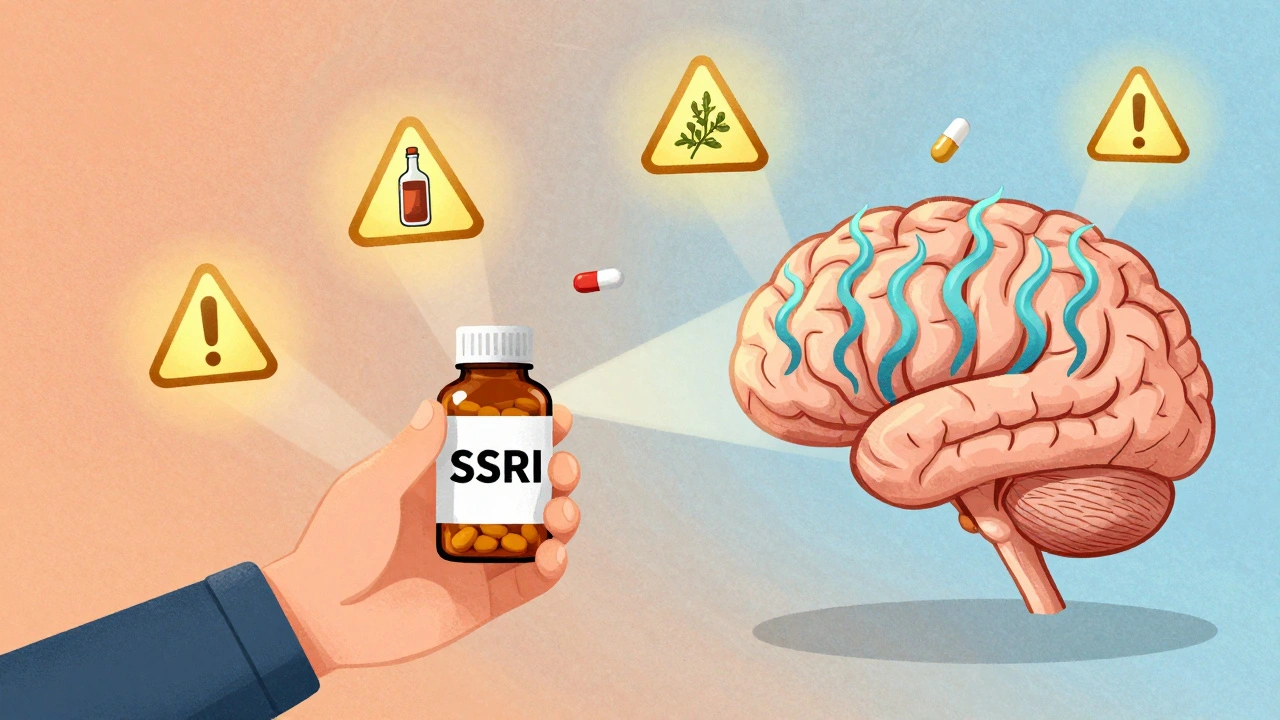
When you're taking an SSRI antidepressant like sertraline or escitalopram, you might assume it's safe as long as you don't miss a dose. But what you don't know could hurt you-especially if you're also taking another medication, supplement, or even an over-the-counter cough syrup. Serotonin syndrome isn't rare. It’s not just a footnote in a drug leaflet. It’s a real, sometimes deadly, reaction that happens when too much serotonin builds up in your brain. And it’s happening more often than you think.
What Exactly Is Serotonin Syndrome?
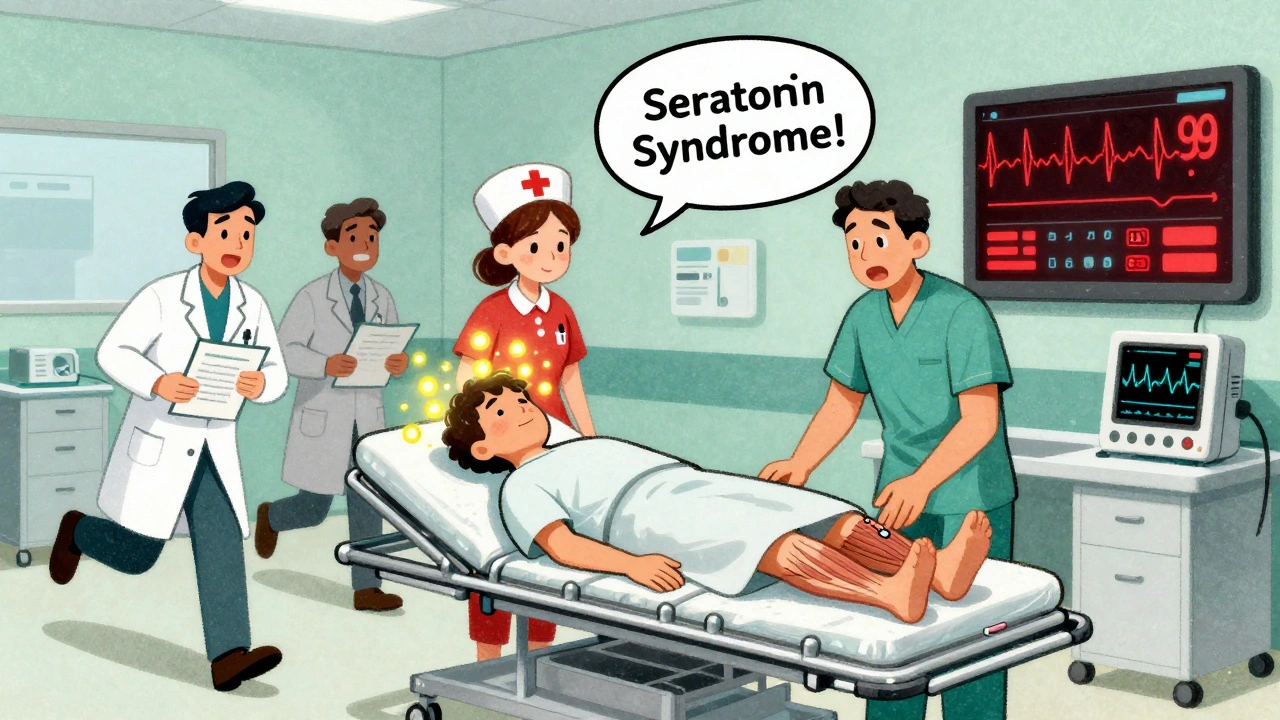
Serotonin syndrome isn’t just feeling a little jittery after coffee. It’s a medical emergency. Your brain uses serotonin to control mood, sleep, and muscle movement. SSRIs stop your brain from reabsorbing serotonin, so more stays around. That’s how they help with depression. But if another drug adds even more serotonin-or blocks its breakdown-the system overloads. Symptoms can start within hours and escalate fast.The classic signs? Shivering, sweating, stiff muscles, fast heart rate, high body temperature, confusion, and involuntary muscle twitches. In severe cases, seizures, irregular heartbeat, and organ failure can follow. The Hunter Criteria, used by ER doctors today, look for specific combinations: spontaneous muscle spasms, or clonus (involuntary muscle contractions) plus fever or agitation. If you have two of these after starting a new drug, it’s likely serotonin syndrome.
It’s not always obvious. Many patients think they’re just getting sick from the flu or having a panic attack. That’s why it’s underdiagnosed. A 2020 review found only about 1 in 1,000 people on SSRIs develop it each year-but that’s likely a low number. Many mild cases go unreported. The FDA’s own database recorded over 1,800 serotonin syndrome cases tied to SSRIs between 2018 and 2022, and 68% of those involved multiple drugs.
Which Medications Are the Biggest Risks?
Not all drug combinations are equal. Some are dangerous. Others are fine. Here’s what actually matters:- MAOIs (like phenelzine or selegiline): Never mix these with SSRIs. This combo has killed people. The risk is so high it’s strictly forbidden. Even waiting a couple of weeks after stopping an MAOI isn’t always enough-fluoxetine sticks around for weeks.
- Linezolid (antibiotic): You might not know you’re taking it. It’s used for stubborn infections like MRSA. A 2022 study found people over 65 on SSRIs who took linezolid had nearly 3 times the risk of serotonin syndrome. It’s rare, but deadly when it happens.
- Tramadol, dextromethorphan, and pethidine: These are opioids, but they also boost serotonin. Tramadol is commonly prescribed for back pain. Dextromethorphan is in cough syrups like Robitussin DM. People don’t realize these are risky. One Reddit user described being hospitalized after taking tramadol with sertraline-fever hit 104.2°F, muscles locked up, and he spent three days in ICU.
- SNRIs (like venlafaxine or duloxetine): These work similarly to SSRIs but hit both serotonin and norepinephrine. Combining them with SSRIs triples the risk of serotonin syndrome, according to a 2023 study.
- St. John’s wort and tryptophan: These herbal supplements are popular for mood support. But they’re not harmless. One user on Drugs.com developed confusion and uncontrollable shaking after taking St. John’s wort with Prozac-just three days in.
On the other hand, morphine, oxycodone, and buprenorphine show little to no increased risk. If you need an opioid for pain and you’re on an SSRI, these are safer choices. The CDC now recommends avoiding tramadol and dextromethorphan entirely in people taking SSRIs.
Why Are Older Adults at Higher Risk?
If you’re over 65, your risk isn’t just higher-it’s dangerously high. Why? Because you’re probably taking more meds. Nearly 22% of Americans over 65 take five or more prescriptions daily, according to the National Council on Aging. That’s a recipe for hidden interactions.Older adults also process drugs slower. Their liver and kidneys don’t clear medications as quickly. That means SSRIs like paroxetine or fluoxetine hang around longer. Fluoxetine’s active metabolite can stick around for two weeks. So even if you stop one drug, the risk lingers.
And here’s the kicker: many older patients are prescribed SSRIs for anxiety or depression, then later get opioids for arthritis or back pain. Doctors don’t always connect the dots. A 2023 study showed that pharmacist-led medication reviews cut serotonin syndrome risks by 47% in Medicare patients. That’s because pharmacists catch what busy doctors miss.
What Should You Do If You’re on an SSRI?
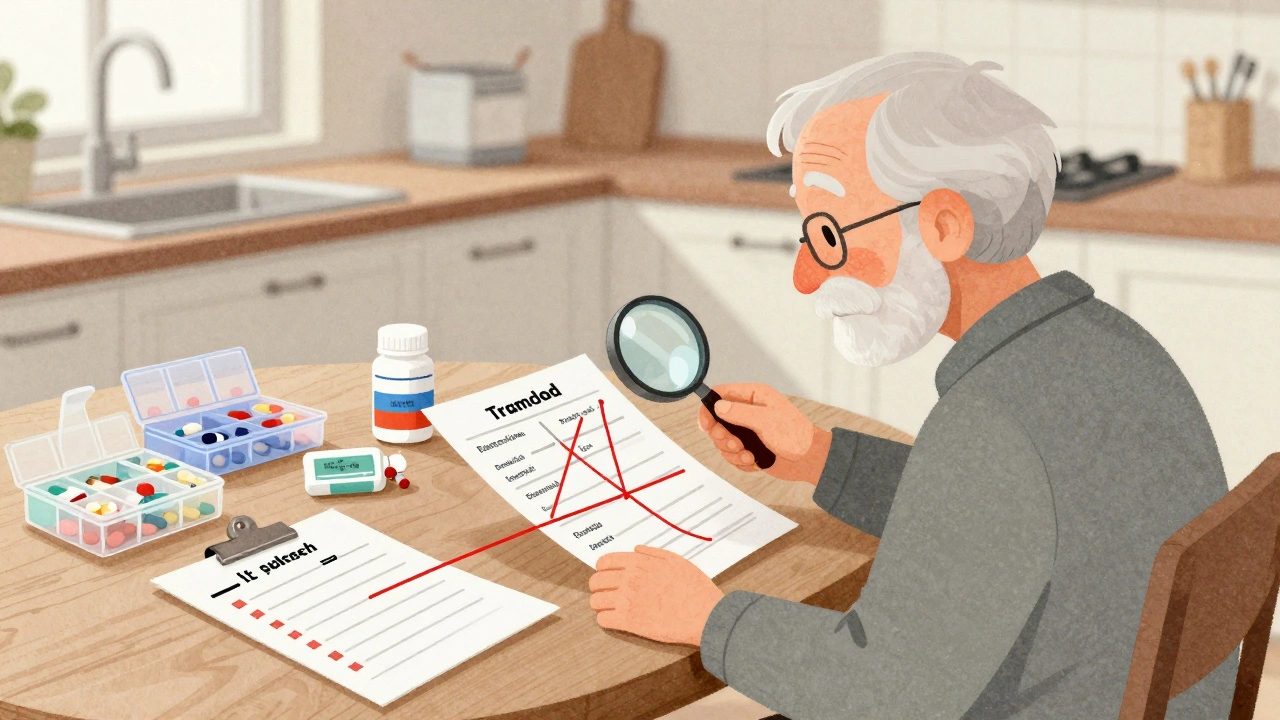
You don’t have to stop your medication. But you need to be smart.- Know your meds: Write down every pill, patch, supplement, and cough syrup you take. Include dosages and why you take them.
- Ask your pharmacist: When a new prescription comes in, ask: “Could this interact with my antidepressant?” Pharmacists are trained to spot these risks. They’re not just filling bottles-they’re safety checks.
- Watch for the 5 S’s: Shivering, Sweating, Stiffness, Seizures (rare), Sudden confusion. If you notice any of these after starting a new drug, go to the ER. Don’t wait. Don’t call your doctor tomorrow. Go now.
- Don’t self-medicate: St. John’s wort, 5-HTP, tryptophan-these aren’t “natural” in a safe way. They’re potent serotonin boosters. Mixing them with SSRIs is like pouring gasoline on a fire.
- Don’t assume your doctor knows: Most primary care doctors aren’t psychiatrists. They may not realize how risky tramadol is with sertraline. Bring your list. Ask specifically about serotonin syndrome.
What About Switching or Stopping SSRIs?
If you’re thinking of switching from one SSRI to another-or to an MAOI-you can’t just stop one and start the other. You need a washout period. For most SSRIs, that’s two weeks. But for fluoxetine? You need five weeks. That’s because its metabolite sticks around so long. Skipping this step has led to fatal cases. The American Psychiatric Association’s 2022 guidelines are clear: no shortcuts.And don’t try to “taper” by doubling up on meds. Some people think taking an extra dose of their SSRI will help them feel better faster. That’s a dangerous myth. More isn’t better. It’s risky.
How Is This Being Fixed?
The system is catching up. Electronic health records like Epic now flag high-risk combinations before a prescription is even written. Since 2022, 32% fewer SSRI-opioid combos have been prescribed in U.S. hospitals because of these alerts.The FDA is requiring stronger warnings on all SSRI labels. In 2024, they’re mandating that all e-prescribing systems include automatic serotonin syndrome alerts for dangerous combos. The European Medicines Agency is even testing a blood test called SerotoninQuant-still in trials-that could one day confirm serotonin syndrome with a simple lab result.
But until those systems are perfect, you’re your own best defense.
What If You’ve Already Taken a Risky Combo?
If you’ve taken tramadol with your SSRI once and felt fine, that doesn’t mean it’s safe. Serotonin syndrome doesn’t always happen right away. It can build up over days. And it can hit harder the second time.Don’t wait for symptoms. Talk to your doctor. Ask for a medication review. If you’re on multiple drugs, especially if you’re older, schedule a session with a pharmacist. Many insurance plans cover this. It’s free or low-cost.
And if you ever feel off-like your muscles are locking up, you’re sweating for no reason, or you’re suddenly confused-don’t rationalize it. Don’t think it’s stress. Go to the ER. Say: “I think I might have serotonin syndrome.” That phrase will get you help fast.
SSRIs save lives. But they’re not risk-free. The real danger isn’t the pill itself. It’s the hidden combinations. The quiet, unnoticed overlaps. The assumption that because something is legal or sold over the counter, it’s safe. It’s not. Knowledge is your shield. Vigilance is your sword.
joanne humphreys
It's terrifying how many people don't realize their cough syrup could be as dangerous as mixing prescription drugs. I had a friend who ended up in the ER after taking Robitussin DM with her SSRI-she thought it was just a bad cold. No one warned her.
Clare Fox
so like... if i take st. johns wort and zoloft and feel kinda wired but not panic-y is that just my personality or am i one step from a hospital?
Kay Jolie
Let’s be clear: serotonin syndrome isn’t some vague ‘side effect’-it’s a pharmacokinetic cascade triggered by monoamine overload, often exacerbated by CYP450 enzyme inhibition. The Hunter Criteria are the gold standard because they operationalize the neurophysiological triad: clonus, hyperthermia, and neuromuscular aberration. Most clinicians still miss it because they’re trained to look for fever and agitation, not subtle inducible clonus. This isn’t just about avoiding OTC meds-it’s about understanding the pharmacodynamic architecture of serotonergic systems.
Myles White
I’ve been on sertraline for six years and I’ve never had an issue, but I also never took anything else without checking with my pharmacist. I mean, think about it-most people don’t even know what a CYP2D6 substrate is, let alone that tramadol is one. And then there’s the whole thing with fluoxetine’s half-life. That metabolite, norfluoxetine, sticks around longer than most people’s relationships. I’ve seen patients on fluoxetine still have dangerous interactions weeks after stopping it because their doctor assumed it was ‘out of their system.’ It’s not just about the drug you’re taking-it’s about the ghost of the drug you took last month.
And don’t even get me started on St. John’s wort. People treat it like chamomile tea. It’s a potent MAO-A inhibitor with a half-life of 16 hours. Combine that with an SSRI? You’re not ‘boosting your mood’-you’re turning your brain into a serotonin pressure cooker. And the worst part? No one regulates it like a drug because it’s ‘natural.’ Natural doesn’t mean safe. Arsenic is natural.
Also, why is it that every time someone posts something like this, the comments section fills up with ‘I’ve been doing this for years and I’m fine!’? That’s survivorship bias. You don’t hear from the people who died. Or the ones who had seizures and spent three days in the ICU. You hear from the lucky ones. But luck isn’t a strategy.
And let’s not pretend doctors are omniscient. I’ve had three different PCPs prescribe me tramadol while I was on an SSRI. All three said, ‘It’s fine.’ One even said, ‘It’s just a little painkiller.’ No, it’s not. It’s a serotonin-releasing opioid with a side of pharmacological chaos. I had to bring the FDA’s own warning printout to the next appointment to get them to listen. It’s exhausting. But someone has to do it.
So yeah. Write down your meds. Talk to your pharmacist. Don’t assume. Don’t rationalize. And for the love of God, don’t take ‘natural’ supplements with SSRIs unless you want to end up on a Reddit thread titled ‘I took St. John’s wort and now I can’t stop shaking.’
Arjun Deva
They’re hiding the real truth-pharma doesn’t want you to know how many of these drugs are designed to create dependency. SSRIs? Fine. But combine them with anything else? Suddenly you’re a walking liability. They profit from ER visits, hospital stays, and lifelong prescriptions. Look at the stats: 1,800 cases in 4 years? That’s a conservative estimate. They’re counting only the ones that made it into the database. What about the ones that got misdiagnosed as ‘anxiety attacks’ or ‘flu’? They’re laughing all the way to the bank.
And don’t tell me about ‘electronic alerts.’ Those systems are full of holes. My cousin got flagged for a ‘possible interaction’-so they just switched her to a different SSRI. No one asked if she was taking dextromethorphan. No one asked why she was coughing. The system doesn’t care. It just moves the problem around. They want you dependent-not safe.
Chris Park
Let’s not pretend this is about safety. It’s about control. The FDA, the AMA, the pharmaceutical lobby-they all benefit from fear. They want you to believe that every supplement is a death trap, so you’ll rely on their ‘approved’ drugs. St. John’s wort has been used for centuries. If it were truly dangerous, why is it still on shelves? Why isn’t it banned? Because they can’t patent it. The real danger isn’t the herb-it’s the monopoly. They’re turning patients into obedient consumers by exaggerating risks. Wake up.
brenda olvera
i grew up in mexico and we always used herbal teas for mood-yerba buena, pasiflora. no one ever died. now i’m in the u.s. and everyone acts like taking a vitamin is a suicide pact. it’s exhausting. maybe some things are risky, but not everything. we used to trust our bodies. now we’re told to fear everything.
Billy Schimmel
lol so if i take a cough drop with dextro and my ssri and i start sweating, do i just yell ‘serotonin syndrome’ at the ER and they’ll believe me? or do i have to bring a flowchart?
Akash Takyar
It is imperative that individuals on SSRIs exercise due diligence regarding concomitant medication use. Pharmacovigilance is not a suggestion-it is a moral and clinical imperative. The data presented here is robust, and the recommendations are not merely prudent; they are life-preserving. I urge all readers to maintain a meticulously documented medication log, and to schedule regular consultations with clinical pharmacists, who are underutilized resources in modern healthcare systems. Proactive intervention, not reactive triage, must be the standard. The cost of inaction is not merely financial-it is existential.
pallavi khushwani
i took st. john’s wort with my escitalopram for like 3 days and felt amazing. then i got dizzy and my hands shook for a week. i thought it was stress. turns out it was serotonin overload. i didn’t know. no one told me. now i just take walks and drink tea. simpler.
Max Manoles
I’ve been on an SSRI for 8 years. I’ve never had a problem. But I also don’t take anything else unless I’ve triple-checked with my pharmacist. I keep a little notebook. I write down every pill, every supplement, even the OTC stuff. I show it to every new doctor. I’ve had people roll their eyes. ‘You’re being paranoid.’ But I’d rather be called paranoid than end up in the ICU because someone assumed I knew what I was doing. Knowledge isn’t paranoia. It’s survival.
And honestly? I wish more people would talk about this. It’s not sexy. No one’s making a TikTok about ‘Why Your Cough Syrup Could Kill You.’ But someone needs to. Because it’s real. And it’s quiet. And it doesn’t care if you’re ‘fine’ today.
Dan Cole
Let’s be brutally honest: serotonin syndrome isn’t a medical condition-it’s a failure of education. The public is treated like children who can’t handle the truth. We’re told to ‘avoid’ things without being taught why. We’re given lists of ‘bad’ drugs without understanding the pharmacology. That’s not safety. That’s infantilization. The real solution isn’t more warnings-it’s better science literacy. Teach people how neurotransmitters work. Teach them what reuptake inhibition means. Then let them decide. Don’t scare them. Empower them. Because fear-based compliance doesn’t save lives-understanding does.
And while we’re at it, stop treating herbal supplements like villains. St. John’s wort isn’t evil. It’s just potent. So is aspirin. So is caffeine. Context matters. The problem isn’t the substance-it’s the ignorance.
Jackie Petersen
Why are we letting foreign pharmaceutical companies dictate our health? The FDA is a puppet. They approve these drugs because of lobbying, not science. And now they’re pushing ‘alerts’ to scare us into buying more of their expensive, patented meds. This is all about profit. Don’t fall for it.
Nigel ntini
You’re not alone in feeling overwhelmed by all this. I’ve been there. But here’s the good news: you don’t need to be a pharmacologist to stay safe. Just three things: write it down, ask your pharmacist, and trust your body. If something feels off-really off-go to the ER and say exactly what you’re feeling. No jargon needed. Just: ‘I’m shaking, sweating, and confused since I started this new medicine.’ That’s enough. You’re not being dramatic. You’re being smart. And you’re not just protecting yourself-you’re helping others learn. Keep speaking up. We need more of you.