
Why Your Food Changes How Your Medicine Works
Ever taken a pill and wondered if it really worked because you ate right after? You’re not imagining it. What you eat, when you eat it, and even what’s in your meal can make your medicine stronger, weaker, or even cause side effects. This isn’t just a suggestion-it’s science. Food affects how your body absorbs drugs, and getting it wrong can mean your treatment fails-or worse, harms you.
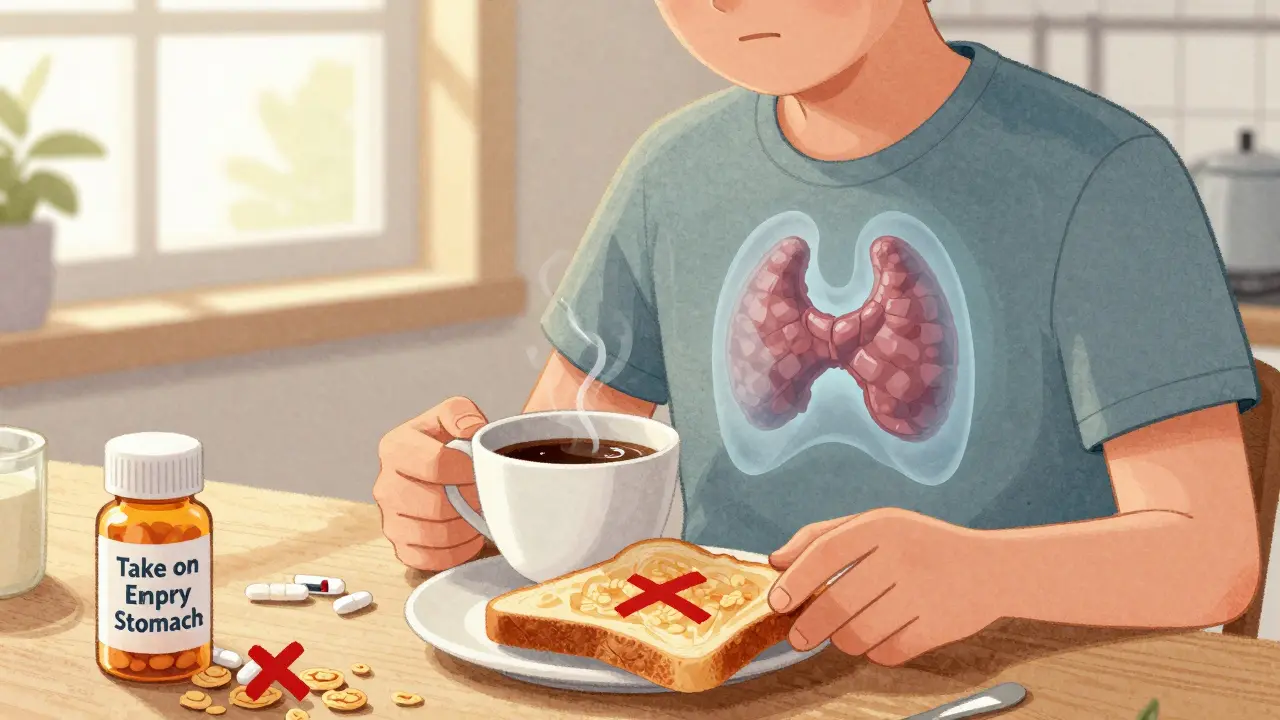
Take levothyroxine, a common thyroid medication. If you take it with your morning coffee and toast, your body might absorb 30% to 55% less of the drug. That’s not a small drop. It means your thyroid levels stay low, you feel tired, gain weight, and your doctor keeps increasing your dose, thinking it’s not working. But the real issue? You ate too soon after taking it.
On the flip side, some drugs like nitrofurantoin (used for urinary infections) actually work better when taken with food. Without it, your body absorbs 40% less. That means the infection might not clear up, and you end up back at the doctor’s office. Food isn’t just something you swallow with your pill-it’s part of the medicine’s journey.
How Food Slows Down or Speeds Up Your Pills
Your stomach doesn’t just sit there while you digest. It’s busy. When you eat, especially a meal with fat, your stomach empties slower. A high-fat meal can delay that process by 1.5 to 2 hours. That means your pill sits in your stomach longer before moving to the small intestine, where most drugs get absorbed.
That delay matters. For example, acetaminophen (Tylenol) usually hits its peak in your blood 45 minutes after you take it on an empty stomach. With a fatty meal? It takes 90 to 120 minutes. That’s not just a delay-it changes how you feel pain relief. If you’re taking it for a headache and eat a burger right after, you’ll wait longer to feel better.
But it’s not just timing. Food can change how much of the drug even gets into your bloodstream. Lipophilic drugs-those that dissolve in fat-like griseofulvin (an antifungal), absorb 200% to 300% better with a high-fat meal. Why? Fat triggers bile release, which helps these drugs dissolve and get absorbed. Take it on an empty stomach? It barely works.
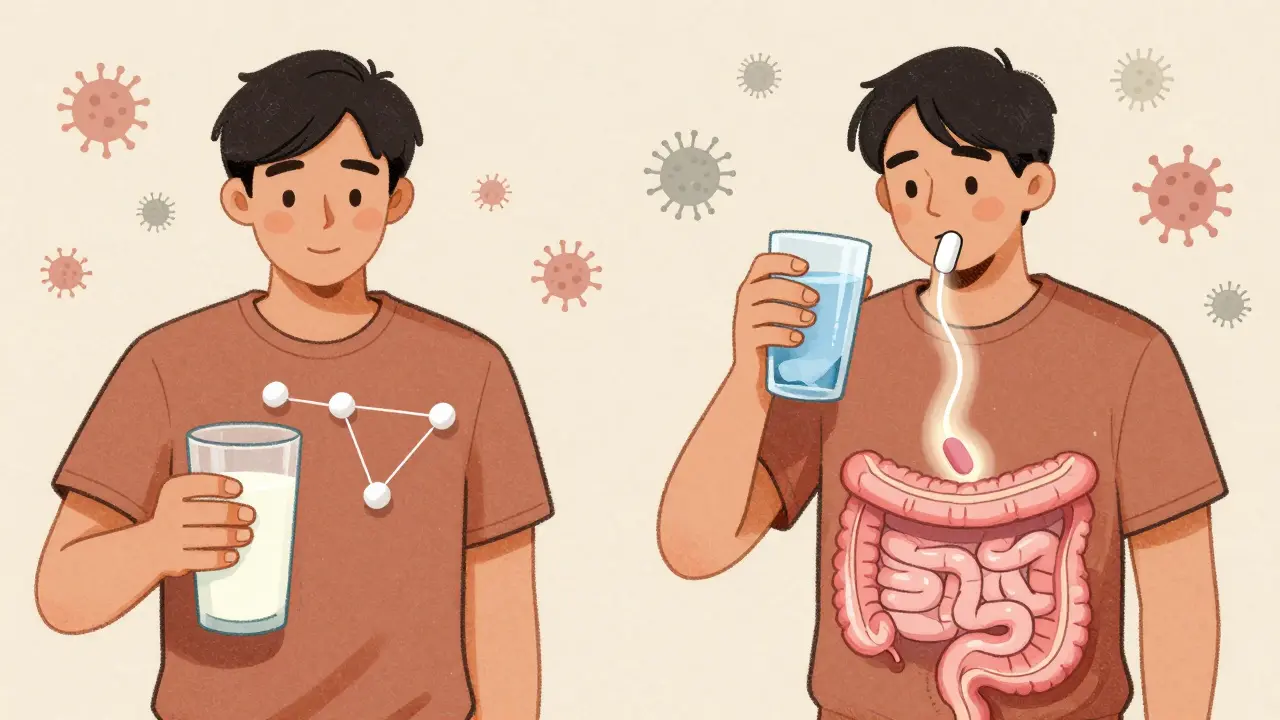
On the other hand, some drugs get blocked by food. Tetracycline antibiotics, for instance, bind to calcium in dairy products. That means if you take doxycycline with milk, yogurt, or cheese, your body absorbs 50% to 75% less. The result? An infection that won’t go away. This isn’t a myth. Reddit users have shared stories of recurring UTIs that only cleared up after they stopped taking their antibiotics with yogurt.
Empty Stomach vs. With Food: What Does It Really Mean?
Labels like “take on an empty stomach” or “take with food” sound simple. But what do they actually mean?
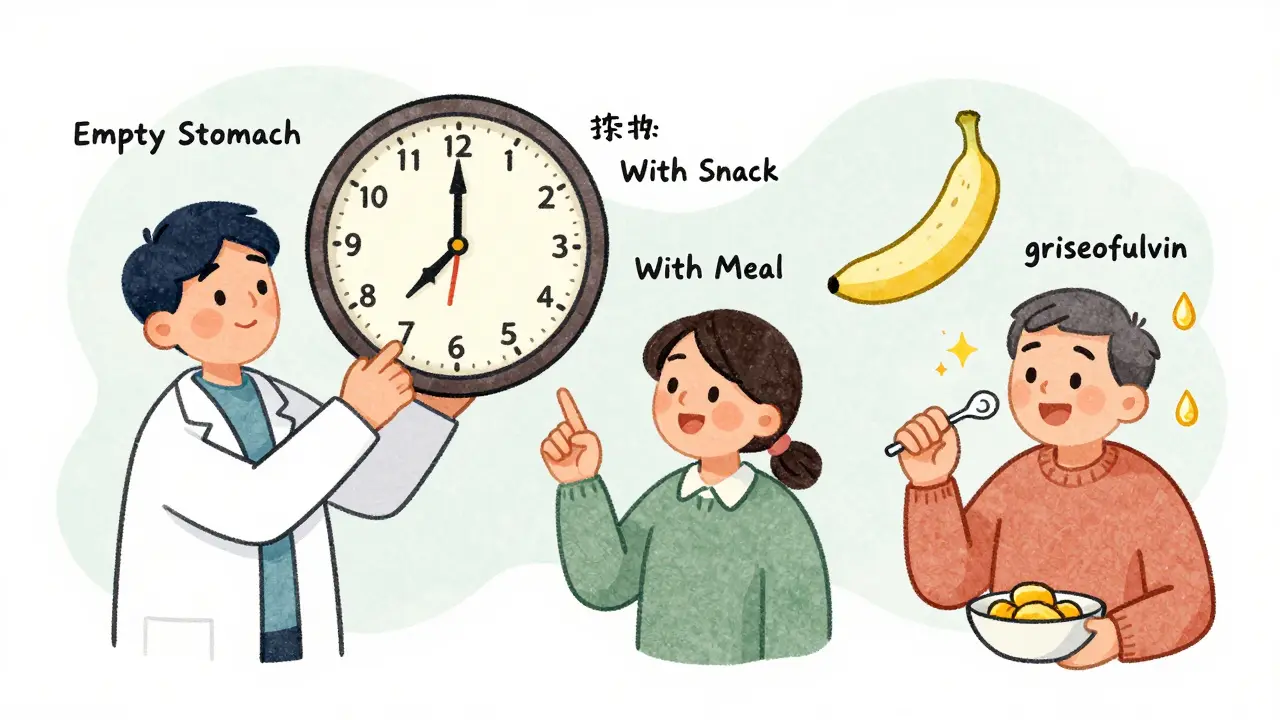
“Empty stomach” means one hour before or two hours after eating. For drugs like levothyroxine, this isn’t optional. Even a small snack or a glass of orange juice can interfere. The same goes for certain antibiotics, bisphosphonates for osteoporosis, and some HIV medications. These drugs need a clean path to your gut. Any food-even a cracker-can block absorption.
“Take with food” is trickier. It doesn’t always mean a full meal. For some medications, like certain antiretrovirals or NSAIDs like ibuprofen, a small snack of 200-300 calories is enough. That’s a banana, a handful of nuts, or a slice of toast. You don’t need a steak dinner. In fact, eating too much fat can slow absorption too much, especially for drugs like itraconazole, which need acid in the stomach to work. High-fat meals raise stomach pH, making it less acidic and reducing absorption by up to 40%.
And then there’s “take with a meal.” That means within 30 minutes of starting to eat. It’s not “right after you finish.” It’s when you’re still chewing your first bite. This matters for drugs like cefpodoxime (an antibiotic) and sulfonylureas for diabetes. Glipizide, for example, triggers insulin release. If you take it on an empty stomach, your blood sugar can crash below 70 mg/dL-dangerously low. Taking it 30 minutes before eating lets your body match insulin release with food intake.
Drugs That Need Food-And Those That Can’t Have It
Some medications simply don’t work right without food. Here’s a clear breakdown:
- Take with food: Nitrofurantoin (40% more absorption), cefpodoxime (50-60% more), griseofulvin (200-300% more), some HIV drugs like atazanavir, and NSAIDs like ibuprofen (to protect your stomach).
- Take on empty stomach: Levothyroxine (absorption drops 30-55%), tetracycline and doxycycline (blocked by calcium), bisphosphonates like alendronate (must be taken with plain water only), and the GLP-1 agonist semaglutide (absorption drops 44% if taken within 30 minutes of food).
And here’s the catch: some drugs have conflicting advice. NSAIDs are a good example. myDr.com.au says take them with food to avoid stomach upset. But the American College of Gastroenterology says enteric-coated versions (like enteric-coated aspirin) can be taken without food because they’re designed to dissolve in the intestine, not the stomach. Always check the label or ask your pharmacist.
Diabetes meds are another big one. Sulfonylureas like glipizide and glyburide must be taken 30 minutes before meals. If you forget, you risk hypoglycemia. A 2022 American Diabetes Association report found that 23% of patients who took these on an empty stomach had symptoms severe enough to need medical help.
What Happens When People Get It Wrong
People mess this up all the time. Why? Because instructions are confusing, or they’re in a rush, or they’ve been taking the same pill for years and never thought to ask.
On Drugs.com, 62% of users taking levothyroxine admit they struggle with the empty stomach rule. Many say they take it with coffee or breakfast because it’s easier. But that’s why their TSH levels stay high-they’re not getting enough medicine. One patient reported feeling exhausted for months, thinking her dose was too low. Then she started taking it 60 minutes before breakfast with water only. Within weeks, her energy came back.
Another common mistake? Taking antibiotics with yogurt. People think probiotics help. But calcium in dairy binds to tetracycline-class antibiotics. One Reddit user, u/ThyroidWarrior, shared how their UTI kept coming back. They took doxycycline with yogurt every day. Only after separating the two by two hours did the infection clear.
But it’s not all bad news. A GoodRx survey of 5,000 people found that 78% had less stomach pain when they took ibuprofen with food. For them, the advice worked. The problem isn’t the instruction-it’s the misunderstanding.
Express Scripts found that 45% of patients don’t know what “take with food” really means. Half think it means a full meal. For some drugs, that’s overkill. For others, it’s dangerous. That’s why pharmacists now use clearer language: “within 30 minutes of starting your meal” or “at least 60 minutes before your first bite.”
How to Get It Right Every Time
Here’s how to avoid mistakes:
- Read the label. Don’t assume. Check if it says “empty stomach,” “with food,” or “with a meal.”
- Ask your pharmacist. They see this every day. If the label is unclear, ask: “Should I take this before, during, or after eating?”
- Set reminders. Use your phone. If you take levothyroxine in the morning, set an alarm for 60 minutes before breakfast. If you take glipizide, set one for 30 minutes before meals.
- Be consistent. If you take your pill with food, do it every day at the same time. Inconsistency is a leading cause of treatment failure.
- Watch what you eat. Avoid dairy with tetracycline. Avoid grapefruit with statins. Avoid high-fat meals with itraconazole. Know the food traps for your meds.
Pharmacists who give specific food-timing advice see 35% higher adherence at 90 days. That’s huge. It’s not just about remembering to take the pill-it’s about taking it right.
What’s Changing in 2026
The rules are evolving. The FDA now requires food-effect testing for 92% of new drugs, up from 67% in 2015. They’re even updating their test meals to include plant-based and gluten-free options, because diets have changed.
Technology is helping too. Apps like Medisafe and MyTherapy now have food-timing reminders. Users who turn them on see 27% fewer timing errors. And new tools are coming. Ingestible sensors that track stomach pH and emptying are being tested. Imagine a pill that tells your phone when your stomach is ready-then sends a notification: “Now’s the time.”
And researchers are looking at timing beyond food. Chronopharmacology-the idea that your body’s daily rhythm affects how drugs work-is gaining ground. Some medications might work better taken at 7 a.m. versus 7 p.m., even if you eat at the same time. This could change how we think about pills in the next five years.
Right now, the biggest risk? Polypharmacy. People over 65 are taking more meds than ever. By 2030, 55% of older adults will be on five or more drugs. That’s a recipe for interactions. One wrong meal, one missed timing window, and the whole system can unravel.
Getting your medication timing right isn’t about being perfect. It’s about being aware. It’s about asking questions. It’s about knowing that your food isn’t just fuel-it’s part of your treatment plan.
Marc Bains
Look, I get that food messes with meds, but let’s stop acting like this is some groundbreaking revelation. I’ve been a pharmacist for 18 years and I’ve seen people take doxycycline with yogurt like it’s a probiotic smoothie. The science’s been clear since the 90s. The real issue? No one’s teaching this in high school. We treat meds like candy and wonder why people end up in the ER. Someone needs to make a viral TikTok about this before another grandma ruins her osteoporosis treatment with a glass of milk.
kate jones
While the post accurately outlines pharmacokinetic interactions, it’s worth noting that food effects are not monolithic. For instance, the bioavailability enhancement of griseofulvin is mediated by bile acid secretion triggered by dietary lipids-specifically long-chain fatty acids-which activate FXR receptors in the ileum. Similarly, the pH-dependent absorption of itraconazole is compromised not merely by fat content, but by the buffering capacity of meals, which elevates gastric pH beyond the optimal 1–3 range. Clinically, this necessitates individualized counseling: a banana may suffice for NSAIDs, but a full-fat meal is required for antifungals. Always verify with the FDA’s labeling or Micromedex data.
Rob Webber
So let me get this straight. You’re telling me I can’t have my coffee and toast with my thyroid med? That’s it. I’m done. I’ve been taking it with breakfast for seven years and I’m fine. If I feel tired, it’s because I’m a busy mom, not because of some stupid timing rule. This whole post feels like medical gaslighting. Next you’ll say I can’t breathe while taking my vitamins.
Beth Beltway
Wow. Another article that sounds like it was written by someone who’s never met a patient. You cite Reddit anecdotes like they’re clinical trials. One guy took doxycycline with yogurt and his UTI came back? Maybe he had a resistant strain. Maybe he didn’t finish the course. Maybe he’s just bad at following instructions. Meanwhile, you ignore that 78% of people taking ibuprofen with food report less GI distress-that’s not a myth, that’s evidence. Stop pretending every interaction is a life-or-death scenario. People aren’t lab rats.
Kimberly Reker
I used to take my levothyroxine with my coffee and bagel like a zombie on autopilot. Then I started setting a 60-min alarm before breakfast. Three weeks later, my doctor said my TSH dropped from 8.2 to 2.1. I didn’t change my dose-I just changed my timing. No magic, just science. If you’re tired all the time and your doctor keeps upping your meds, try waiting. It’s not hard. Just water. Just 60 minutes. You’ll thank yourself.
Claire Wiltshire
Thank you for this thorough and well-referenced overview. I particularly appreciate the distinction between ‘with food,’ ‘with a meal,’ and ‘on an empty stomach’-these nuances are routinely lost in patient education materials. As a healthcare provider, I now use the phrase ‘within 30 minutes of starting your meal’ instead of ‘take with food,’ which has significantly improved adherence. For patients on polypharmacy, I recommend color-coded pill organizers with food-timing stickers. Small changes, big impact.
Darren Gormley
Let’s be real-this whole ‘take with food’ thing is just Big Pharma’s way of selling you more snacks. Who even eats a ‘meal’ anymore? I take my meds with a protein bar and call it a day. And don’t even get me started on the ‘empty stomach’ nonsense. I’ve got a 3-year-old and a 9-to-5. I don’t have time to wait an hour after pooping to take my thyroid pill. The real problem? The system is broken, not the patient. 😎
Kelly Weinhold
Okay but can we just take a second to appreciate how wild it is that our food is basically a co-pilot for our medicine? Like, imagine if your car only worked if you filled it with gas at exactly 7:15 a.m. and never with the kind of gas your cousin uses. That’s what this is. And honestly? It’s kind of beautiful. We’re not just popping pills-we’re syncing with our bodies, with our meals, with our routines. It’s not about being perfect. It’s about being curious. Try the 60-minute rule for a week. You might be surprised how much better you feel. No guilt. No pressure. Just a little more awareness. You got this.