
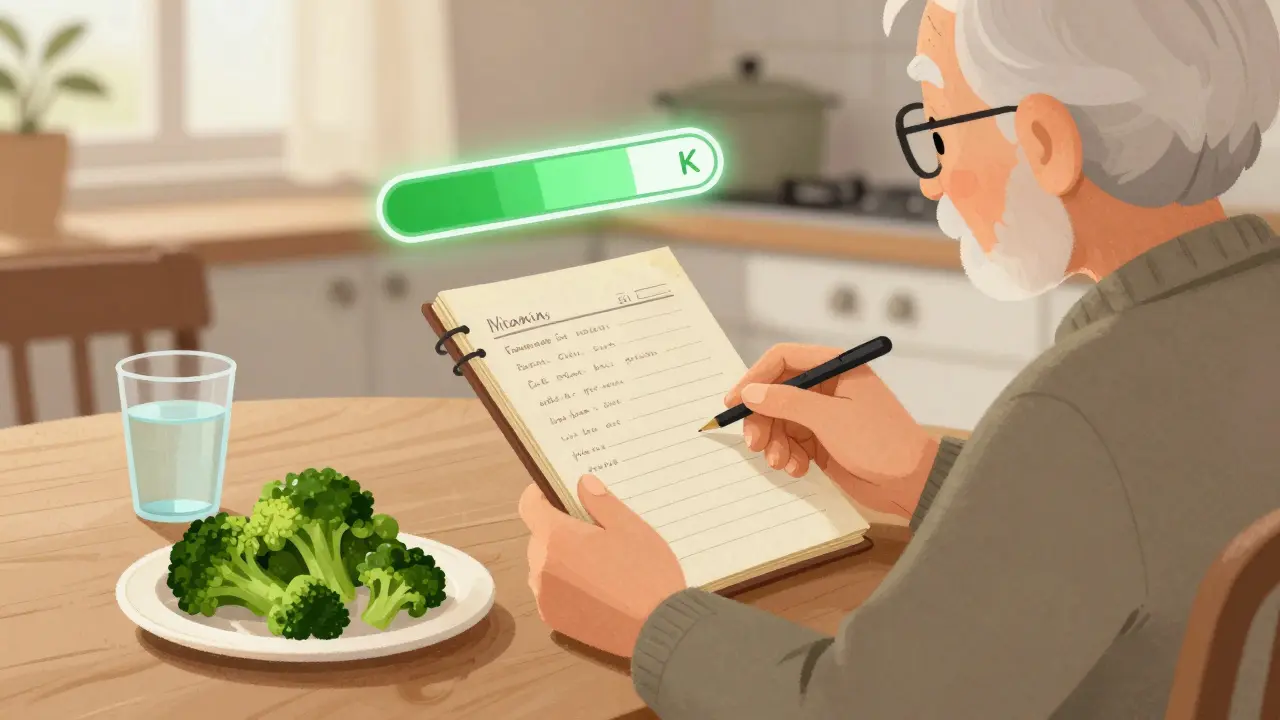
Vitamin K Intake Tracker for Warfarin Safety
Track Your Daily Vitamin K
Enter your servings of vitamin K-rich foods to see your total intake. Keep your daily intake within 20% of your usual amount for stable INR levels.
Your Vitamin K Intake
Total vitamin K: 0 mcg
Safe Caution Risky
When you're on warfarin, your body is walking a tightrope. Too much blood thinning, and you risk dangerous bleeding. Too little, and you could get a clot that leads to a stroke or heart attack. The key to staying balanced isn't just taking your pill at the same time every day-it’s what you eat. Specifically, it’s how much vitamin K you get from your food. And that’s where a food diary becomes more than a habit-it becomes a lifeline.
Why Vitamin K Matters More Than You Think
Warfarin works by blocking vitamin K’s job in your blood. Vitamin K helps make proteins that let your blood clot. Without it, you bleed longer. Warfarin slows that process down. But if you suddenly eat a big bowl of kale or spinach, you flood your system with vitamin K. That can undo warfarin’s effect. Your INR drops. Your risk of clotting goes up.On the flip side, if you go a week without greens, your vitamin K levels drop. Warfarin then works too well. Your INR spikes. You could start bruising easily or bleed for hours from a small cut.
It’s not about avoiding vitamin K. It’s about keeping it steady. The American Heart Association says adults need about 90-120 micrograms of vitamin K daily. But if you’re on warfarin, you don’t need to hit that number-you need to hit the same number every day. A change of more than 20% from your usual intake can throw your INR off. And that’s why consistency beats perfection.
What Foods Really Have Vitamin K?
Not all greens are equal. Kale, spinach, and broccoli are the big players. Here’s what you’re really dealing with:- 1 cup cooked kale: 817 mcg
- 1 cup cooked spinach: 483 mcg
- 1 cup cooked broccoli: 220 mcg
- 2 cups raw romaine lettuce: 138 mcg
- 1 serving of soybean oil (1 tbsp): 25 mcg
- 1 serving of Ensure (8 oz): 25 mcg
That’s not a typo. One cup of cooked kale has more vitamin K than your entire daily requirement. So if you normally eat a small side of broccoli and suddenly switch to a big salad with kale, you’re not just changing your diet-you’re changing your medication’s effectiveness.
And it’s not just salads. Soybean oil is in everything: salad dressings, fried foods, margarine, even some breads. Multivitamins? Many contain 25-100 mcg of vitamin K. If you take one on Monday and skip it on Tuesday, your INR will wobble.
Paper vs. Digital: Which Diary Works Better?
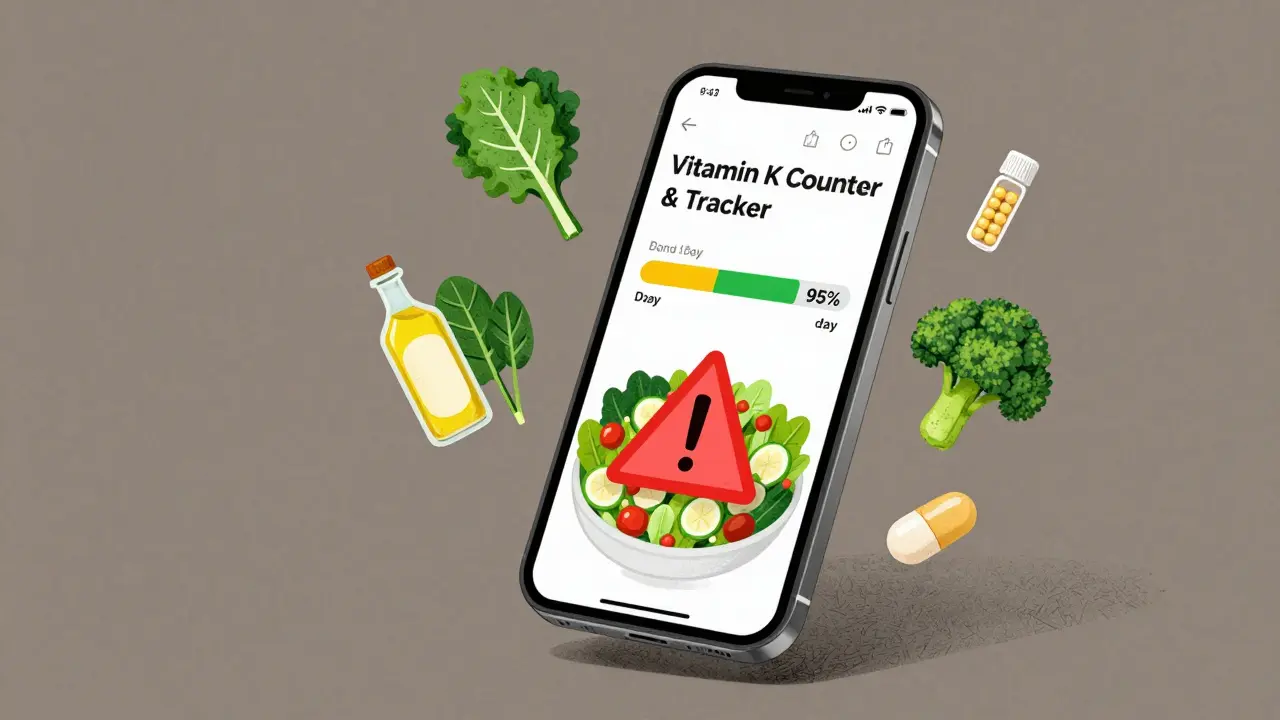
For years, people used paper logs. Write down what you ate, how much, and your INR number from your last blood test. Simple. Reliable. But messy. A 2022 study found that 43% of VA clinics still use paper-but only 57% of patients over 75 stick with it. Why? Lost pages, smudged ink, forgetting to write.Digital apps changed the game. The Vitamin K Counter & Tracker app, updated in September 2023, lets you scan barcodes or search a database of over 1,200 foods. It shows you how much vitamin K you’ve eaten so far today. You get a progress bar. You get alerts. You get peace of mind.
A 2022 clinical trial with 327 patients found those using the app stayed in their target INR range 72.3% of the time. Paper users? Only 61.8%. That’s a 10.5% difference in safety. For some, it meant fewer emergency trips and less dose tweaking.
But not all apps are equal. A 2023 review found 68% of vitamin K apps had no clinical backing. Some listed broccoli as 50 mcg when it’s actually 220. That’s dangerous. The Vitamin K-iNutrient app scored 94.7% accurate in a University of Toronto study. Most free apps? Error rates over 30%.
The Hidden Problem: Underreporting
Even the best diary won’t help if you don’t track everything. A 2020 NIH study found patients underreported vitamin K intake by 22-37%. Why? Because they didn’t know.Like that sandwich with mayo made with soybean oil. Or the soup with chicken broth that had added greens. Or the protein shake with added vitamin K. These hidden sources don’t show up on your radar unless you’re trained to look for them.
That’s why clinics now use “spot checks.” A dietitian asks you to recall everything you ate in the last 24 hours. Then they compare it to your diary. If there’s a mismatch, they help you adjust. One study showed this method improved tracking accuracy by 28%.
How to Make Your Diary Work
You don’t need to be perfect. You need to be consistent. Here’s how:- Start with your baseline. Track your food for 2 weeks without changing anything. Note your INR. That’s your normal.
- Choose 3-4 consistent meals. Pick one breakfast, one lunch, one dinner you eat every day. Keep them the same. Example: scrambled eggs with toast, turkey sandwich with mustard, baked chicken with ½ cup cooked broccoli.
- Use portion guides. A fist = 1 cup. A deck of cards = 3 oz meat. A thumb = 1 tbsp oil. Visuals cut estimation errors by 41%.
- Track multivitamins. If you take one, take it at the same time as your warfarin. Every day. No exceptions.
- Check your app or log before each meal. If you’re planning a big salad, ask: “Will this push me over my daily limit?”
Some clinics now use meal prepping. Patients plan 5 days of meals with consistent vitamin K (100-120 mcg per day). That’s how the University of Michigan cut INR swings by 15%.
What Experts Say
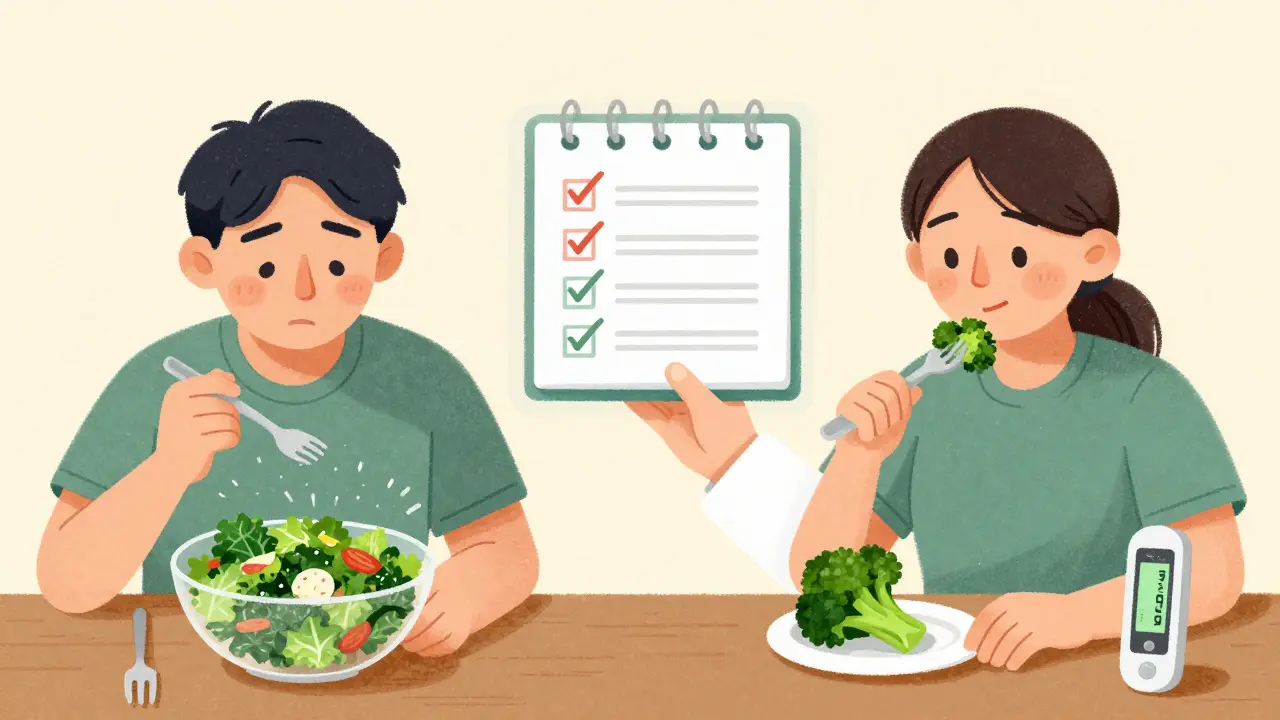
Dr. Gary Raskob, a top anticoagulation expert, puts it simply: “Don’t change your diet. Don’t start eating kale every day. Don’t quit it cold turkey. Just keep it the same.”The American Heart Association calls food tracking a Class I recommendation-meaning it’s strongly supported by evidence. Why? Because it’s one of the few things patients can control that directly affects their INR. Blood tests show you’re off. Your diary tells you why.
And it works. A 2023 review found that patients using food diaries improved their time in therapeutic range by 8.2 percentage points. For someone who used to spend half their time outside the safe zone, that’s the difference between a hospital visit and a normal life.
What’s Next?
New tech is coming. In January 2024, the FDA approved NutriKare-an AI system that takes a photo of your food and estimates vitamin K content. It’s 89% accurate. Hospitals like Epic are building food diary tracking right into patient portals. Soon, your INR prediction might update automatically based on what you ate yesterday.But for now, the best tool is still yours: a notebook, a phone app, or a printed log. It doesn’t need to be fancy. It just needs to be honest. And consistent.
Can I eat leafy greens while on warfarin?
Yes, you can-and you should. But keep it consistent. If you normally eat spinach once a week, keep doing that. Don’t suddenly eat it every day or stop completely. The goal isn’t to avoid vitamin K; it’s to avoid changes.
What if I forget to track one day?
Don’t panic. One missed day won’t ruin your INR. But if it becomes a habit, your tracking loses value. Try to track every day-even if it’s just a quick note. Consistency builds trust with your doctor and helps spot patterns over time.
Do I need to track every single food?
No. Focus on the big ones: leafy greens, cruciferous veggies, soybean oil, multivitamins, and fortified drinks like Ensure. Most other foods have little to no vitamin K. Don’t stress over rice, fruit, or chicken unless it’s cooked in a lot of oil.
Can I use MyFitnessPal or Lose It! for vitamin K tracking?
They can help, but they’re not reliable. A 2023 study found general nutrition apps were 3.2 times less accurate than specialized vitamin K trackers. MyFitnessPal might list kale as 100 mcg when it’s really 817. That’s a dangerous mistake. Use a tool built for warfarin patients.
How long should I keep using a food diary?
As long as you’re on warfarin. Even if your INR is stable for months, your body and diet can change. A new medication, a change in appetite, or even a new brand of salad dressing can throw things off. Your diary is your early warning system.
If you’ve ever had your warfarin dose changed because your INR jumped or dropped, you know how frustrating it is. It’s not your fault. It’s not your doctor’s fault. It’s often just a change in your broccoli intake. A food diary doesn’t just track what you eat-it gives you back control.
Laura Gabel
I just skip the diary. My INR is fine. Why overcomplicate life?
Nicole Blain
I use the Vitamin K Counter app and it's been a game changer 🙌 No more guessing. I even track my soy sauce now. Crazy, right?
Srividhya Srinivasan
They say 'consistency'-but who controls the food industry? Who puts vitamin K in EVERYTHING? Soybean oil in bread? Multivitamins with hidden K? This is a pharmaceutical scam to keep us dependent on apps and blood tests. They don't want you to be free!
Gaurav Kumar
I find it amusing how Americans treat vitamin K like it's rocket science. In India, we've been eating consistent greens for centuries-no app needed. Just eat your spinach, don't flip-flop, and stop overthinking. Simple. Elegant. Efficient.
Prathamesh Ghodke
I used to think this was overkill-until I had a near-clot last year. Now I track everything. Even the damn salad dressing. It’s not about being perfect. It’s about not ending up in the ER. Trust me, it’s worth it.
Kal Lambert
The 10.5% difference between app users and paper users? That’s not just data. That’s fewer strokes. Fewer hospital visits. More time with family. This isn’t just health advice-it’s life preservation.
Melissa Starks
I’ve been on warfarin for 7 years. I started with paper. Then I tried 5 different apps. Most were garbage. One gave me kale as 100 mcg instead of 800. I almost had a bleed. Now I use a notebook, a ruler for portions, and I pray every night. I don’t trust tech. I trust my hands. And my doctor. That’s it.
Lauren Volpi
So let me get this straight-we’re supposed to be scientists now? Track every leaf? Scan every bar code? What’s next? QR codes on our toothpaste? This is how capitalism turns medical care into a productivity hack. I’m not a data point.
Stephen Habegger
This post changed my life. I used to eat kale every other day. Now I stick to broccoli. My INR hasn’t budged in 6 months. Small changes. Big results.
Justin Archuletta
I track EVERYTHING. Even the damn peanut butter. And guess what? My doctor said I’m the most consistent patient she’s ever had. I feel like a superhero. No capes. Just a phone app and a steady diet.
Ayan Khan
In my culture, food is not just fuel-it’s memory, love, family. But I understand the science. So I made peace: I eat my mother’s spinach curry every Sunday. Same day. Same amount. It’s my anchor. Not a log. Not an app. A ritual.
Kathy Underhill
The real issue isn't the diary. It's the assumption that patients can manage complex biochemistry alone. The system should adapt to us-not the other way around. But until then, yes, consistency matters. And yes, the diary helps. Not because it's perfect. But because it's honest.
Linda Olsson
They say 'the FDA approved NutriKare'. But who owns it? Who funded the study? Who gets paid when you buy the app? I’ve seen this movie before. They turn your health into a subscription. Don’t be fooled. Your body doesn’t need an algorithm. It needs a doctor who listens.