
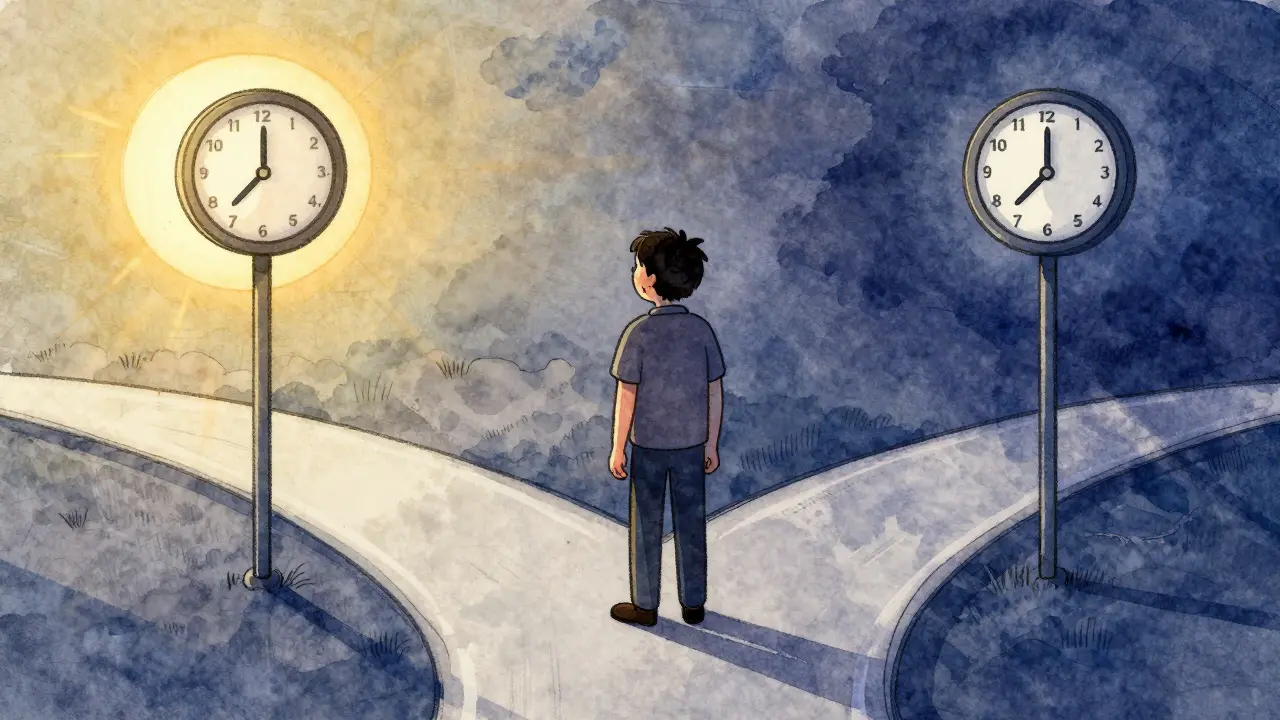
Most people think sleep problems are just about being tired. But what if your body is stuck in the wrong time zone-even when you haven’t flown anywhere? That’s the reality for millions living with circadian rhythm disorders. Two of the most common are jet lag and delayed sleep-wake phase disorder (DSWPD). One is temporary, caused by travel. The other is a long-term biological mismatch that can wreck your school, job, and mental health. Neither is just ‘being a night owl.’ They’re real, measurable, and treatable.
What Exactly Is a Circadian Rhythm?
Your body runs on a 24-hour internal clock. It’s not just about when you feel sleepy. This clock controls your body temperature, hormone levels, digestion, and even how alert you are during the day. The master switch is a tiny cluster of cells in your brain called the suprachiasmatic nucleus. It responds mostly to light-especially morning sunlight-and tells your body when to wake up, when to make melatonin, and when to wind down. When this clock gets out of sync with the outside world, you get a circadian rhythm disorder. Two of the most frequent types are jet lag and delayed sleep-wake phase disorder. They look similar: you’re sleepy when you shouldn’t be, awake when you should be sleeping. But their causes and fixes are totally different.Jet Lag: When You Cross Time Zones
Jet lag hits after you fly across two or more time zones. It’s not about being tired from the flight. It’s about your internal clock still thinking it’s 3 a.m. in Dublin, while your watch says 9 a.m. in New York. The worse the jet lag, the more time zones you crossed-and especially if you flew east. Why is east harder? Because your body naturally wants to delay sleep (stay up later), not advance it (go to bed earlier). Crossing five time zones east means your body needs to shift its rhythm by about 7.5 hours. But it can only adjust about one hour per day. That’s why it takes nearly a week to recover. Westward travel is easier-you’re essentially extending your day, which your body does more naturally. Symptoms? Excessive daytime sleepiness, trouble concentrating, stomach upset, and even mood swings. Studies show cognitive performance drops by 20-30% during peak jet lag. Business travelers report 68% lower productivity for three or more days after long-haul flights. And yes, many turn to sleeping pills. But those don’t fix the clock-they just mask the symptoms.Delayed Sleep Phase Disorder: Not a Choice, But a Biology
Now imagine never traveling. You still can’t fall asleep until 4 a.m. You sleep until noon. You feel fine-until you have to be at work at 9 a.m. That’s delayed sleep-wake phase disorder (DSWPD). It’s not laziness. It’s not bad habits. It’s a genetic shift in your internal clock. Research shows 7-16% of teens and young adults have DSWPD. Their melatonin-the sleep hormone-starts rising around 2 a.m., two hours later than most people. Their body is wired to sleep late. When they force themselves to wake up early for school or work, they’re chronically sleep-deprived. A 22-year-old student on Reddit said, “I failed three 8 a.m. classes even with accommodations.” A software developer wrote, “I’m most productive at 2 a.m., but I’m forced to work 9-5. I’m exhausted all the time.” Unlike jet lag, DSWPD doesn’t go away after a few days. It lasts for months, even years. The ICSD-3 diagnostic criteria require this pattern to last at least three months. And the problem isn’t sleep quality-it’s sleep timing. When they follow their own schedule, they sleep just fine. It’s only when society demands early hours that everything breaks down.
Jet Lag vs. DSWPD: Key Differences
| Feature | Jet Lag | Delayed Sleep Phase Disorder (DSWPD) |
|---|---|---|
| Duration | Days to a week | Months to years |
| Trigger | Traveling across time zones | Genetic predisposition, often starts in adolescence |
| Best Time to Sleep | Normal for location, but delayed temporarily | 3 a.m. to 6 a.m. (stable pattern) |
| Daytime Function | Severely impaired during adjustment | Normal if on own schedule; impaired when forced early |
| Recovery | 1-1.5 days per time zone crossed | Requires active treatment; doesn’t resolve on its own |
How to Fix Jet Lag (Without Pills)
You can’t stop flying, but you can outsmart your clock. The key is light exposure and timing. When traveling east: Seek bright light in the morning after arrival. Avoid bright light in the evening. Start adjusting your schedule 3-5 days before departure. Go to bed 1 hour earlier each night. Use a light therapy lamp if needed. When traveling west: Seek light in the evening. Avoid morning light. Let yourself sleep in. Your body will catch up faster. The “rule of 15” helps: 15 minutes of bright light (natural or artificial) per day, timed to the direction you’re heading. If you’re flying from Dublin to Tokyo (8 hours ahead), you’ll need about 8 days to fully adjust. Don’t try to force it. Let your body shift gradually.Treating Delayed Sleep Phase Disorder: The Proven Plan
DSWPD won’t vanish if you just “try harder.” You need a structured plan backed by science. 1. Morning Bright Light Therapy - Use a 10,000-lux light box for 30-60 minutes within an hour of waking. This tells your brain: “It’s time to reset.” Do this every day, even weekends. Studies show this alone can shift your sleep time forward by 2-3 hours over four weeks. 2. Evening Melatonin - Take 0.5 mg (not 3 mg!) about 5-7 hours before your target bedtime. Melatonin isn’t a sleeping pill. It’s a timing signal. Too much (like the 3.2 mg most people take) makes your body ignore it. The right dose helps nudge your clock earlier. 3. Strict Sleep Schedule - This is the hardest part. No sleeping in on weekends. Even if you’re exhausted, wake up at the same time. Your body needs consistency to relearn the rhythm. A 2020 study found adherence jumped from 58% in week one to 89% by week six. The first month is brutal. After that, it gets easier. Combine all three, and you’ll see a 2.1-hour phase advance on average. That’s the difference between sleeping at 4 a.m. and 1:30 a.m. It’s life-changing.
Why This Matters Beyond Sleep
Ignoring circadian rhythm disorders isn’t harmless. Long-term misalignment increases your risk of serious health problems. The UK Biobank study found people with untreated circadian disorders had a 29% higher risk of type 2 diabetes and a 23% higher risk of heart disease. Why? Your liver, pancreas, and metabolism run on the same clock. When your sleep schedule is chaotic, your body can’t regulate blood sugar or inflammation properly. Night shift workers get 4 hours less sleep than day workers. That’s not just fatigue-it’s metabolic stress. And mental health? Depression and anxiety are far more common in people with DSWPD. One teen on HealthUnlocked said they took modafinil for months to stay awake in class-only to develop worse insomnia. That’s a vicious cycle. Medication misuse happens in 22% of untreated cases.What’s Changing in 2025
The field is evolving fast. The new ICSD-4 (released in 2023) now requires objective proof-like measuring dim light melatonin onset (DLMO)-to diagnose DSWPD. No more guesswork. Apps like Timeshifter use algorithms to create personalized light and sleep schedules for jet lag. A 2023 trial showed users recovered 63% faster than those using old advice. Corporate wellness programs are catching on. Two-thirds of Fortune 500 companies now offer shift scheduling tools. Universities are starting to offer later class times for students with DSWPD. But the biggest shift? Circadian health is becoming part of routine medicine. By 2027, nearly half of family doctors in Europe are expected to screen for sleep timing issues. This isn’t just about sleep anymore-it’s about long-term health.What to Do If You Think You Have One
If you’ve struggled with sleep timing for months, and it’s affecting your life, don’t wait. Track your sleep for two weeks. Note when you fall asleep, wake up, and how you feel. Use a free app or even a notebook. If you’re constantly tired during the day but sleep fine at night, you might have DSWPD. If you feel awful after flying and take days to recover, you’ve got jet lag. Start with light: Get sunlight within 30 minutes of waking. Avoid screens an hour before bed. Cut caffeine after 2 p.m. If that doesn’t help, talk to a sleep specialist. Ask about light therapy and melatonin dosing. Don’t settle for sleeping pills. They don’t fix the clock. Your body isn’t broken. It’s just out of sync. And with the right tools, you can bring it back.Is jet lag worse when flying east or west?
Jet lag is worse when flying east because your body has to shift its internal clock earlier, which is harder than delaying it. Eastward travel requires advancing your sleep cycle, and your natural circadian rhythm prefers to delay (stay up later). Each time zone crossed eastward creates about 1.5 hours of misalignment, compared to 1 hour westward. That’s why crossing five time zones east can take up to seven days to recover, while the same trip west may only take three to four days.
Can you outgrow delayed sleep phase disorder?
Some people do, especially as they get older. DSWPD often starts in adolescence and can improve in the late 20s or early 30s. But for many, it persists into adulthood. It’s not something you simply “grow out of” without intervention. Without treatment, the pattern often continues. The key is whether you adapt your life around it-or actively treat it with light therapy, melatonin, and schedule consistency.
Is melatonin a sleeping pill for DSWPD?
No. Melatonin is not a sleeping pill. It’s a hormone that signals your body it’s time to prepare for sleep. For DSWPD, taking 0.5 mg of melatonin 5-7 hours before your target bedtime helps shift your internal clock earlier. Most people take too much-often 3 mg or more-which makes your body ignore it. The low dose works like a timer, not a sedative. It’s the timing that matters, not the amount.
Why can’t I just sleep in on weekends to catch up?
Sleeping in on weekends resets your clock back to where you started. If you go to bed at 4 a.m. Monday through Friday, then sleep until noon on Saturday, your body learns that 4 a.m. is still your bedtime. When Monday rolls around, you’re back to feeling exhausted. Consistency is the only way to retrain your circadian rhythm. Even on weekends, waking up at the same time helps your body stabilize.
Can light therapy help with jet lag?
Yes, light therapy is one of the most effective tools for jet lag. If you’re flying east, use bright light in the morning at your destination to advance your clock. If you’re flying west, use light in the evening to delay it. Light exposure is your fastest way to reset your internal clock. A 10,000-lux light box for 30-60 minutes works as well as natural sunlight. The key is timing: get it right, and you cut recovery time in half.
Is DSWPD the same as insomnia?
No. Insomnia is trouble falling or staying asleep, even when you want to sleep. DSWPD is when you can’t fall asleep until much later than desired-but once you do, you sleep well. People with DSWPD often sleep 7-9 hours if they follow their natural schedule. The problem isn’t sleep quality-it’s sleep timing. They’re not broken sleepers; they’re just on the wrong schedule for the world around them.
Do I need a sleep study to diagnose DSWPD?
Not always, but it helps. A doctor can diagnose DSWPD based on your sleep diary and symptoms lasting three months or more. But for a definitive diagnosis, especially if you’re seeking treatment, measuring your dim light melatonin onset (DLMO) is the gold standard. This test shows exactly when your body starts releasing melatonin. If it’s two or more hours later than normal, it confirms DSWPD. Many clinics now offer at-home saliva tests for this.
Nancy Kou
Finally someone explains this without calling us lazy. I’ve been sleeping at 5 a.m. since I was 16 and forced into 8 a.m. classes. I’m not broken. My body just runs on a different clock. Light therapy changed everything.
Hussien SLeiman
Let me be clear-this whole ‘circadian rhythm’ thing is just modern society’s way of pathologizing natural human variation. Your body isn’t ‘out of sync’-it’s perfectly synchronized to its own environment. The problem isn’t you, it’s the 9-to-5 tyranny that demands conformity from biological outliers. We’ve been conditioned to believe that waking at dawn is ‘healthy,’ but that’s a cultural myth dressed in scientific jargon. Your melatonin rhythm isn’t a bug-it’s a feature. And no, light boxes won’t fix the systemic oppression of sleep diversity.
anthony funes gomez
It’s not merely a phase delay-it’s a neuroendocrine desynchronization event, wherein the suprachiasmatic nucleus fails to entrain to zeitgebers-specifically photic cues-resulting in a phase-shifted circadian oscillation. Melatonin’s role as a chronobiotic is well-documented, but dosing is critical: supra-physiological concentrations induce receptor downregulation, rendering the signal ineffective. Hence, 0.5mg at 5–7h pre-target bedtime is the only evidence-based protocol. Anything else is placebo-driven pseudoscience.
Chris Clark
As a software dev who works 2am–10am, I can confirm: my brain works best when everyone else is asleep. I used to force myself into 9–5 and crashed hard. Now I negotiate remote hours. Companies need to stop treating night people like they’re defective. It’s not laziness-it’s neurodiversity. Also, no caffeine after 2pm? Bro, I’m already a zombie by 3pm.
Dorine Anthony
My sister has DSWPD and she’s been on light therapy for 6 months. She’s not cured-but she’s functional. Waking up at 8am still kills her, but now she can get through meetings without crying. It’s not about being ‘fixed.’ It’s about finding a way to exist in a world that doesn’t understand you. Small wins matter.
William Storrs
You got this. Seriously. I used to think I was just lazy until I learned about DLMO testing. Started with 15 minutes of morning light and a 0.5mg melatonin. First week was hell. Second week? Better. Month two? I slept at midnight instead of 4am. It’s not magic-it’s biology. And you deserve to feel like yourself again.
James Stearns
It is imperative to underscore that the conflation of circadian misalignment with mere ‘night owl’ preference constitutes a dangerous oversimplification, bordering on epistemological negligence. The medical literature, particularly the ICSD-4 criteria, mandates objective chronobiological validation-namely, dim light melatonin onset quantification-before any clinical intervention may be deemed legitimate. To suggest otherwise is to risk therapeutic malpractice.
Nina Stacey
i just wanna say thank you for writing this. i didnt know i had dswpd until last year when i started tracking my sleep and realized i was always asleep at 5am and awake at 2pm even on weekends. i thought i was just weird. turns out i just need to live by my body not the clock. still working on the weekend thing but im proud of myself for trying
Kevin Motta Top
Jet lag is worse east because your body hates shortening the day. West? You get extra hours. Easy. East? You’re fighting biology. Light therapy works. Don’t overthink it. Just get sunlight when you land.
James Stearns
It is worth noting that the notion of ‘sleeping in on weekends’ as a viable strategy for circadian adjustment is not only empirically unsound, but actively countertherapeutic. Such behavior reinforces phase delay through temporal inconsistency, thereby perpetuating the very pathology one seeks to correct. Chronobiological entrainment requires temporal rigidity-no exceptions. Even on Sundays.