
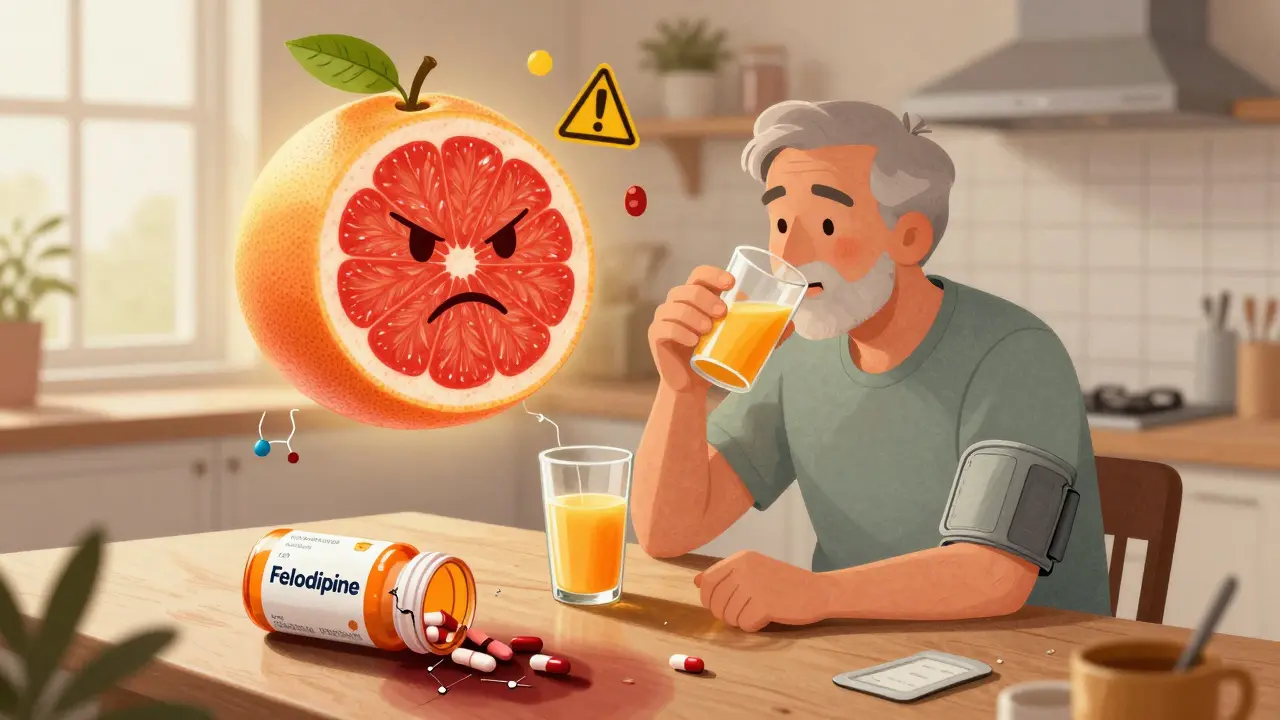
Every morning, millions of people take their blood pressure pills with a glass of orange juice. It feels harmless-natural, even. But if you're on a calcium channel blocker, that glass could be doing more harm than good. The interaction between certain citrus fruits and these common heart medications isn't just a footnote in a medical textbook. It's a silent, potentially dangerous combo that catches even doctors off guard.
Why Grapefruit Is the Problem, Not All Citrus
Not all citrus fruits are created equal when it comes to drug interactions. Grapefruit is the real culprit. It contains chemicals called furanocoumarins, specifically 6',7'-dihydroxybergamottin and bergamottin. These compounds shut down an enzyme in your gut called CYP3A4, which normally breaks down certain medications before they enter your bloodstream. When that enzyme is blocked, your body absorbs way more of the drug than it should.
Other citrus fruits like sweet oranges, tangerines, and lemons don’t have enough of these compounds to cause trouble. But Seville oranges (used in marmalade) and tangelos do. They’re close relatives of grapefruit and carry the same risk. If you’re on a calcium channel blocker, skip those too.
Which Calcium Channel Blockers Are Most Affected?
Not all calcium channel blockers react the same way. The interaction is strongest with the dihydropyridine group-especially felodipine. Studies show grapefruit juice can boost felodipine levels by 3 to 5 times. That means a 10 mg dose could act like 30 or 50 mg. Imagine taking five pills when you only meant to take one.
Other high-risk CCBs include:
- Nicardipine
- Nimodipine
- Pranidipine
Amlodipine (Norvasc) is often thought to be safer-but it’s not risk-free. Research shows it still has a measurable interaction, though less dramatic. If you’re on amlodipine, you can’t assume you’re in the clear.
Verapamil and nifedipine? The risk is lower. But doctors still advise caution. The bottom line: if your medication is a calcium channel blocker, assume grapefruit is off-limits unless your doctor says otherwise.
How Long Does the Effect Last?
Here’s where most people get it wrong. You don’t have to take grapefruit and your pill at the same time. The enzyme shutdown isn’t temporary. Furanocoumarins don’t just slow down CYP3A4-they permanently disable it. Your gut cells have to regenerate the enzyme, and that takes time.
One 200ml glass of grapefruit juice (about 1 cup) can block CYP3A4 for up to 72 hours. That means if you drink grapefruit juice on Monday morning, and take your blood pressure pill Tuesday night, you’re still at risk. By day four, a 60 mg dose of a CCB might as well be 140 mg. That’s not a typo. That’s a medical emergency waiting to happen.
Dr. Amelie Hollier, a nurse practitioner who’s studied this extensively, put it bluntly: "An elderly lady won’t be able to stand at this dose." The body doesn’t handle sudden, massive spikes in blood pressure meds well. The result? Dizziness, fainting, dangerously low blood pressure, swollen ankles, or even a heart rhythm gone wrong.
What Happens When You Mix Them?
The effects aren’t subtle. When grapefruit juice floods your system with too much calcium channel blocker, your blood vessels relax too much. Your blood pressure drops faster and harder than intended. Symptoms include:
- Sudden dizziness or lightheadedness
- Feeling like you might pass out
- Swelling in the legs or ankles
- Flushing or warm skin
- Rapid or irregular heartbeat
- Severe fatigue
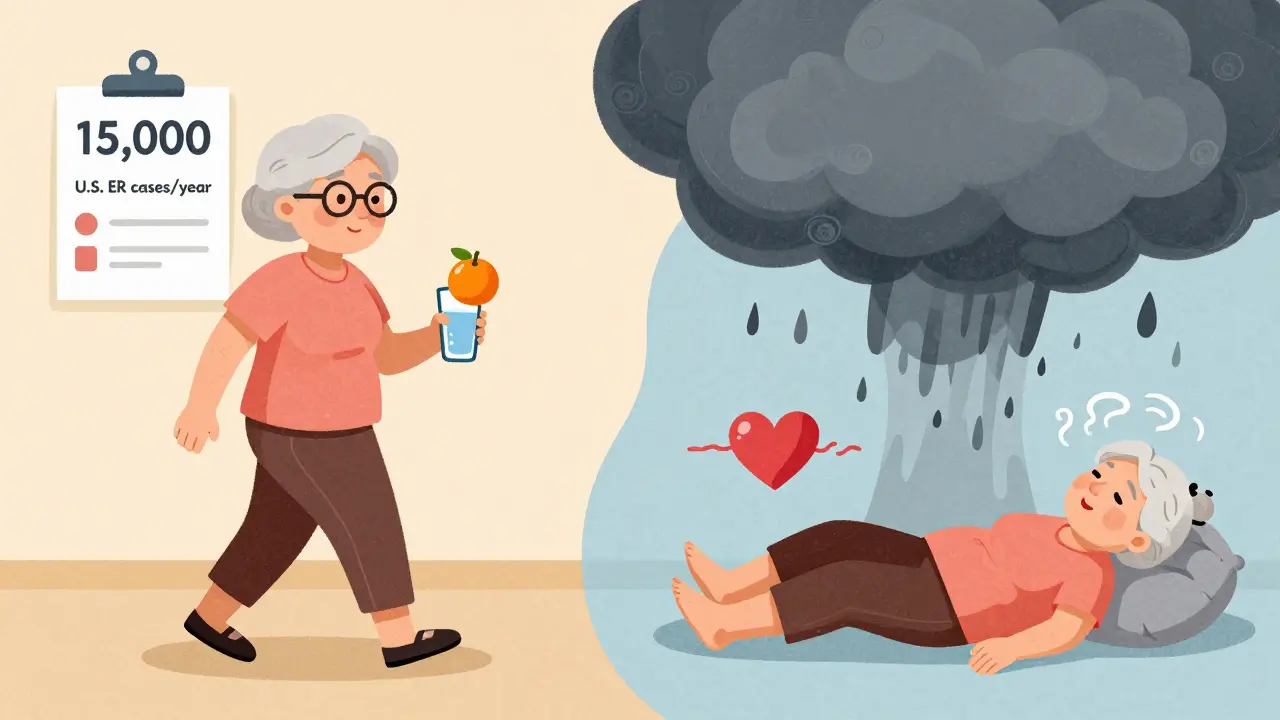
In older adults, these symptoms can lead to falls. In people with heart conditions, it can trigger chest pain or arrhythmias. Emergency rooms see about 15,000 cases per year in the U.S. alone linked to grapefruit and blood pressure meds. That’s not rare. That’s routine.
Why Do Doctors Often Miss This?
It’s shocking, but true: only 37% of primary care doctors routinely ask patients about grapefruit consumption when prescribing calcium channel blockers. A 2022 survey by the American Society of Health-System Pharmacists found that 68% of patients had no idea this interaction existed.
Part of the problem? The warning labels on pills don’t always scream "GRAPEFRUIT DANGEROUS." Some package inserts mention it in tiny print. Others don’t mention it at all. Patients assume, "If it were dangerous, my doctor would’ve told me." But many doctors don’t know either.
Dr. David Bailey, who first discovered this interaction in the 1980s, says: "The greatest hazards come from consuming grapefruit repeatedly during the day." People think one glass is harmless. They don’t realize that daily consumption-every morning, every week, every year-builds up the risk. It’s not about occasional mistakes. It’s about habit.
What Can You Do Instead?
If you love citrus, you don’t have to give up flavor entirely. Here’s what’s safe:
- Sweet oranges (navel, Valencia)
- Tangerines
- Lemons and limes (in normal food amounts)
- Orange marmalade made from sweet oranges (not Seville)
Still, if you’re unsure, skip citrus juice altogether. Water, herbal tea, or plain milk are safer choices with your pill.
If you need to switch medications, talk to your doctor about alternatives that don’t interact with grapefruit:
- Lisinopril (ACE inhibitor)
- Valsartan (ARB)
- Hydrochlorothiazide (diuretic)
- Metoprolol (beta blocker)
These classes of drugs have no known interaction with citrus fruits. Switching isn’t always easy-but it’s safer than guessing.
What’s Changing in the Future?
Researchers are working on solutions. Two new extended-release versions of amlodipine are in Phase III trials (ClinicalTrials.gov: NCT04567890 and NCT04567891). Early results show a 70% reduction in grapefruit interaction. That’s promising. But these aren’t on the market yet. Don’t wait for them.
Until then, the advice hasn’t changed: if you’re on a calcium channel blocker, avoid grapefruit and its close relatives. No exceptions. No "just a little." No "I’ve been doing it for years." Your body doesn’t build up a tolerance. The enzyme keeps getting knocked out. Every time.
Final Advice: Talk to Your Pharmacist
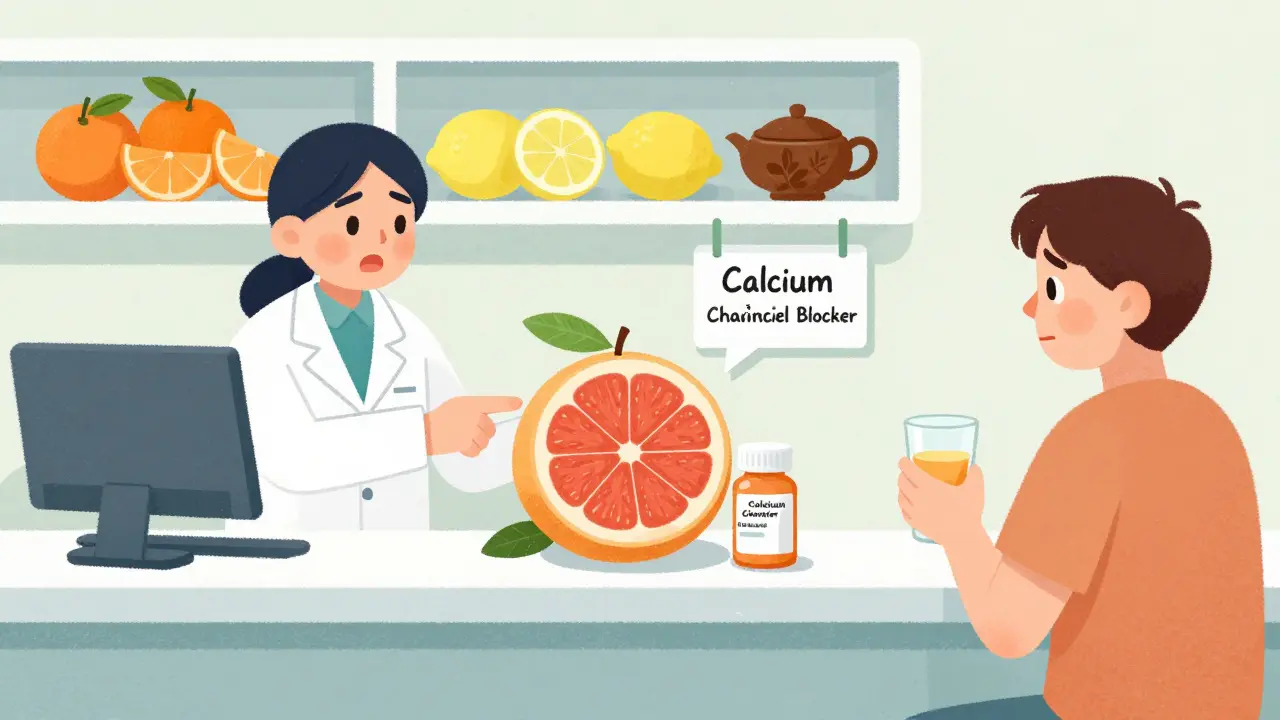
Pharmacists are trained to catch these interactions. They see your full medication list. They know what’s in your prescriptions. When you pick up a new blood pressure pill, ask: "Does this interact with grapefruit?" Don’t wait for them to ask you. Most won’t.
Keep a list of your medications. Bring it to every appointment. If you’ve been drinking grapefruit juice for years and just found out it might be dangerous-you’re not alone. But now you know. And knowledge like this? It can save your life.
Cory L
I used to drink grapefruit juice with my pills every morning like it was some kind of health ritual. Then I read this and nearly choked on my own arrogance. Turned out I was on felodipine. One week after switching to orange juice? My dizziness stopped. My legs stopped swelling. I didn't even know I was in danger until I stopped doing the thing that was slowly killing me. Don't be me.
Bhaskar Anand
This is why India is better off we dont even have grapefruit here in most places and if we do its not in juice form people here drink tea with medicine or water why do Americans make everything so complicated
William James
I've been telling my patients for years that grapefruit isn't just a fruit-it's a silent saboteur. But nobody listens until they're lying in an ER with a BP of 70/40 and a bottle of juice in their bag. We treat medicine like it's a grocery list. It's not. It's a living system. And we're the ones who keep throwing wrenches into it. Maybe next time, we listen before we learn the hard way.
David McKie
This is the kind of thing that makes me want to scream into the void. People treat their prescriptions like they're cereal. "Oh, I'll just have my juice with it." And then they wonder why they passed out in the shower. The healthcare system is a joke. Doctors don't warn you. Pharmacists are too busy. And you? You're just another statistic waiting to happen. Wake up. Before it's too late.
Southern Indiana Paleontology Institute
i heard about this from my cousin who works at a hospital. he said 3 of his patients almost died last year from grapefruit. one was 72 and thought "it's just orange juice". it's not. it's poison. stop being dumb. water. always water.
Anil bhardwaj
I used to drink grapefruit juice every day with my pills. Never thought twice. Then I started feeling weird-like I was always about to pass out. I switched to plain water. Everything went back to normal. I wish someone had told me sooner. Simple things save lives.
lela izzani
I’m a pharmacist, and I can’t tell you how many times I’ve had to pull someone aside at the counter because they didn’t know. The warning labels are buried. The doctors assume someone else told you. And patients? They trust the system. But the system isn’t perfect. Ask. Always ask. Even if it feels awkward. Even if they roll their eyes. You’re not being difficult-you’re being smart.
Joanna Reyes
I’ve been on amlodipine for five years and always drank orange juice with it because I thought it was safe. Then I read this article and dug into the studies. Turns out, even amlodipine has a measurable interaction-just less dramatic. So now I don’t drink anything with my meds except water. I don’t want to risk it. Not for taste. Not for habit. Not for convenience. My body isn’t a lab experiment. And neither is yours.
John Smith
So you're telling me the entire American healthcare system can't handle a single fruit? How quaint. I suppose next you'll tell me oxygen is dangerous if you're on nitroglycerin.
Shalini Gautam
My mom took nifedipine for 12 years and drank grapefruit juice every morning. She never had a problem. So maybe not everyone reacts the same? I get the risk, but blanket statements scare me. I think we need more personalized data-not fear.