

When a new drug hits the market, everyone celebrates - patients get new treatment options, doctors have more tools, and companies see returns on years of research. But what happens after the clinical trials end? That’s when the real safety work begins. The risks you saw in trials - the nausea, the dizziness, the mild rash - are often just the tip of the iceberg. The real dangers? They hide in plain sight, buried in millions of real-world patient reports, waiting to be found. This is where drug safety signals come in.
What Exactly Is a Drug Safety Signal?
A drug safety signal isn’t just a report of someone feeling sick after taking medicine. It’s a pattern - a red flag that something unusual is happening. The Council for International Organizations of Medical Sciences (CIOMS) defines it clearly: information suggesting a new or unexpected link between a drug and an adverse event that’s strong enough to warrant investigation. Think of it like a smoke alarm going off in a building where everyone thought the wiring was safe. These signals don’t prove a drug causes harm. They say: “Look closer.” A signal could be a spike in liver injuries among patients on a new diabetes drug, or a cluster of rare heart rhythm problems in older adults taking a newly approved antidepressant. What makes a signal dangerous is not the number of reports, but whether the pattern is unexpected, consistent, and serious enough to change how the drug is used.Why Clinical Trials Miss the Big Risks
Clinical trials are tightly controlled. They enroll a few thousand patients - sometimes as few as 1,000 - who are carefully selected. They’re generally healthier than the average patient. They don’t take 10 other medications. They’re closely monitored. And trials usually last months, not years. That’s fine for proving a drug works. But it’s terrible for catching rare or delayed side effects. Here’s what gets missed:- Rare events: If a side effect happens in 1 in 10,000 people, you’d need 100,000 patients to see it. Most trials don’t have that many.
- Long-term effects: A drug might cause joint damage after five years. Trials rarely run that long.
- Complex interactions: What happens when the drug is taken with blood pressure meds, herbal supplements, or alcohol? Trials rarely test those combinations.
- Special populations: Elderly patients, pregnant women, people with kidney disease - they’re often excluded.
Where Signals Come From - Beyond the Trial Data
Once a drug is approved, safety monitoring shifts from controlled trials to real-world chaos. That’s where the real data flows in:- Spontaneous reports: Doctors, pharmacists, or patients report side effects to regulators. This makes up about 90% of data in systems like the FDA’s FAERS and the EMA’s EudraVigilance. Together, these databases hold over 30 million reports.
- Epidemiological studies: Researchers compare health outcomes in groups of people who took the drug versus those who didn’t. These studies can detect patterns across entire populations.
- Electronic health records (EHRs): The FDA’s Sentinel Initiative now pulls data from 300 million patients across 150 healthcare systems. This lets them spot signals in near real-time.
- Drug registries and patient forums: People with chronic conditions often share experiences online. Sometimes, the first warning comes from a patient group noticing a trend.
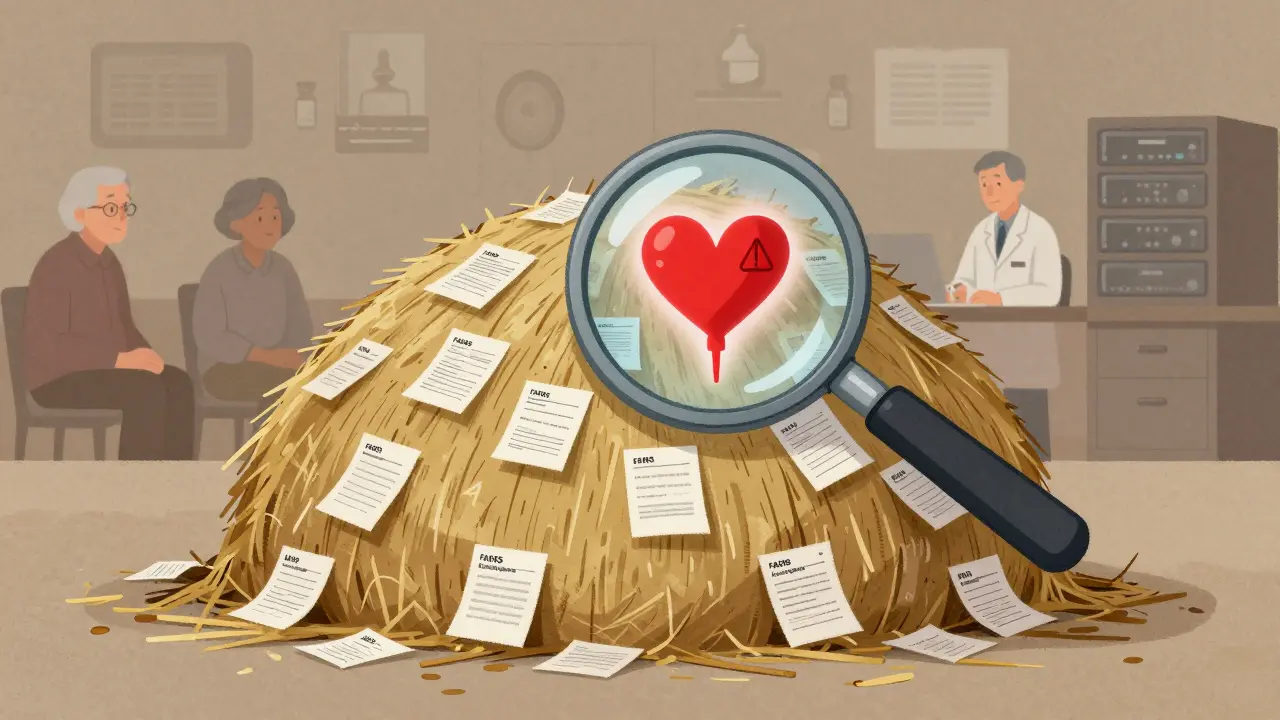
How Regulators Find Signals - The Math Behind the Alarm
Finding a signal in millions of reports is like finding a needle in a haystack made of other needles. Regulators don’t look manually. They use statistical tools:- Reporting Odds Ratio (ROR): Compares how often a side effect is reported with a specific drug versus all other drugs. A ratio above 2.0 triggers review.
- Proportional Reporting Ratio (PRR): Measures whether a side effect is reported more frequently with this drug than expected based on historical data.
- Bayesian Confidence Propagation Neural Network (BCPNN): Uses machine learning to detect patterns while filtering out noise.
What Makes a Signal Turn Into a Warning?
Not every signal leads to a black box warning or a drug recall. Only certain ones do. A 2018 analysis of 117 signals found four key factors that predict whether regulators will update prescribing information:- Replication across sources: If the same signal appears in FAERS, EudraVigilance, and a peer-reviewed study, the chance of a label change jumps by 4.3 times.
- Plausibility: Does the mechanism make sense? Rosiglitazone’s link to heart attacks was confirmed because it raised LDL cholesterol - a known risk factor.
- Severity: 87% of serious events led to label updates. Only 32% of mild ones did.
- Drug age: New drugs (under five years old) are 2.3 times more likely to get label changes than older ones. Regulators are more cautious with newer products.

The Human Side - Why Signal Detection Is So Hard
Behind every signal is a team of pharmacovigilance experts. They’re the ones sifting through messy, incomplete reports. A 2021 survey of 327 professionals by the International Society of Pharmacovigilance found:- 73% said the biggest frustration was the lack of standardized ways to assess whether a drug actually caused the reaction.
- 61% were overwhelmed by false signals.
- 57% couldn’t get follow-up info from reporting doctors - no lab results, no medical history, no timeline.
The Future: Bigger Data, Smarter Systems
The global pharmacovigilance market is growing fast - projected to hit $15 billion by 2030. Why? Because regulators are demanding more. The EU now requires every new drug application to include a detailed signal detection plan. The FDA is pushing for real-time monitoring. The WHO connects 155 countries, processing 350,000 reports a month. The biggest shift? Integrating data. By 2027, 65% of priority signals will come from combined sources: spontaneous reports + EHRs + patient apps + lab results. That’s a huge leap from today’s siloed systems. But challenges remain. Biologics - complex drugs made from living cells - are exploding in use. Their side effects are harder to predict. And the elderly population is taking more drugs than ever. Polypharmacy - taking five or more medications - is now the norm for older adults. Current systems weren’t built for that.What You Need to Know
If you’re a patient: if you notice something unusual after starting a new drug - especially if it’s persistent or worsening - report it. Your report might be the first clue in a signal that saves thousands. If you’re a prescriber: don’t ignore odd patterns. A single case might not mean much. But if three patients in your practice report the same rare symptom? That’s worth a call to your regional pharmacovigilance center. If you’re in the industry: don’t rely on one method. Use triangulation. Validate. Wait for consistency. The cost of acting too soon? A drug pulled unnecessarily. The cost of waiting too long? Lives lost. Drug safety isn’t about perfection. It’s about vigilance. It’s about accepting that we don’t know everything when a drug launches - and that’s okay, as long as we’re listening.What is the difference between a drug side effect and a safety signal?
A side effect is any known reaction to a drug, listed in the prescribing information - like dizziness or dry mouth. A safety signal is an unexpected pattern of adverse events that suggests a possible new risk. Side effects are documented; signals are suspected and require investigation.
Can a drug be pulled from the market because of a safety signal?
Yes, but it’s rare. Most signals lead to label updates - stronger warnings, new contraindications, or monitoring requirements. A full withdrawal usually requires multiple confirmed signals, strong evidence of harm, and no safer alternatives. Examples include rosiglitazone (restricted) and fenfluramine (withdrawn).
How long does it take to confirm a safety signal?
It varies. Simple signals with clear patterns can be confirmed in weeks. Complex ones - especially rare or delayed events - can take years. The average time for full assessment is 3 to 6 months, but some, like bisphosphonate-related jaw damage, took over seven years.
Why are spontaneous reports so unreliable?
They’re uncontrolled. Reports can be incomplete, inaccurate, or biased. Serious events are reported far more often than mild ones. Many reports lack details like dosage, timing, or other medications. They can’t prove causation - only suggest it. That’s why they’re always combined with other data sources.
Do newer drugs have more safety signals than older ones?
Yes. New drugs are more likely to trigger signals because they’re used by fewer people, so rare events stand out more. Also, long-term effects haven’t had time to appear. About 68% of label changes happen within the first five years after approval. Older drugs have well-known profiles, so new signals are rarer - but when they appear, they’re often more serious.
Aliyu Sani
man, this whole drug safety thing is like trying to hear a whisper in a hurricane. we throw billions at trials but still miss the quiet screams in the data. the real horror? we think we're safe because the numbers look clean. but real people? they're the ones getting crushed by the 1-in-10k side effects that never made it past phase 2. we need more than stats-we need soul in the system.
Sam Black
the magic of pharmacovigilance isn’t in the algorithms-it’s in the lonely pharmacist who notices three patients with the same weird rash and says, ‘huh, that’s odd.’ that’s where the real signal starts. machines crunch numbers, but humans notice the silence between the noise. kudos to the unsung heroes sifting through FAERS at 2 a.m.
Jeremy Hendriks
let’s be real-this whole system is a corporate circus. big pharma funds the trials, the regulators are cozy with the industry, and the ‘signals’? mostly noise engineered to scare people into paying for ‘updated’ meds. if you think the FDA’s doing this for patients, you’re high on your own supply. the moment a drug becomes profitable, safety becomes a footnote.
Gabriella da Silva Mendes
OMG I just read this and I’m so mad 😤 like why do we even trust ANY drug?? I mean, I took that new migraine pill and my hair fell out in clumps-no one even asked me to report it!! 🤯 and now they’re saying it’s ‘statistical noise’?? NOPE. I’m not noise. I’m a person. and if my hair’s gone, so is my trust in science 🙄 #PharmaLies #MyHairWasMyPride
Kiranjit Kaur
love this breakdown! 🙌 so many people think drugs are ‘safe’ because they got FDA approval-but safety is a journey, not a stamp. kudos to the real heroes: the patients sharing their stories on forums, the doctors who listen, the researchers connecting dots across continents. we’re not just data points-we’re humans waiting for someone to pay attention. keep going!
Sai Keerthan Reddy Proddatoori
this is all fake. the government and pharma are hiding the truth. the real side effects? They cause autism, brain damage, and make people gay. the trials are rigged. they use only healthy white people to hide the truth. if you're brown, Indian, or poor-you're the test subject. they don't care. they just want your money. watch the videos. the truth is buried.
Ajay Brahmandam
solid post. really breaks it down without the fluff. i’ve worked in med info for 12 years-most signals never go anywhere because no one follows up. docs don’t call back, patients vanish, records are incomplete. the system’s broken, but it’s not hopeless. small wins matter. one report, one conversation, one updated label-it adds up.
jenny guachamboza
wait wait wait-so you’re telling me AI can detect a signal in 48 hours but we still don’t know if my cousin’s liver failure was caused by the drug or his bad taco Tuesday? 🤔 and you’re telling me to trust this? lol. i’ve seen too many ‘safe’ drugs turn into nightmares. the FDA is just a marketing arm for big pharma. #TruthBomb #TheyKnow
Tarun Sharma
the distinction between side effect and safety signal is critical. the former is documented; the latter requires rigorous validation. adherence to ICH guidelines and triangulation remains the gold standard. premature conclusions risk public trust and clinical harm.
Jim Brown
there is a profound epistemological tension here: we demand certainty from a system built on probabilistic inference. clinical trials offer controlled illusions of safety; real-world data reveals the messy truth of human biology. the signal is not the danger-it is the whisper of our ignorance. to act on it requires not just data, but humility.
Cara Hritz
sooo… you’re saying the FDA is just guessing? 😒 and all these ‘signals’ are just people typing ‘i feel weird’ into a form? i took metformin and got a headache-does that mean it causes brain tumors?? 🤦♀️ this article is so overcomplicated. just tell me if the drug is safe or not. stop with the jargon.
Jamison Kissh
the most chilling part? the system works better than we think-but only because people still care enough to report. imagine if no one ever said anything. we’d be flying blind. the real innovation isn’t AI-it’s the patient who writes to their doctor, the pharmacist who calls the hotline, the nurse who says ‘this doesn’t look right.’ that’s the heartbeat of safety.