
Have you ever picked up a prescription bottle and felt a moment of confusion? The doctor wrote one name, but the label says another. Or maybe the pill looks completely different from what you remember taking last year. This is a common scenario in American pharmacies today. Understanding the difference between generic and brand-name medications isn't just about saving money; it’s about knowing exactly what you are putting into your body.
The short answer is that they are chemically identical in their active ingredients. However, the labeling, appearance, and cost differ significantly. Knowing how to read these labels can prevent errors, save you hundreds of dollars, and give you peace of mind when managing your health.
What Is Actually on Your Prescription Label?
When you look at a prescription bottle, you are looking at a regulated document. Federal law requires specific information to be present. Usually, you will see two names for the same drug. The Brand Name is the proprietary trademark created by the pharmaceutical company that originally developed the drug. It is often catchy, easy to pronounce, and heavily marketed. Think of names like Lipitor or Prilosec.
Beneath that, usually in smaller print, is the Generic Name is the scientific name of the active pharmaceutical ingredient. For example, atorvastatin is the generic name for Lipitor. This name tells you exactly what chemical compound is working in your body. According to the National Association of Boards of Pharmacy, 92% of prescription labels follow this standardized format where both names appear. If you only see one name, it is likely the generic version, which is now the standard for most prescriptions.
Why do two names exist? When a company spends billions developing a new drug, they get a patent. During this time, they sell it under a brand name to recoup costs. Once the patent expires, other manufacturers can make the same drug using the generic name. This competition drives prices down dramatically.
The Science Behind the Swap: Bioequivalence
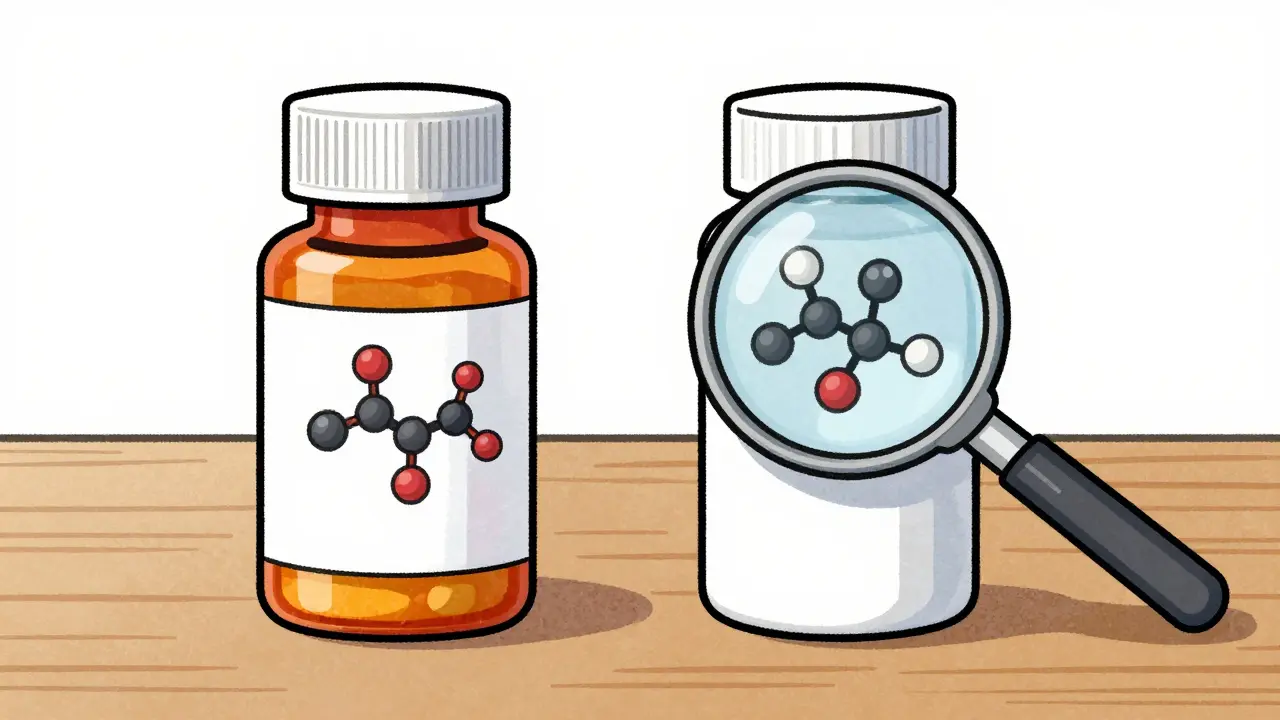
You might wonder if the cheaper option works as well. The U.S. Food and Drug Administration (FDA) has strict rules. Under the Hatch-Waxman Act of 1984, any generic drug must prove it is "bioequivalent" to the brand-name version. This means it delivers the same amount of active ingredient into your bloodstream within the same timeframe.
Specifically, the FDA requires that the 90% confidence interval for the drug's absorption falls within 80-125% of the brand-name drug. In plain English, the generic must work almost identically to the original. A study published in the NIH's PMC database confirms that generic labels must mirror the brand-name label's content regarding indications, dosage, and safety. The therapeutic effect is the same.
| Feature | Brand-Name Drug | Generic Drug |
|---|---|---|
| Active Ingredient | Original formula | Identical to brand |
| Cost | High (covers R&D) | Low (80-85% less) |
| Appearance | Distinct color/shape | May differ (trademark laws) |
| Efficacy | Clinically proven | Bioequivalent to brand |
| Regulatory Path | Full clinical trials | Abbreviated approval |
Why Do They Look Different?
If the chemistry is the same, why does my pill look different? Trademark law prevents generic manufacturers from copying the exact look of the brand-name drug. If a generic looked exactly like the brand, it could confuse consumers and infringe on trademarks. So, while the active ingredient is identical, the inactive ingredients-like dyes, binders, and fillers-can vary.
This change in appearance can cause anxiety. A 2022 CVS Health survey found that 24% of patients reported confusion due to different pill appearances. However, Cedars-Sinai pharmacists note that these physical differences do not affect how the drug works. The color or shape is purely cosmetic. If you are sensitive to certain dyes or gluten, always check the inactive ingredient list with your pharmacist, but for most people, the visual change is harmless.
The Cost Factor: Saving Billions
The biggest difference between generic and brand-name drugs is price. Brand-name manufacturers spend an average of $2.6 billion on research and development for each approved drug. Generics skip these expensive trials because they rely on the existing data from the brand-name drug. This allows them to sell at a fraction of the cost.
According to GoodRx, generic drugs typically cost 80-85% less than their brand-name equivalents. To put that in perspective, a month's supply of brand-name Lipitor might cost around $300, while the generic atorvastatin could cost as little as $4. From 2007 to 2016, generic drugs saved the U.S. healthcare system $1.67 trillion. For individuals, this savings can mean the difference between adhering to a treatment plan and skipping doses due to cost.
Insurance plans also push for generics. Most commercial plans require you to use the generic version if available to keep your out-of-pocket costs low. Only in rare cases will insurance cover the brand name without a significant penalty.
When Might You Need the Brand Name?
Are generics always safe? For the vast majority of medications, yes. However, there is a small category called "Narrow Therapeutic Index" (NTI) drugs. These are medications where a tiny difference in blood concentration can lead to serious side effects or lack of efficacy. Examples include warfarin (a blood thinner) and levothyroxine (for thyroid conditions).
For NTI drugs, some doctors prefer sticking with one manufacturer, whether brand or generic, to avoid minor variations in inactive ingredients that might affect absorption. The FDA maintains a list of these drugs. Even then, generics are approved, but consistency is key. If you are on an NTI drug, talk to your doctor before switching manufacturers.
Another reason to stick with a brand is if you have experienced adverse reactions to the inactive ingredients in a generic. While rare, some people may be sensitive to specific dyes or fillers used by a particular generic manufacturer. In these cases, your doctor can write "Dispense as Written" (DAW) on the prescription, instructing the pharmacist not to substitute the generic.
How to Read Your Label Like a Pro
To avoid confusion, take a moment to understand the sections on your Rx label:
- Patient Name and DOB: Ensures the medication is for you.
- Prescriber Name: The doctor who ordered the drug.
- Drug Name: Look for both the brand (if applicable) and generic name. The generic name is the most important identifier.
- Strength: The amount of active ingredient per dose (e.g., 20mg).
- Directions: How and when to take the medication.
- Quantity: How many pills are in the bottle.
- Refills: How many times you can renew the prescription.
- Pharmacist Name: Who filled the prescription. Call them if you have questions!
If you see a code like "DAW 1," it means the patient requested the brand name. "DAW 2" usually means the doctor specified the brand. If there is no DAW code, the pharmacist substituted the generic, which is standard practice in 28 states unless prohibited.
Common Myths Debunked
Misinformation about generics is widespread. Let's clear up a few myths:
Myth: Generics are lower quality.
Fact: The FDA inspects generic manufacturing facilities just as rigorously as brand-name ones. They must meet identical quality standards.
Myth: Generics don't work as well.
Fact: Clinical studies consistently show no difference in therapeutic outcomes for 90% of prescriptions. University Hospitals reports that 78% of patients are satisfied with generics once educated about their equivalence.
Myth: All generics are made by different companies.
Fact: Surprisingly, about 50% of generic medications are actually manufactured by the original brand-name companies themselves, just sold under a different label.
What About Biosimilars?
As more complex biological drugs lose patent protection, a new category called biosimilars is emerging. Unlike traditional generics, which are simple chemical copies, biologics are large, complex molecules derived from living organisms. They cannot be perfectly copied, only closely mimicked.
Biosimilars are priced 15-30% lower than reference biologic products, compared to the 80-85% discount for small-molecule generics. While they are highly similar, they undergo slightly different regulatory scrutiny. As the market evolves, expect to see more biosimilars on labels, particularly for conditions like rheumatoid arthritis and cancer.
Next Steps for Patients
If you are confused about your medication, here is what you should do:
- Talk to your pharmacist. They are the best resource for explaining label details and inactive ingredients.
- Check your insurance formulary. See if your plan prefers a generic or has restrictions on brand names.
- Monitor your response. If you switch from brand to generic and notice changes, report them to your doctor. It might be due to inactive ingredients, not the active drug.
- Ask for consistency. If you tolerate a specific generic manufacturer well, ask your pharmacy to try to keep you on that brand of generic.
Understanding your prescription label empowers you to make informed decisions. Whether you choose a brand or generic, knowing that the FDA ensures safety and efficacy helps you focus on what matters: getting better.
Is it safe to switch from a brand-name drug to a generic?
Yes, for most medications, it is safe. The FDA requires generics to be bioequivalent, meaning they work the same way in the body. However, for narrow therapeutic index drugs like warfarin, consult your doctor before switching to ensure consistent dosing.
Why does my generic pill look different from the brand name?
Trademark laws prevent generic manufacturers from copying the exact appearance of brand-name drugs. While the active ingredient is identical, inactive ingredients like dyes and binders may differ, resulting in different colors or shapes. This does not affect the drug's effectiveness.
Can I request the brand-name drug instead of the generic?
Yes, you can ask your doctor to write "Dispense as Written" (DAW) or "Do Not Substitute" on the prescription. However, your insurance may charge higher copays for brand-name drugs, so check with your provider first.
Are generic drugs cheaper than brand-name drugs?
Yes, generics typically cost 80-85% less than brand-name equivalents. This is because generic manufacturers do not bear the high costs of initial research and development, allowing them to offer significant savings to patients.
What does bioequivalence mean?
Bioequivalence means that a generic drug delivers the same amount of active ingredient into the bloodstream within the same timeframe as the brand-name drug. The FDA requires the 90% confidence interval for absorption to fall within 80-125% of the brand-name drug.
Do all countries allow generic substitution?
In the U.S., 28 states permit automatic generic substitution unless the prescriber indicates otherwise. Policies vary globally, but many countries encourage generic use to reduce healthcare costs. Always check local regulations and insurance requirements.
What are biosimilars?
Biosimilars are biological products that are highly similar to an existing FDA-approved reference product. Unlike traditional generics, they are complex molecules derived from living organisms and cannot be identical copies. They are priced 15-30% lower than reference biologics.
How can I tell if my prescription is generic or brand?
Look at the label. If both names are listed, the smaller print is usually the generic name. If only one name is listed and it matches the scientific name (e.g., atorvastatin), it is generic. If it is a trademarked name (e.g., Lipitor), it is brand-name. Pharmacists can also confirm this for you.