
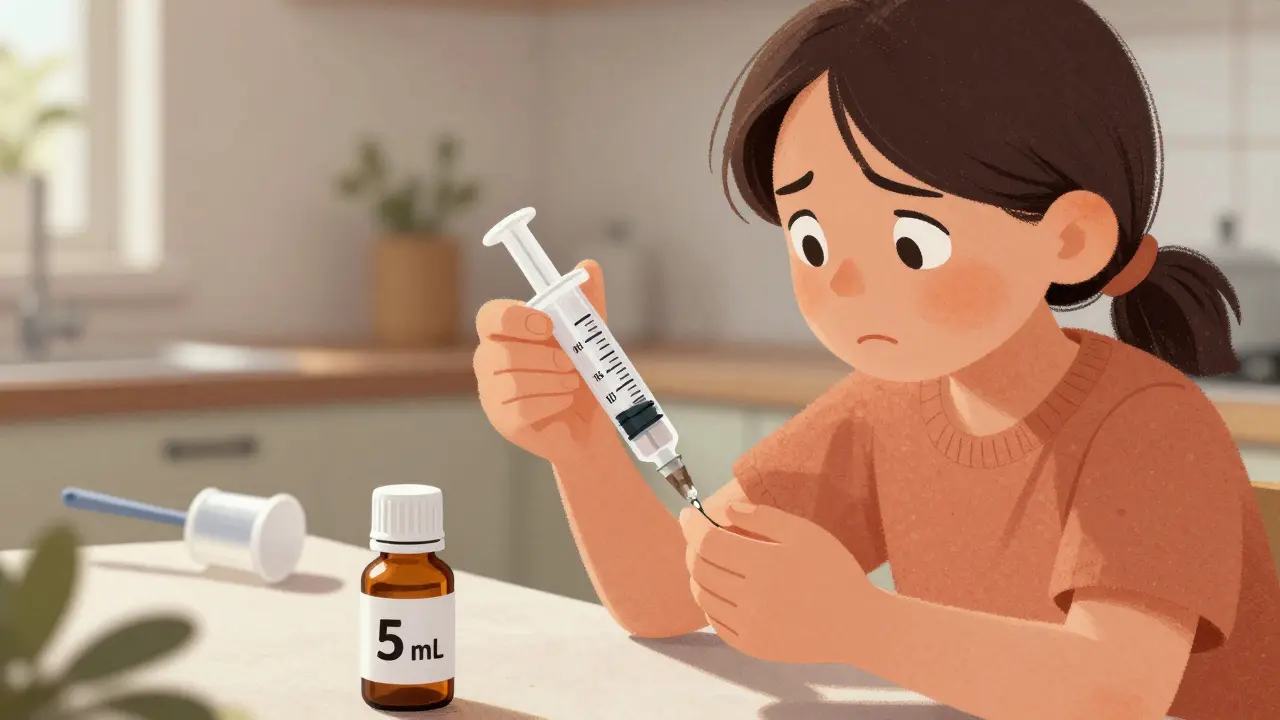
Wrong doses of liquid medications aren’t just mistakes-they’re dangerous. Every year, thousands of children and adults end up in emergency rooms because someone gave them too much-or too little-of a liquid drug. This isn’t rare. In fact, liquid medication errors account for about 80% of all pediatric home dosing mistakes, according to a 2023 study in the Journal of Pediatrics. And it’s not just parents. Nurses, pharmacists, and even doctors can slip up when measuring liquids. The good news? These errors are mostly preventable. With the right tools, clear labels, and simple habits, you can cut the risk by more than half.
Why Liquid Medications Are So Easy to Mess Up
Liquid meds are tricky because they’re measured in tiny amounts. A child’s dose might be 2.5 mL. An adult’s could be 15 mL. But most people don’t have a clear sense of what a milliliter looks like. That’s where things go wrong.
One major cause? Using kitchen spoons. A tablespoon isn’t 15 mL-it’s often 18 mL or more. A teaspoon? Maybe 4 mL, maybe 6. A 2021 study in Academic Emergency Medicine found that household spoons led to errors in 38% of cases. Even worse, caregivers often don’t realize they’re using the wrong tool. A Reddit thread from March 2024 showed 68% of parents admitted to using spoons at least once.
Another big problem? Confusing labels. Some bottles say “teaspoon,” others say “mL.” Some cups have both. That mix of units is a recipe for disaster. The World Health Organization says ditching non-metric units like teaspoons and tablespoons alone could prevent 33% of errors. That’s why the American Society of Health-System Pharmacists now requires all liquid meds to be labeled in milliliters only.
The Best Tool for Measuring Liquid Medication: The Oral Syringe
If you’re giving liquid medicine to a child-or even an adult-skip the cup. Use an oral syringe. Not the plastic kind that comes with the bottle. Get a separate one with clear, bold markings.
Here’s why: a 2016 Yale study in Pediatrics found oral syringes were 37% more accurate than dosing cups. For doses under 1 mL, syringes with 0.1 mL graduations cut errors by nearly half. For doses between 1 and 5 mL, syringes with 0.5 mL marks were far more reliable. In NIH testing, syringes hit 94% accuracy at 2.5 mL. Dosing cups? Only 76%. Household spoons? Just 62%.
Pharmacies should give you one with every prescription. But they don’t always. A 2023 HealthyChildren.org survey found that 82% of parents preferred syringes, but only 54% actually received one. If yours didn’t come with one, ask for it. Or buy a pack online-they cost less than $1 each. Look for syringes labeled “oral use only” and with clear mL markings. Avoid ones with plastic caps that are hard to clean.
Standardize the Labels: mL Only, No Exceptions
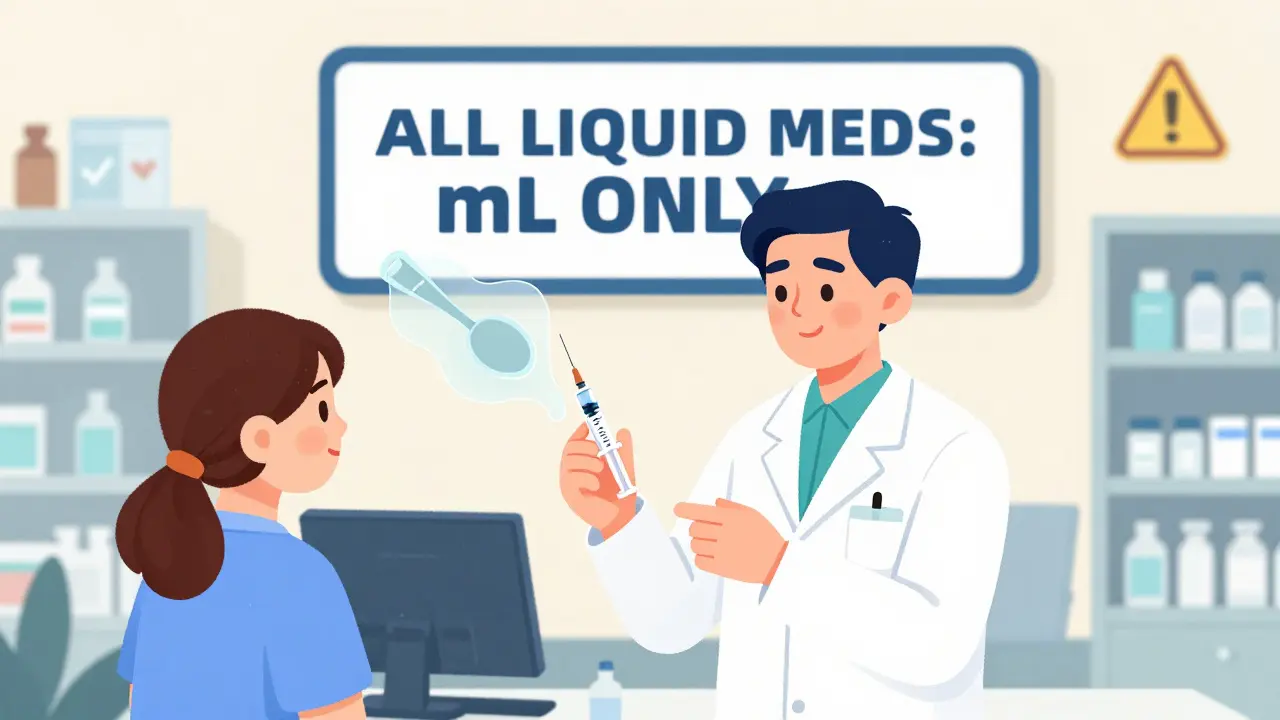
Prescriptions used to say “give 1 tsp.” Now, they shouldn’t. The FDA, ISMP, and Joint Commission all agree: only milliliters (mL) should appear on labels and prescriptions. Why? Because “teaspoon” means different things to different people. One person’s teaspoon might be 4 mL. Another’s might be 6 mL. That’s a 50% difference.
Look at the bottle. Does it say “1 tsp” or “5 mL”? If it says both, ask the pharmacist to re-label it. If the pharmacy won’t, go elsewhere. The Joint Commission’s National Patient Safety Goal (NPSG.01.05.01) requires all liquid medications to be dispensed with metric-only labeling. That’s not optional. It’s mandatory.
Even over-the-counter meds are changing. The FDA’s 2024 draft guidance requires all OTC liquid meds to include enclosed dosing devices with metric-only markings. This is a big shift-and it’s coming fast. By 2026, you shouldn’t see a teaspoon on any medicine bottle in the U.S.
Technology Is Helping-But Only If It’s Used Right
Hospitals are using smart tools to cut errors. Barcode scanning (BCMA) cuts wrong-dose errors by 48%. Computerized prescribing (CPOE) systems flag doses that are too high or too low for a patient’s weight. One 2023 Cochrane Review found these systems reduced pediatric errors by 58%.
But these tools only work if they’re used correctly. A 2023 study in the Journal of Patient Safety found BCMA systems only reached their full potential when nurses scanned every single dose. If they skipped scans because they were in a rush, the error rate stayed high.
Another game-changer? The ENFit system. This is a new connector standard for feeding tubes and oral syringes. Before ENFit, a syringe could accidentally plug into an IV line-killing someone. ENFit connectors are shaped differently so they can’t fit into IV ports. Hospitals that switched to ENFit cut wrong-route errors by 98%. The catch? It costs $50,000 to $100,000 to upgrade an entire hospital. Many still haven’t made the switch. But if you’re in a hospital, ask if they use ENFit. If they don’t, ask why.
What Caregivers Can Do Right Now
You don’t need a hospital budget to prevent errors. Here’s what you can do today:
- Always use an oral syringe. Not a cup. Not a spoon. Not a dropper. A syringe with mL markings.
- Check the label. Does it say “mL”? If it says “tsp” or “tbsp,” ask for a new label.
- Measure at eye level. Hold the syringe on a flat surface, look straight at the mark. Don’t tilt it.
- Double-check the dose. Read the prescription. Read the label. Read the syringe. Say it out loud: “The doctor ordered 3 mL. The bottle says 3 mL. The syringe shows 3 mL.”
- Ask the pharmacist. “Do you have an oral syringe with this?” If they say no, say, “I need one. It’s for safety.”
These steps aren’t extra work. They’re basic safety. And they work. Kaiser Permanente cut liquid medication errors by 92% by making syringes mandatory, using EHR dose calculators, and training caregivers. You don’t need a big system to do the same.
The Hidden Cost of Getting It Wrong
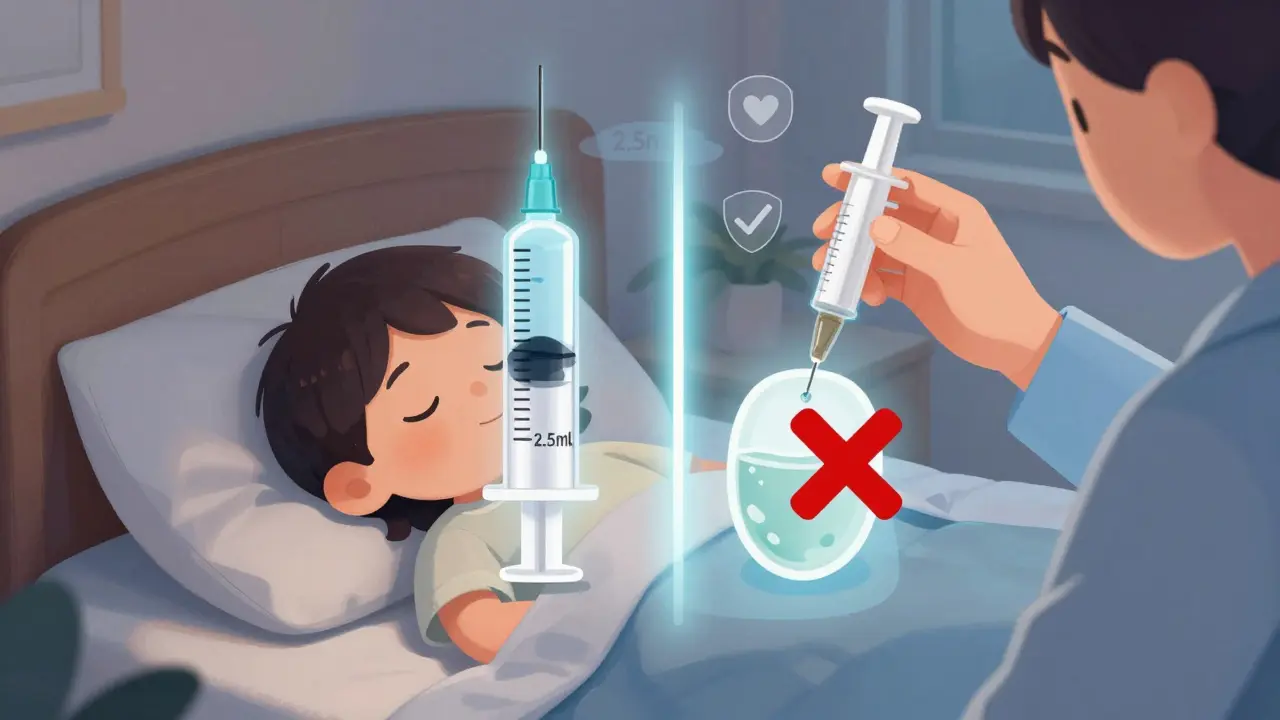
Wrong doses aren’t just inconvenient. They’re deadly. The Institute for Safe Medication Practices says 14% of liquid medication errors lead to permanent harm or death. A child given too much acetaminophen can suffer liver failure. Too little antibiotics can let an infection spread. An adult given an overdose of blood pressure meds can crash.
The financial cost is huge too. The U.S. spends $8.3 billion a year on liquid medication errors, according to AHRQ. That’s not just hospital bills. It’s lost work, long-term care, and emotional trauma.
But here’s the thing: nearly all of it is preventable. You don’t need fancy tech. You need one syringe. One clear label. One moment to double-check.
What’s Next? The Future of Liquid Medication Safety
The future is getting smarter. Boston Children’s Hospital is testing augmented reality apps that let you point your phone at a bottle and see the right dose highlighted. Johns Hopkins is trialing RFID syringes that talk to the hospital’s computer system and alert staff if the wrong dose is drawn.
By 2026, all certified electronic health records must include automatic pediatric dose checks. The FDA will require metric-only labeling on all OTC liquids. ENFit will become the universal standard. But none of this matters if caregivers don’t use the tools they have today.
Right now, the best innovation is the one you can hold in your hand: a simple, clear, mL-marked oral syringe. Use it. Always. For every dose. No exceptions.
Why are oral syringes better than dosing cups for liquid medications?
Oral syringes are more accurate because they have fine, clear markings in milliliters (mL) and allow precise control over the dose. A 2016 Yale study found they’re 37% more accurate than dosing cups. For doses under 5 mL, syringes have an error rate of just 8.2%, while dosing cups have a 41.1% error rate. Cups are harder to read, often have blurry lines, and people tend to overfill or underfill them. Syringes eliminate guesswork.
Can I use a kitchen teaspoon if I don’t have a measuring device?
No. A kitchen teaspoon holds anywhere from 4 to 6 milliliters-never the standard 5 mL used in medical dosing. Using it can lead to a 20-30% overdose or underdose. In fact, 28% of preventable pediatric errors come from using teaspoons or tablespoons. Always use an oral syringe. If you don’t have one, ask your pharmacy for one. They’re inexpensive and often provided free.
Why do some medicine labels still say “teaspoon” instead of “mL”?
Some older prescriptions and over-the-counter products still use non-metric units because regulations haven’t been fully enforced everywhere. But this is changing. The FDA, ISMP, and Joint Commission now require all liquid medications to be labeled in milliliters only. If your prescription or bottle still says “tsp,” ask the pharmacist to re-label it. You have the right to a safe, clear label.
How can I tell if my pharmacy is giving me the right dosing device?
Ask for an oral syringe with mL markings. It should be clearly labeled “FOR ORAL USE ONLY” and have bold, easy-to-read numbers. Avoid devices with both mL and tsp markings. If they give you a cup, ask why. Most pharmacies now provide syringes with pediatric prescriptions. If they don’t, they’re not following best practices. You can also buy syringes online or at medical supply stores for under $1 each.
What should I do if I accidentally give the wrong dose?
Call your pharmacist or poison control center immediately. In the U.S., call 1-800-222-1222. Don’t wait for symptoms. Even small overdoses can be dangerous, especially in children. Bring the medicine bottle and the measuring device with you. This helps them assess the dose accurately. Never try to “wait it out” or assume it’s fine. Quick action saves lives.
Final Thoughts: Safety Starts With You
Medication errors aren’t always the fault of the system. Sometimes, they’re the result of habits we don’t question. Using a spoon. Guessing a dose. Skipping the syringe. Assuming “close enough” is okay.
But safety isn’t about assumptions. It’s about action. Every time you give a liquid medication, you have a chance to prevent harm. Grab the syringe. Read the mL. Measure it right. Double-check. It takes 10 seconds. That’s all it takes to keep someone safe.
Mike Dubes
I used to use spoons till my kid got sick from an overdose. Now I always use the syringe. Seriously, they're like $1 online. Just get one. No excuses. It's not that hard.
And if your pharmacy gives you a cup? Tell them you want a syringe. They'll give it to you. I've done it ten times. They don't even blink anymore.
Helen Brown
They're lying about the syringes. The real reason they don't give them out is because they want you to buy them. I know a guy who works at a pharmacy and he said they make a profit on syringes. They'll give you a cup so you'll go buy the syringe later. Don't fall for it.
John Cyrus
If you're using a kitchen spoon you're an idiot. No one needs a study to tell you that a tablespoon isn't 15 mL. That's basic math. If you can't measure 5 mL you shouldn't be giving medicine to anyone. The real problem is lazy parents not reading labels. Simple fix. Read the damn bottle.
John Smith
Man I was so mad when my kid’s prescription came with a cup. I told the pharmacist I’d rather pay $20 than risk my kid’s liver. He laughed and said 'Sir, we don't make money on syringes.' I said 'Then why the hell are you giving me a cup?' He looked at me like I was from another planet. Next week I went to another pharmacy. Got the syringe. No drama. Just do it. Your kid’s life isn’t a suggestion.
Sharon Lammas
I think about how many people have been hurt because we treat medicine like it's a cooking recipe. We don't say 'add a pinch of salt' to a vaccine. But we say 'give a teaspoon' to a child. That disconnect is terrifying. We need to stop normalizing guesswork with life-saving drugs. It's not about being perfect. It's about being intentional.
Donna Zurick
I started using syringes after my niece had a bad reaction. It changed everything. Now I keep a pack in my purse. I give them to friends. I tell strangers at the pharmacy. It’s not a big deal. Just one small habit. But it saves lives. Seriously. Do it.
Tobias Mösl
The FDA doesn't care. They're all bought off by Big Pharma. Syringes cost pennies. Why don't they mandate free ones with every prescription? Because they want you to pay for them. They want you to be scared. They want you to feel guilty. And then they sell you the 'solution' for $4.99. Wake up. This isn't safety. It's a profit scheme.
Ethan Zeeb
I work in ER. Saw a 3-year-old come in with liver failure from acetaminophen. Mom used a tablespoon. Said she 'thought it was 5 mL.' We saved her. But she'll have scars. Not physical ones. Mental ones. That's the real cost. Don't wait for the hospital to tell you what to do. Do it before it's too late.
Darren Torpey
I used to think syringes were for babies. Then I gave my wife her migraine med with one. 10 mL. Perfect. No spills. No guesswork. I bought three more. One for the car. One for the office. One for the nightstand. Now I don't trust anything that doesn't come with a syringe. It's just… better. Like using a seatbelt. You don't need a reason. You just do it.
Lebogang kekana
In my village we used spoons. We didn’t know better. Then a nurse came from Johannesburg and taught us. She brought syringes. We cried. Not because we were sad. Because we realized we could have lost so many. Now we teach every new parent. One syringe. One life. It’s that simple.