
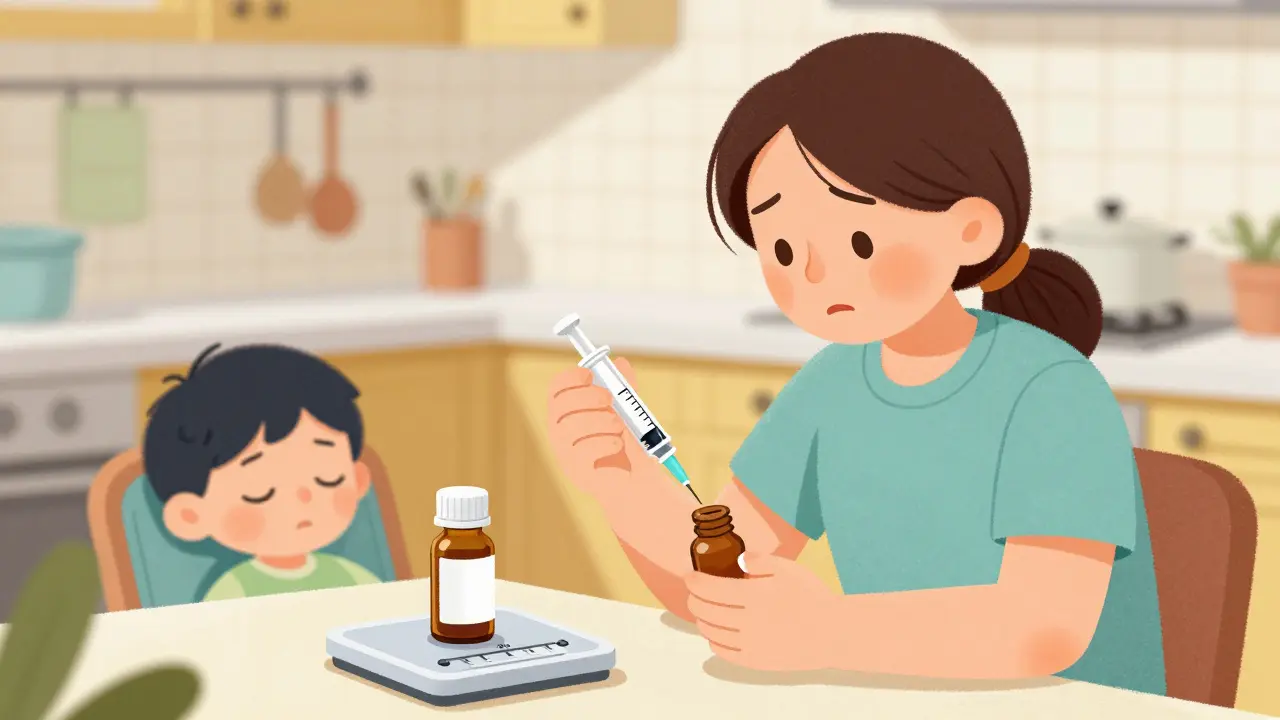
Every year, over 1.4 million children in the U.S. end up in the emergency room because of mistakes with over-the-counter (OTC) medicines. Most of these errors happen because parents give the wrong dose - not because they’re careless, but because the labels are confusing. You’re not alone if you’ve stared at a medicine bottle, unsure whether to use age or weight, or if you’ve wondered if your kitchen spoon is safe to use. The truth is, weight is the most accurate way to dose your child, and learning how to read the label correctly can keep them safe.
Why Weight Matters More Than Age
You’ve probably seen those age-based charts on medicine bottles: "For children 2-3 years: 5 mL." But those charts are just a backup. The real rule is this: use your child’s weight. A 2-year-old who weighs 40 pounds needs more medicine than a 2-year-old who weighs 22 pounds. Age doesn’t tell you that. Weight does. A study from Johns Hopkins Children’s Center found that using age instead of weight leads to dosing errors in 23% of cases. That means nearly one in four kids get either too little or too much medicine. Underdosing won’t help their fever or pain. Overdosing - especially with acetaminophen - can cause serious liver damage. In fact, acetaminophen overdose is the top reason kids end up with acute liver failure. The American Academy of Pediatrics (AAP) says clearly: "Always dose by weight if you know it. If you don’t know your child’s weight, use age - but get a scale as soon as you can." Many parents don’t realize their child’s weight changes faster than their age. A child who just hit 30 pounds might still be labeled "2-3 years" on the bottle, but that’s not enough. You need the number.What to Look for on the Label
OTC children’s medicine labels have changed a lot since 2011, thanks to FDA rules. Now, every bottle must show the same key details - and you need to know where to find them.- Active ingredient: This tells you what’s in the medicine. Look for "acetaminophen" or "ibuprofen." Never mix two medicines with the same active ingredient - like giving Tylenol and a cold medicine that also has acetaminophen. That’s how accidental overdoses happen.
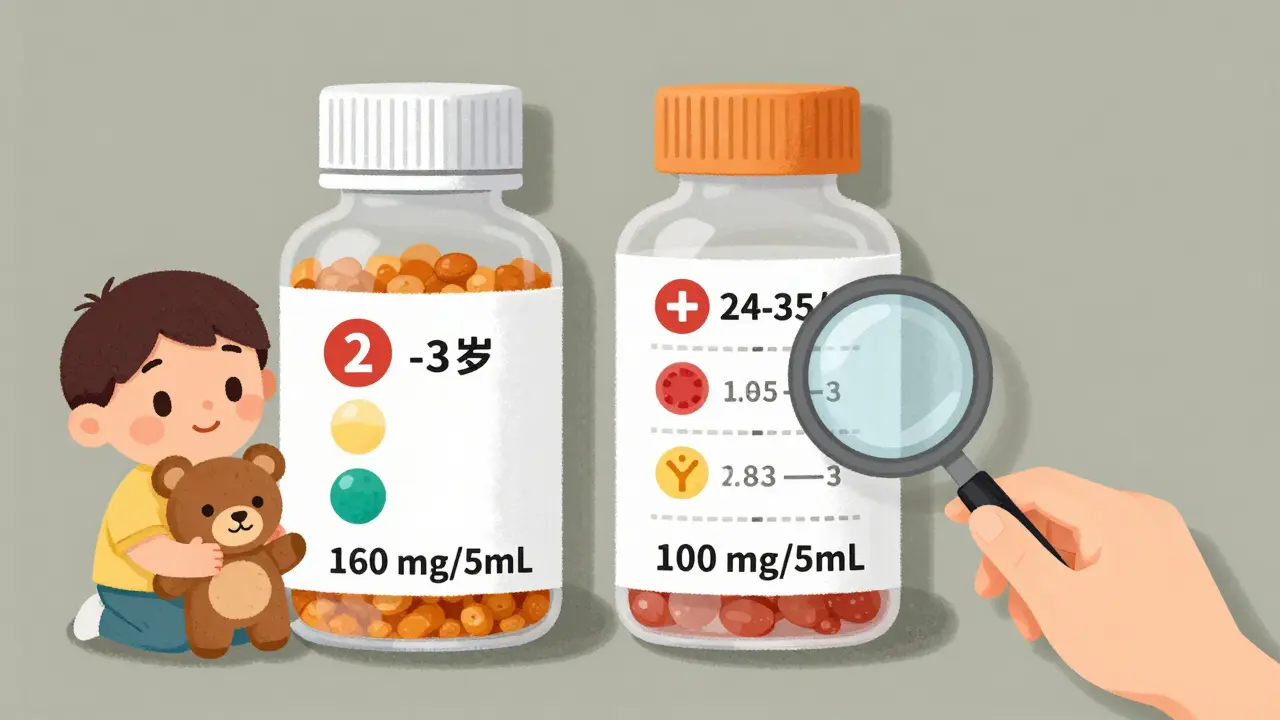
- Concentration: This is critical. Liquid acetaminophen is now standardized at 160 mg per 5 mL. That means every 5 mL has 160 mg. Ibuprofen is 100 mg per 5 mL. If you see "80 mg per 0.8 mL," that’s concentrated infant drops - you need a different syringe and a different dose.
- Dosing chart by weight: You’ll see ranges like "12-17 lbs," "18-23 lbs," up to "96+ lbs." Always pick the range your child falls into. If your child weighs 25 pounds, use the 24-35 lb range - never round up.
- How often to give it: Acetaminophen can be given every 4 hours. Ibuprofen every 6-8 hours. Never give more than 5 doses of acetaminophen in 24 hours. For ibuprofen, don’t go over 4 doses.
- Maximum daily dose: This is usually listed as "Do not exceed [X] mg in 24 hours." For acetaminophen, that’s usually 2,400 mg for a 40-pound child. If you’re unsure, calculate it: weight in pounds × 10-15 mg = max daily dose. Always stay on the low end.
- Warnings: "Do not use for children under 6 months" - that’s for ibuprofen. "Do not use with other medicines containing acetaminophen" - that’s for everything with Tylenol in it. "Do not use household spoons" - that’s non-negotiable.
How to Measure Correctly
Your kitchen spoon is not a measuring tool. A teaspoon holds about 5 mL - but only if it’s a medical measuring spoon. Your regular spoon? It can hold anywhere from 4 to 7 mL. That’s a 40% error. One parent on Reddit gave their 2-year-old 15 mL thinking it was 5 mL because they misread "tsp" as "tbsp." That’s 3 times the dose. Always use what comes with the medicine: a dosing syringe, cup, or oral dropper. If it didn’t come with one, buy a plastic dosing syringe at any pharmacy. They cost less than $2. They’re marked in mL, and they’re easy to read.- Never use a tablespoon unless the label says "TBSP" - and even then, only if it’s a medical measuring spoon.
- Remember: 1 tsp = 5 mL, 1 TBSP = 15 mL. Write that down if you have to.
- Hold the syringe at eye level when drawing up the dose. Tilting it up or down can throw off the measurement.
- Wipe the syringe clean after each use. Don’t let medicine dry on it - it can clog the tip.
Acetaminophen vs. Ibuprofen: Know the Difference
These two are the most common OTC kids’ meds. They work differently, and you can’t treat them the same.| Feature | Acetaminophen | Ibuprofen |
|---|---|---|
| Best for | Fever, mild pain | Fever, inflammation, swelling |
| Minimum age | 2 months (with pediatrician approval) | 6 months |
| Dosing frequency | Every 4 hours | Every 6-8 hours |
| Max doses per day | 5 | 4 |
| Concentration | 160 mg per 5 mL | 100 mg per 5 mL |
| Key warning | Do not exceed 5 doses in 24 hours. Liver damage risk. | Do not use under 6 months. Stomach irritation possible. |
For example: A 30-pound child gets 5 mL of acetaminophen (160 mg/5 mL = 160 mg total). For ibuprofen, they also get 5 mL - but that’s only 100 mg. So even though the volume is the same, the amount of medicine is different. That’s why concentration matters.
Also, don’t use ibuprofen if your child is dehydrated or has kidney issues. Acetaminophen is safer in those cases - but only if you don’t go over the daily limit.
What About Other Medicines? Benadryl, Cold Meds, and More
Benadryl (diphenhydramine) is often used for allergies or sleep. But it’s not safe for kids under 2 unless a doctor says so. The concentration varies: liquid is 12.5 mg per 5 mL, tablets are 25 mg. Giving a tablet to a toddler because you think it’s "stronger" could cause seizures or coma. Cold and flu medicines are the biggest trap. They often contain acetaminophen or ibuprofen already. If you give your child a cold medicine and then add Tylenol, you’re doubling the dose. That’s how 19% of acetaminophen overdoses happen. Always check the "Active Ingredients" section - even if the bottle says "for kids." Chewable tablets are another trap. Some are 80 mg, others are 160 mg. You can’t assume. Always read the label on the bottle, not the box.What If You’re Not Sure?
If you’re confused - stop. Don’t guess.- Call your pediatrician. They’ve seen hundreds of these questions. They won’t mind.
- Use a trusted online tool. HealthyChildren.org and OU Health have free, updated dosing calculators. They ask for weight, age, and medicine - then give you the exact dose.
- Ask the pharmacist. Walk into any pharmacy and say, "I need help reading this label for my 2-year-old who weighs 28 pounds." They’ll show you.
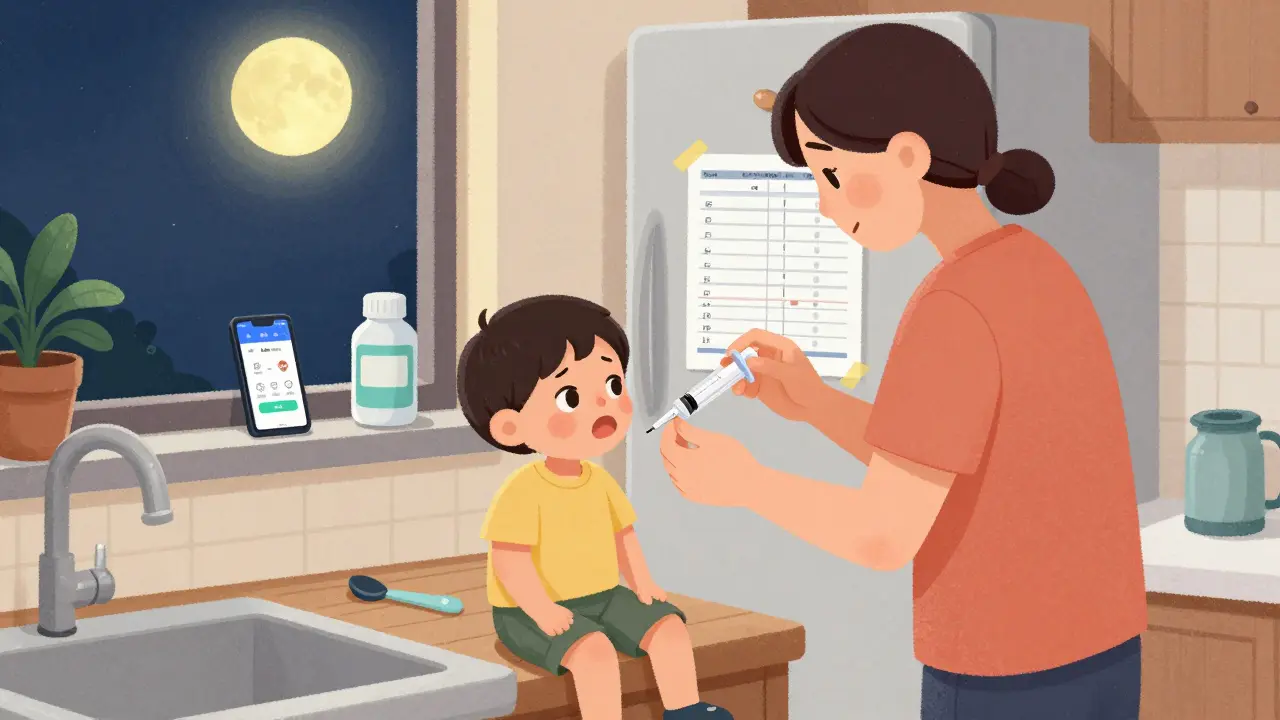
One parent told us she kept a printed copy of the dosing chart from St. Louis Children’s Hospital taped to her fridge. She used it every time her child got sick. "It saved me three times," she said. "I didn’t have to search online at 2 a.m. with a crying kid in my arms."
Common Mistakes (And How to Avoid Them)
- Mistake: Using age instead of weight. Solution: Weigh your child at least once a year. Keep a note on your phone.
- Mistake: Using a kitchen spoon. Solution: Buy a dosing syringe - it’s cheaper than a trip to the ER.
- Mistake: Giving medicine too often. Solution: Set a phone alarm. Don’t rely on memory.
- Mistake: Giving two medicines with the same ingredient. Solution: Always check the "Active Ingredients" line. If it says acetaminophen - don’t give another one.
- Mistake: Assuming "infant" means safer. Solution: Infant drops are concentrated. You need less volume - but only if you use the right syringe.
And if your child is under 3 months and has a fever? Call your doctor immediately. Don’t give any medicine without their advice.
What’s Changing in 2026?
The FDA is pushing for even clearer labels. By 2026, 75% of children’s OTC medicines will have QR codes that link to short video instructions on how to measure the dose. Some bottles will now show "syringe units" - like "1.5" or "2.0" - instead of just mL, because parents still get confused. But the core rule hasn’t changed: weight is king. No matter how fancy the label gets, if you don’t know your child’s weight, you’re guessing. And guessing with medicine is dangerous.Can I use a regular teaspoon to measure my child’s medicine?
No. A household teaspoon can hold anywhere from 4 to 7 mL, while a proper medical teaspoon holds exactly 5 mL. Using a regular spoon can lead to giving your child 20-40% more medicine than intended, which can be dangerous - especially with acetaminophen. Always use the dosing syringe or cup that comes with the medicine.
What if my child’s weight falls between two dosing ranges?
Always round down to the lower weight range. For example, if your child weighs 25 pounds and the chart lists 24-35 lbs and 36-47 lbs, use the 24-35 lb dose. Giving the higher dose can lead to overdose. The dose is calculated to be safe and effective for that range - going up increases risk without added benefit.
Is it safe to give ibuprofen to a 5-month-old?
No. Ibuprofen is not approved for children under 6 months of age. The FDA requires this warning on all ibuprofen labels. For infants under 6 months with a fever, acetaminophen is the only OTC option - and even then, you should call your pediatrician first. Never give ibuprofen to a baby under 6 months unless directed by a doctor.
How do I know if I’m giving too much acetaminophen?
The maximum is 5 doses in 24 hours, no matter the weight. For a child under 12, the total daily dose should not exceed 2,400 mg. If you’re giving multiple medicines - like a cold remedy and Tylenol - you might be doubling the dose. Always check the "Active Ingredients" section. Signs of overdose include nausea, vomiting, loss of appetite, and yellowing of the skin or eyes. If you suspect overdose, call Poison Control at 1-800-222-1222 or go to the ER immediately.
Can I use a digital scale at home to weigh my child?
Yes - and you should. A bathroom scale works if you weigh yourself holding your child, then weigh yourself alone and subtract. For accuracy, use a pediatric scale if you have one, or visit your doctor’s office to get an updated weight every 6-12 months. Keep a note of your child’s current weight on your phone or in your medicine cabinet. It’s the single best thing you can do to prevent dosing errors.
Final Tip: Keep It Simple
You don’t need to be a pharmacist to give your child medicine safely. You just need to know three things:- Know your child’s weight - and use it.
- Use the dosing tool that comes with the medicine - never a spoon.
- Never mix medicines with the same active ingredient.
Medicine labels are designed to protect your child. But they only work if you read them - carefully, slowly, and without rushing. When in doubt, call your doctor. It’s always better to be safe than sorry.
Wendy Claughton
I used to just guess with my twins... until one time I gave them both the wrong dose because I thought "teaspoon" meant my kitchen spoon. 🥲 I bought those cheap syringes from the pharmacy and now I tape the dosing chart to the fridge. It’s saved me so many times at 2 a.m. with a feverish kid screaming. Weight > age. Always. 🙏
Stacey Marsengill
Why are we even trusting Big Pharma to label these things? They’ve been hiding the truth for decades. The FDA? A puppet. They want you to think it’s about "weight"-but really, they just want you to buy more syringes and keep buying their overpriced bottles. And don’t even get me started on QR codes… next they’ll be tracking your kid’s meds via Bluetooth.
Aysha Siera
They say weight matters but what if your child is malnourished? Or if they’re on steroids? Or if they’re a preemie? No one talks about that. The label is a lie. The system is rigged. You’re not supposed to know your child’s real weight. They want you confused. So you’ll keep buying their drugs.
rachel bellet
Let’s be clear: the overwhelming majority of dosing errors stem from parental negligence, not ambiguous labeling. The AAP guidelines are unambiguous. The concentration standards are federally mandated. If you’re using a kitchen spoon, you’re not a victim-you’re a liability. Your child’s liver doesn’t care about your "confusion." It just metabolizes toxins. And if you’re not tracking daily max doses in a spreadsheet, you’re not parenting-you’re gambling.
Pat Dean
Why are we letting foreign countries dictate how we dose our kids? I mean, look at India-they don’t even have proper labeling standards. We’re importing their lax attitudes with these "weight-based" ideas. In America, we trust tradition. Age-based dosing has worked for generations. If your kid’s 3, give them the 3-year-old dose. End of story.
Selina Warren
Stop overcomplicating this. You don’t need a PhD to read a label. You need to care. I weigh my kid every month. I write it on the bottle with a Sharpie. I use the syringe. I don’t mix anything. I set alarms. That’s it. You’re not too busy. You’re just not prioritizing. Your kid’s life isn’t a suggestion. It’s your job. Do it.
Robert Davis
Interesting. I read this whole thing and still don’t know if I should use the red syringe or the blue one. I mean, the bottle says "160 mg per 5 mL" but the syringe has little lines that don’t match. And the box says something different than the bottle. I think the manufacturer is trolling us. Or maybe the FDA is just too lazy to fix it. Either way, I’m just giving half the dose and hoping for the best.
Joni O
OMG I just realized I’ve been using the wrong syringe for months!! 😭 I thought the one that came with the ibuprofen was for everything. I just bought a new one today and I’m writing down my daughter’s weight on my phone. I’m so sorry to all the parents who’ve had to deal with this mess. You’re not alone. We got this 💪
Max Sinclair
This is one of the clearest, most practical guides I’ve ever read on pediatric dosing. The emphasis on weight over age is spot-on. I’ve seen too many ER visits from parents mixing cold meds with Tylenol. The dosing syringe advice? Non-negotiable. I keep three in my medicine cabinet-just in case. And yes, I’ve printed the chart and taped it to the fridge. It’s saved us twice. Thank you for this.
christian Espinola
Of course the FDA changed the labels. They don’t want you to think. They want you to follow. The "standardized concentration"? A marketing ploy. Acetaminophen has been used safely for 70 years with age-based charts. Now they want you to buy a $2 syringe and weigh your child monthly. Who benefits? The pharmaceutical industry. The medical establishment. Not you.
Robert Cassidy
Let me tell you what’s really going on here. The government doesn’t want you to know that acetaminophen is just a slow poison. They’ve been covering up liver damage cases since the 80s. The "dosing chart"? A distraction. The real issue? Corporate greed. They don’t care if your kid gets liver failure-as long as they keep selling. And now they’re pushing QR codes so they can track your child’s medication history. Welcome to the surveillance state, folks.
Andrew Qu
Just a quick tip: if your child weighs 28 lbs and the chart says "24-35 lbs," use that range. Don’t overthink it. The dose is calculated with a safety buffer. Also, if you’re using the same syringe for both acetaminophen and ibuprofen, rinse it with water between uses. No need to buy two. I’ve been doing this for 12 years. No ER visits. No problems. Simple. Consistent. Done.
Tyler Myers
Wait-so you’re telling me I’ve been giving my 4-year-old the wrong dose for 3 years because I didn’t weigh him? I thought the age chart was the official one. You mean the weight chart is the real one? And I’ve been using a spoon? Oh my god. I’m going to the ER right now. I think he’s already brain damaged. I’m calling my lawyer.
Kristin Dailey
Use the syringe. Weigh the kid. Don’t mix meds. That’s it.
Ryan Otto
The entire paradigm of pediatric OTC dosing is predicated on a flawed biomedical model that privileges quantitative metrics over holistic, contextual care. The reductionist reliance on weight-based algorithms ignores developmental variability, metabolic heterogeneity, and socioeconomic determinants of health. Furthermore, the institutional endorsement of pharmaceutical instrumentation as a panacea reflects a deeper epistemological crisis in clinical pediatrics-a capitulation to technocratic authority over embodied parental intuition. One might reasonably conclude that the FDA’s 2011 labeling reform was less about safety and more about liability containment for manufacturers.
Wendy Claughton
Wait, you used a kitchen spoon? 😳 I’m so sorry you went through that. I just had to reply-I’ve been there. I thought my 2-year-old was fine with the spoon until he threw up for 6 hours. Now I keep a syringe in my purse, my car, and my diaper bag. It’s not about being perfect. It’s about being prepared. You’re not alone.