

Imagine standing in your kitchen, needle in hand, staring at a vial of insulin. You know you need to take it. But for a split second, doubt creeps in. Did you read the label right? Is that a 10 or a 100 on the syringe? This moment of hesitation is more common than you might think, and it highlights a critical gap in how we talk about medication safety. Insulin isn't just another pill; it’s a potent hormone where a small miscalculation can lead to dangerous drops in blood sugar, known as hypoglycemia, or ineffective control leading to long-term complications.
Getting the dose right starts with understanding what you’re actually injecting. Most people use U-100 insulin, which means there are 100 units of insulin in every milliliter of liquid. That’s the standard. But then there’s U-500 insulin, a concentrated form used by some patients who require very high doses. If you accidentally draw up U-500 using a scale meant for U-100, you could end up injecting five times your intended dose. That’s not a typo; that’s a medical emergency waiting to happen. Understanding these concentrations is the first line of defense in keeping yourself safe.
The Hidden Danger of Conversion Errors
Here’s a fact that might surprise you: there is widespread confusion even among healthcare professionals about how to convert insulin units into mass-based measurements. Research published in PubMed (PMID: 30318910) revealed that an incorrect conversion factor is widely used, underreporting insulin concentrations by approximately 15%. While this might sound like academic nitpicking, it has real-world implications for research and clinical guidelines. The correct conversion factor between bioefficacy units (IU/mL) and Système International units (pmol/L) is often misapplied, with many online calculators and journal articles using a factor of 6.0 instead of the more accurate 5.18.
For most patients, you don’t need to memorize these scientific conversions. However, you do need to be aware that "units" are not interchangeable with "milligrams" or other weight measures. When your doctor prescribes 20 units of insulin, they mean 20 biological units, not 20 milligrams. Always rely on the markings on your specific syringe or pen device, never on a generic weight-to-volume guess. This distinction is crucial because insulin potency varies slightly between types, and relying on mass rather than standardized units can lead to significant dosing errors.
Choosing the Right Syringe and Device
Not all delivery methods are created equal, and choosing the wrong one can introduce unnecessary risk. Let’s look at the options available today:
| Method | Precision Level | Risk Factors | Best For |
|---|---|---|---|
| Insulin Pens | High (usually 1-unit increments) | Dialing errors, forgetting to replace needle | Most daily users, travel |
| U-100 Syringes | Medium (depends on user vision/dexterity) | Misreading markings, air bubbles | Patient-controlled mixing, cost-saving |
| Insulin Pumps | Very High (0.1-unit increments) | Tubing kinks, site infections, pump failure | Complex regimens, frequent dosing needs |
| U-500 Syringes | Low (specialized scales only) | Catastrophic overdose if mixed with U-100 syringes | High-dose requirements only |
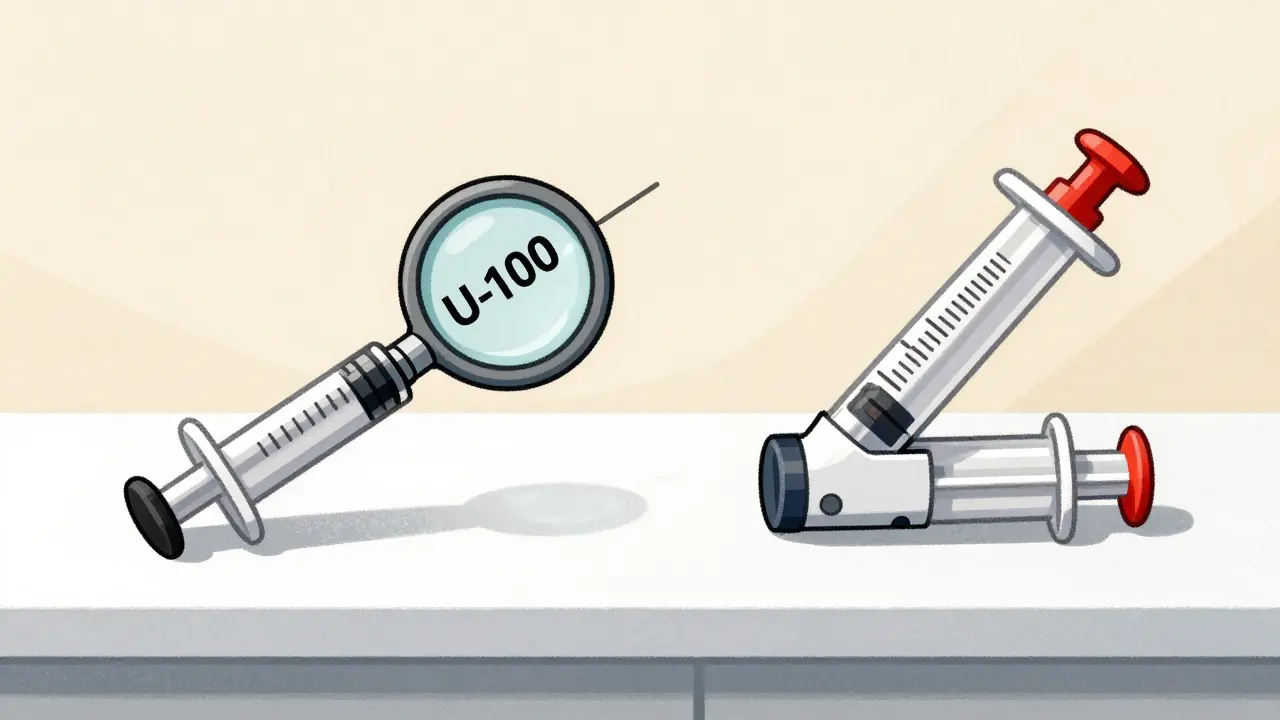
If you use syringes, make sure you’re using the right size. A 3-mL syringe is too large for precise small doses; the markings are spread out, making it hard to distinguish between 4 and 5 units. Stick to 1-mL (100-unit) syringes for standard doses. They have tighter gradations, allowing for better accuracy. And always check the color coding. U-100 syringes typically have black plungers and clear barrels, while U-500 syringes often have distinct red or orange accents to prevent mix-ups. Never swap them.
Calculating Your Dose: The Rules of Thumb
Many people feel overwhelmed by the math involved in insulin therapy. But once you understand the basic formulas, it becomes much less intimidating. There are two main calculations you’ll likely encounter: the carbohydrate ratio and the correction factor.
The Carbohydrate Ratio (The 500 Rule): This tells you how many grams of carbs one unit of rapid-acting insulin covers. You take the number 500 and divide it by your Total Daily Insulin Dose (TDD). For example, if you take 40 units of insulin a day, your ratio is 500 ÷ 40 = 12.5. This means one unit covers roughly 12 to 13 grams of carbohydrates. So, if you’re eating a meal with 60 grams of carbs, you’d need about 5 units (60 ÷ 12.5 = 4.8).
The Correction Factor (The 1800 Rule): This helps you figure out how much insulin to take to lower a high blood sugar reading. You take the number 1800 and divide it by your TDD. Using that same 40-unit example: 1800 ÷ 40 = 45. This means one unit of rapid-acting insulin will drop your blood glucose by approximately 45 mg/dL. If your target is 100 mg/dL and you’re currently at 220 mg/dL, you’re 120 points over. Divide 120 by 45, and you get 2.6. You’d round this to 2 or 3 units depending on your provider’s advice.
Note that some older guidelines use the 1500 rule for NPH insulin, but the 1800 rule is standard for modern rapid-acting analogs like Lispro or Aspart. Always confirm which rule your doctor recommends for your specific insulin type.
Recognizing and Treating Hypoglycemia
Hypoglycemia, or low blood sugar, is the most immediate danger of insulin therapy. It happens when your blood glucose drops below 70 mg/dL. Symptoms can come on quickly: shakiness, sweating, confusion, dizziness, or a racing heart. If you ignore these signs, it can progress to seizures or loss of consciousness.
The treatment is straightforward but must be acted upon immediately. Follow the "Rule of 15":
- Check your blood sugar if possible.
- Consume 15 grams of fast-acting carbohydrates. Examples include 4 ounces of fruit juice, 3-4 glucose tablets, or a tablespoon of honey.
- Wait 15 minutes.
- Check your blood sugar again.
- If it’s still below 70 mg/dL, repeat step 2.
Once your blood sugar is back above 70 mg/dL, eat a small snack with protein and complex carbs (like crackers with cheese) to keep it stable. Avoid treating a low with candy bars or ice cream alone, as the fat content slows down absorption and can cause a rebound spike later.

Switching Insulins: Proceed with Caution
Changing insulin brands or types is never a simple swap. Each product has a different onset, peak, and duration. For instance, switching from NPH (intermediate-acting) to Lantus or Basaglar (long-acting analogs) usually requires a dose reduction. Clinical guidelines suggest reducing the dose by about 20% to account for the smoother, more predictable action of the analogs. So, if you were taking 60 units of NPH, you might start with 48 units of Lantus.
Similarly, moving from Tresiba (insulin degludec) to Basaglar requires careful adjustment because Tresiba has a longer, flatter profile. If you were on 100 units of Tresiba daily, splitting that into twice-daily Basaglar might involve calculating 80% of the original dose, divided by two, resulting in 40 units every 12 hours. These transitions should always be done under medical supervision, with close monitoring of fasting glucose levels during the switch.
Practical Tips for Everyday Safety
Beyond the math and the devices, habits matter. Here are some practical steps to reduce error:
- Lighting: Always draw up or dial your insulin in good light. Poor lighting is a major cause of misreading syringe markings.
- Double-Check: Read the label twice. Once before preparing the dose, and once after. Say the name and strength out loud.
- Storage: Keep unopened insulin in the refrigerator (36°F to 46°F). Opened pens or vials can stay at room temperature for up to 28 days, but heat and cold extremes degrade the medicine. Never freeze insulin.
- Rotation: Rotate injection sites to prevent lipohypertrophy (lumpy tissue), which can affect insulin absorption. Don’t inject into the same spot repeatedly.
- Emergency Kit: Keep glucagon kits accessible and ensure family members know how to use them. Newer nasal glucagon formulations are easier to administer than injections.
Remember, insulin safety isn’t just about avoiding mistakes; it’s about building confidence through knowledge. By understanding the units, respecting the concentration differences, and knowing how to respond to lows, you take control of your health rather than letting fear dictate your actions.
What is the difference between U-100 and U-500 insulin?
U-100 insulin contains 100 units per milliliter, which is the standard concentration for most patients. U-500 insulin is highly concentrated, containing 500 units per milliliter. It is used for patients who require very large volumes of insulin daily. Using a U-100 syringe for U-500 insulin can result in a massive overdose, so specialized syringes or pens are mandatory for U-500.
How do I calculate my insulin correction factor?
For rapid-acting insulin, use the Rule of 1800. Divide 1800 by your total daily insulin dose. For example, if you take 50 units a day, 1800 ÷ 50 = 36. This means one unit of insulin will lower your blood sugar by approximately 36 mg/dL. Consult your doctor to verify this calculation for your specific regimen.
What should I do if I miss an insulin dose?
If you miss a dose, check your blood sugar immediately. If it’s been less than a few hours, take the missed dose as soon as you remember. However, if it’s close to the time for your next dose, skip the missed one and resume your regular schedule. Do not double up on doses to make up for a missed one, as this can cause severe hypoglycemia. Always follow the specific advice given by your healthcare provider.
Can I switch insulin brands without telling my doctor?
No. Different insulin brands and types have varying absorption rates and durations. Switching without medical guidance can lead to dangerous highs or lows. Even biosimilars may require slight dose adjustments. Always consult your doctor before changing products.
Why is there confusion about insulin conversion factors?
Research indicates that many sources incorrectly use a conversion factor of 6.0 instead of 5.18 when converting insulin units to mass-based SI units. While this mainly affects scientific reporting and lab values, it highlights the importance of sticking to standardized "units" for patient dosing rather than attempting mass conversions, which can vary based on the specific insulin formulation.