
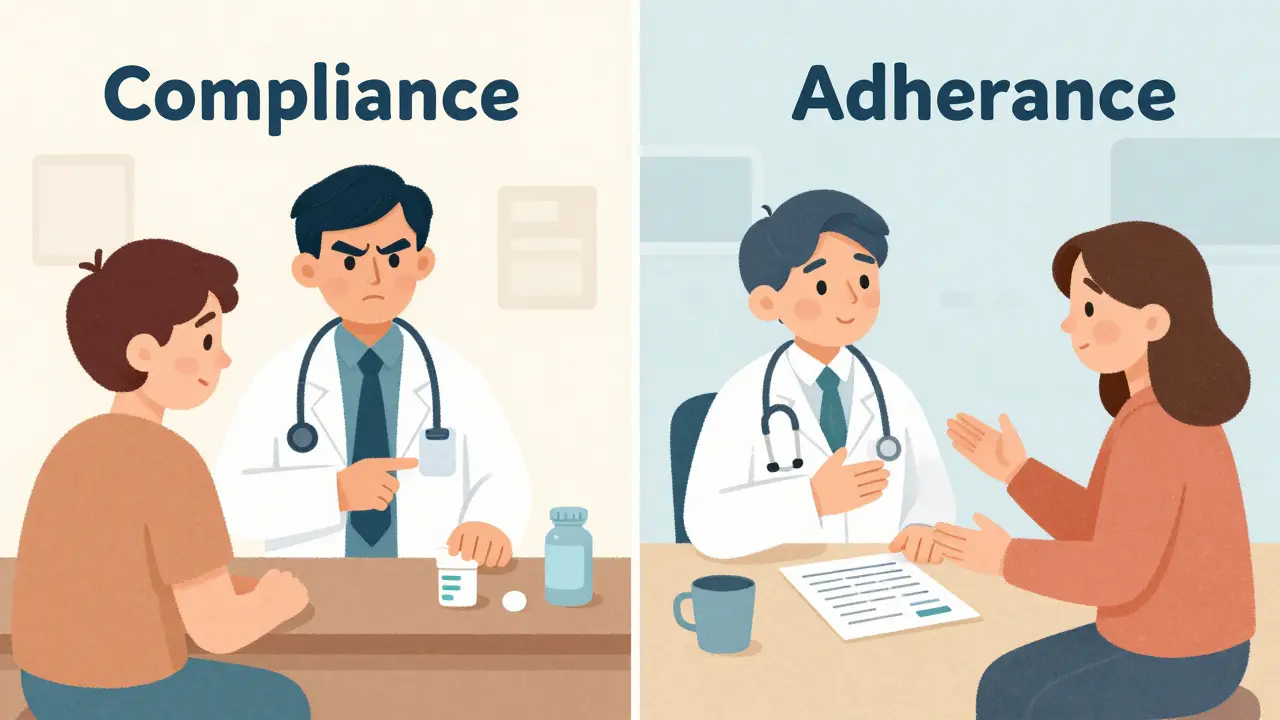
You’ve probably heard your doctor ask if you’ve been "compliant" with your meds. It sounds like a legal term, and for a long time, that's exactly how medicine treated it. But there is a massive difference between simply following orders and actually sticking to a health plan. While they might seem like the same thing, Medication Adherence is the extent to which a patient's behavior corresponds with agreed-upon recommendations from a healthcare provider . It is a partnership. Compliance , on the other hand, is more like a command-you do what you're told, and if you don't, you've "failed." Understanding this shift isn't just about semantics; it's about why some people get better while others stay sick despite having the right prescriptions.
The Big Shift: From "Doing as Told" to Working Together
For decades, medicine was paternalistic. The doctor was the boss, and the patient was a passive recipient of care. If you missed a dose, you were labeled "non-compliant." This approach ignores the human side of health. Why did you miss the dose? Was it too expensive? Did it make you dizzy? Or maybe you just forgot because your life is chaotic.
By the early 2000s, the industry started moving toward patient-centered care. This is where adherence comes in. Instead of a one-way street, it's a collaboration. When you and your provider agree on a plan, you're more likely to stick to it because you understand the why behind the treatment. A study published in the PubMed database (2023) highlights that adherence recognizes the patient's agency and choice, whereas compliance treats the patient as a subject following instructions.
How Doctors Actually Measure Success
It's one thing to say you're taking your meds, but how does a clinic actually prove it? In the world of Chronic Disease Management , data is everything. The American Medical Association (AMA) sets a pretty clear bar: you are considered adherent if you take at least 80% of your prescribed medicine. To figure this out, they use a few different tools:
- Pill Counts: Literally counting the remaining tablets in a bottle.
- Prescription Record Reviews: Checking how often you refill your script at the pharmacy.
- Electronic Monitoring: Using high-tech caps like the Medication Event Monitoring System (MEMS) that record every single time a bottle is opened.
- Medication Possession Ratio (MPR): A formula that calculates the percentage of days the patient actually had the medication in their possession.
Compliance measurements are much narrower. They usually only care if the drug was taken during a specific window, regardless of the patient's reasons for missing a dose.
| Feature | Compliance | Adherence |
|---|---|---|
| Patient Role | Passive (Follows orders) | Active (Partner in care) |
| Core Philosophy | Paternalistic/Command-based | Collaborative/Agreement-based |
| View of Failure | Disobedience or negligence | Identifiable barriers (cost, side effects) |
| Scope | Implementation (Taking the pill) | Full Journey (Start, use, and stop) |
| Outcome Goal | Obedience to the script | Improved health outcomes |
Why This Matters for Your Recovery
Why should you care about the terminology? Because the approach changes the outcome. When a doctor focuses on compliance, they might just tell you to "try harder" to remember your pills. When they focus on adherence, they ask, "What's stopping you from taking these?"
This makes a massive difference in the real world. Data from the Agency for Healthcare Research and Quality (AHRQ) suggests that adherence-focused care can lead to success rates 20-50% higher than compliance-based approaches. Why? Because it tackles intentional non-adherence (like when a patient decides the side effects aren't worth the benefit) and unintentional non-adherence (like forgetting a dose due to a busy schedule).
Think about a patient with hypertension. If they are just "complying," they might stop taking their meds the moment they feel "fine," because they don't understand that high blood pressure is a silent killer. An "adherent" patient, however, has had a conversation with their doctor about why the meds are necessary even when they feel great, making them far more likely to stay on the treatment long-term.
The Role of Technology in Staying on Track
We are moving into an era of precision health. It's no longer just about a plastic pill box and a prayer. New tools are closing the gap between intending to take a med and actually doing it. For example, systems like Hero Health have shown a 42% reduction in missed doses in some clinical settings. These devices don't just remind you; they track your behavior and alert your care team if things go off track.
Even bigger is the move toward AI. Recent studies by Google Health have shown that machine learning can predict who is likely to struggle with their meds with over 83% accuracy. By looking at socioeconomic factors-like whether you have reliable transport to a pharmacy-AI can help doctors intervene before you miss a dose, rather than scolding you after the fact.
Real-World Consequences of Getting It Wrong
The stakes are incredibly high. According to the World Health Organization (WHO), about 50% of patients with chronic diseases stop taking their medications within the first year. This isn't just a medical failure; it's a financial disaster. When people aren't adherent, they end up back in the emergency room. This is why the Centers for Medicare & Medicaid Services (CMS) now ties hospital payments to adherence metrics. If a hospital can't keep its patients adherent after discharge, they lose money.
In high-stakes scenarios, compliance still has a place. For example, when treating tuberculosis, doctors often use Directly Observed Therapy (DOT), where a healthcare worker literally watches the patient swallow the pill. In that narrow case, compliance is the only thing that matters. But for the millions of people dealing with diabetes, heart disease, or depression, a collaborative adherence model is the only way to see long-term improvement.
How to Improve Your Own Adherence
If you struggle to keep up with your prescriptions, stop blaming yourself and start looking at the barriers. Here are a few practical steps to move from passive compliance to active adherence:
- Ask the "Why": If you don't understand why you're taking a drug, you're less likely to take it. Ask your doctor exactly what this med is doing for your body.
- Discuss Side Effects Early: Don't just endure a side effect. Tell your provider. They can often adjust the dose or switch the medication to something that fits your lifestyle better.
- Sync Your Refills: Ask your pharmacy if they can align all your medication refills to the same day of the month to reduce the number of trips.
- Use Digital Aids: Whether it's a simple phone alarm or a smart dispenser, remove the "memory" requirement from your health routine.
- Be Honest: If you've missed doses, tell your doctor. They can't help you fix the problem if they think the medication isn't working, when in reality, you just weren't taking it.
Is it bad to be called "non-compliant" by a doctor?
It's not "bad" in a moral sense, but it is an outdated way of looking at healthcare. Being called non-compliant suggests you are simply disobeying orders. In reality, non-adherence is usually caused by specific barriers-like cost, fear of side effects, or forgetfulness. If your doctor uses this term, it's a great opportunity to pivot the conversation toward why the current plan isn't working for you.
What is the 80% rule in medication adherence?
The 80% rule, established by the American Medical Association, means that a patient is considered adherent if they take their medication correctly at least 80% of the time. This acknowledges that occasional missed doses are human and doesn't necessarily mean the treatment is failing.
Can AI actually help me take my meds?
Yes. Modern AI is being used to analyze behavioral patterns and socioeconomic data to predict when a patient is likely to stop their medication. This allows healthcare providers to step in with personalized support, such as reminding you about a refill or helping you find a cheaper generic version of a drug, before the gap in treatment occurs.
Does medication adherence actually save money?
Absolutely. Research shows that adherence-focused care can reduce treatment costs by 18-27% and significantly lower the rate of avoidable hospitalizations. While the initial consultation might take longer, it prevents the massive expense of an emergency room visit due to a condition that could have been managed at home.
What is the difference between intentional and unintentional non-adherence?
Intentional non-adherence happens when a patient consciously decides not to take a medication, perhaps because they disagree with the treatment or dislike the side effects. Unintentional non-adherence is when the patient wants to take the medicine but can't due to external factors, like forgetting the dose or not being able to afford the copay.
Steve Grayson
This is a really helpful way to look at it. Shifting the focus to a partnership definitely makes the whole process feel less like a chore and more like a health goal.
Nigel Gosling
Oh, please! Let's not pretend that changing a word from 'compliance' to 'adherence' is some grand enlightenment of the medical industrial complex!
It is absolutely tragic that we've reached a point where the mere vocabulary of a doctor's visit is treated like a spiritual awakening.
We are simply rebranding the same old power dynamic to make patients feel like they have a 'voice' while the pharmaceutical companies continue to bleed them dry.
It's a facade! A complete and utter masquerade of empathy designed to keep us docile and 'adherent' to a system that views us as nothing more than walking insurance claims.
The sheer audacity of suggesting that a 'partnership' exists when the doctor holds all the cards and the patient is just trying to survive the copay is laughable.
We're not partners; we're customers in a very expensive, very sterile waiting room.
The philosophy here is shallow, the logic is flawed, and the optimism is frankly nauseating.
I find it utterly repulsive that we celebrate this as progress.
True agency isn't being 'allowed' to discuss side effects; it's having a healthcare system that isn't designed to fail the poorest among us.
This entire shift is just lipstick on a pig.
It's a moral failure to pretend that semantics equal systemic change.
I am exhausted by this relentless pursuit of 'patient-centered' buzzwords.
Give me a break.
The tragedy of modern medicine isn't the word 'compliance'.
It's the void where actual care used to be.
Stephen Johnson
I think there's a quiet beauty in the idea of agency here. It's about acknowledging that the human experience is messy and that a pill isn't just a chemical-it's a part of a daily routine that can be disrupted by life.
Kat G
The 80% rule is a fair standard for measuring progress.
Sharon Mathew
I completely disagree with the idea that AI is some magical solution! 🙄
Imagine letting a machine predict your 'behavior' based on your zip code! That is absolutely terrifying and honestly just a new way to discriminate against people!
Who cares if it's 83% accurate? That means 17% of the time it's just guessing and probably judging us for being poor!
What a joke!
prince king
That's a very interesting point about the AI! 🌟 I think if we use it to help people instead of judge them, it could really be a game changer for accessibility! 😊
Aubrey Johnson
The distinction between intentional and unintentional non-adherence is basic. Only someone with a rudimentary understanding of behavioral psychology would find this revelation surprising.
Ryan Wilson
Let's be real: the 'partnership' talk is just a shiny wrapper for the same old medical gaslighting. They call it 'adherence' so they can pretend they care about your 'barriers' while they charge you five hundred bucks for a pill that costs three cents to manufacture. It's a parasitic dance of terminology where the only thing actually being 'adhered' to is the profit margin of the clinic.
Abhishek Charan
Wait... so doctors basically just guess if we're taking our meds... unless they have a high-tech cap??? 😱 That is so invasive!! 💊🚫 Why is this even allowed???
Thomas Jorquez
Its interesting how they use the MPR formula to track things, though it seems a bit overcomplicated for most folks.
Justin Crice
The integration of Medication Event Monitoring Systems (MEMS) suggests a pivot toward quantitative longitudinal data over qualitative patient self-reporting, which inherently reduces recall bias in chronic disease management cohorts.
Jarrett Jensen
The prose in this explanation is adequate, though the conceptualization of 'partnership' remains laughably idealistic given the structural hierarchies inherent in clinical settings.
Jenna Riordan
I have a friend who stopped taking her blood pressure meds because they made her feel exhausted all day. Her doctor just told her she was non-compliant and didn't even offer an alternative for months.
Raymond Lipanog
It is perhaps worthwhile to consider that the transition toward adherence represents a broader societal shift toward recognizing individual autonomy within institutional frameworks.
Nigel Gosling
Exactly! It is the institutionalization of the 'self' to make the machine run smoother! Absolute madness!