

You step on the scale after a week of eating clean and hitting the gym, only to find the number hasn't budged-or worse, it went up. It's a crushing feeling. But what if I told you that the scale is actually one of the least reliable ways to tell if you're getting healthier? Your weight is a fickle number, influenced by everything from a salty dinner to a hormonal shift. If you only look at that little screen on the bathroom floor, you're missing the real story of your transformation.
That's where Non-Scale Victories is any measurable improvement in a person's health, well-being, or behavior change that does not involve body weight. Also known as NSVs, these are the wins that prove your hard work is paying off, even when the scale is being stubborn. By shifting your focus from a single number to a broader set of health markers, you can maintain your motivation and build a lifestyle that actually lasts.
Why the Scale Often Lies
We've been conditioned to believe that weight loss equals health gain. In reality, the scale is a blunt instrument. It doesn't distinguish between muscle, fat, water, or bone density. You could be losing fat and gaining lean muscle-which is exactly what you want-but the scale might show you're "stuck." This creates a psychological trap where you feel like you're failing despite making objective improvements.
Daily fluctuations are a huge part of the problem. Factors like Sodium intake, hydration levels, and sleep quality can cause your weight to swing by 2 to 5 pounds in a single day. For women, hormonal cycles can cause significant water retention that has nothing to do with fat gain. When you rely solely on the scale, you're essentially gambling your mood on water weight.
The Four Pillars of Real Progress
To get a true picture of your health, you need to look at different domains. Clinical nutritionists often categorize these victories into four main areas. Tracking these gives you a comprehensive view of how your body is actually responding to your changes.
Biochemical Data
These are the "invisible" wins that happen inside your bloodstream. You can't see them in the mirror, but they are the most critical markers for long-term survival and disease prevention. For example, a drop in your Hemoglobin A1C (which measures average blood sugar over three months) or an improvement in your lipid panel is a massive win. When your blood pressure drops or your fasting glucose stabilizes, you are literally adding years to your life, regardless of what you weigh.
Functional Nutrition and Physicality
This is all about how your body *performs*. Are you less winded when climbing the stairs? Can you put on your shoes without holding your breath? These are functional markers. Notice if you're sleeping better and waking up feeling refreshed instead of groggy. Other signs include improved digestion, less bloating, and an increase in overall energy levels that means you no longer need a third cup of coffee to survive the 3 PM slump.
Behavioral Changes
The most sustainable victories are the ones that happen in your head and your habits. When you start listening to hunger and fullness cues instead of eating until you're stuffed, that's a win. Replacing sugary drinks with water or consistently prepping your meals for the week are behavioral milestones. These habits are the actual "engine" of health; the weight loss is just the exhaust.
Psychosocial Improvements
Health isn't just physical; it's mental. A huge non-scale victory is the reduction of food anxiety. Instead of obsessing over every calorie, you might find you're actually enjoying your food again. Improved mood, a more positive outlook on life, and a sense of pride in your discipline are powerful indicators that your lifestyle is moving in the right direction.
| Metric Type | Weight-Centric Focus | Holistic (NSV) Focus | Why It Matters |
|---|---|---|---|
| Measurement | Pounds/Kilograms | Biomarkers, Energy, Habits | Captures internal health, not just mass |
| Stability | High Daily Fluctuation | Gradual, Stable Trends | Prevents emotional burnout |
| Outcome | Aesthetic/Number | Functional Ability/Longevity | Focuses on quality of life |
| Motivation | External/Pressure-based | Internal/Achievement-based | Encourages long-term adherence |

How to Track Your Own Victories
If you don't track your wins, you'll forget them the moment the scale gives you a bad reading. To avoid this, stop guessing and start documenting. A great way to do this is by using the SMART Goal framework. Instead of saying "I want to feel better," make it specific and measurable.
Here are some relatable examples of how to turn a vague hope into a concrete non-scale victory:
- Vague: "I want to be more active." $ ightarrow$ SMART: "I will walk for 30 minutes five days a week for the next month."
- Vague: "I want to eat healthier." $ ightarrow$ SMART: "I will cook four dinners at home every week for the next three months."
- Vague: "I want more energy." $ ightarrow$ SMART: "I will replace my afternoon soda with sparkling water for 14 days straight."
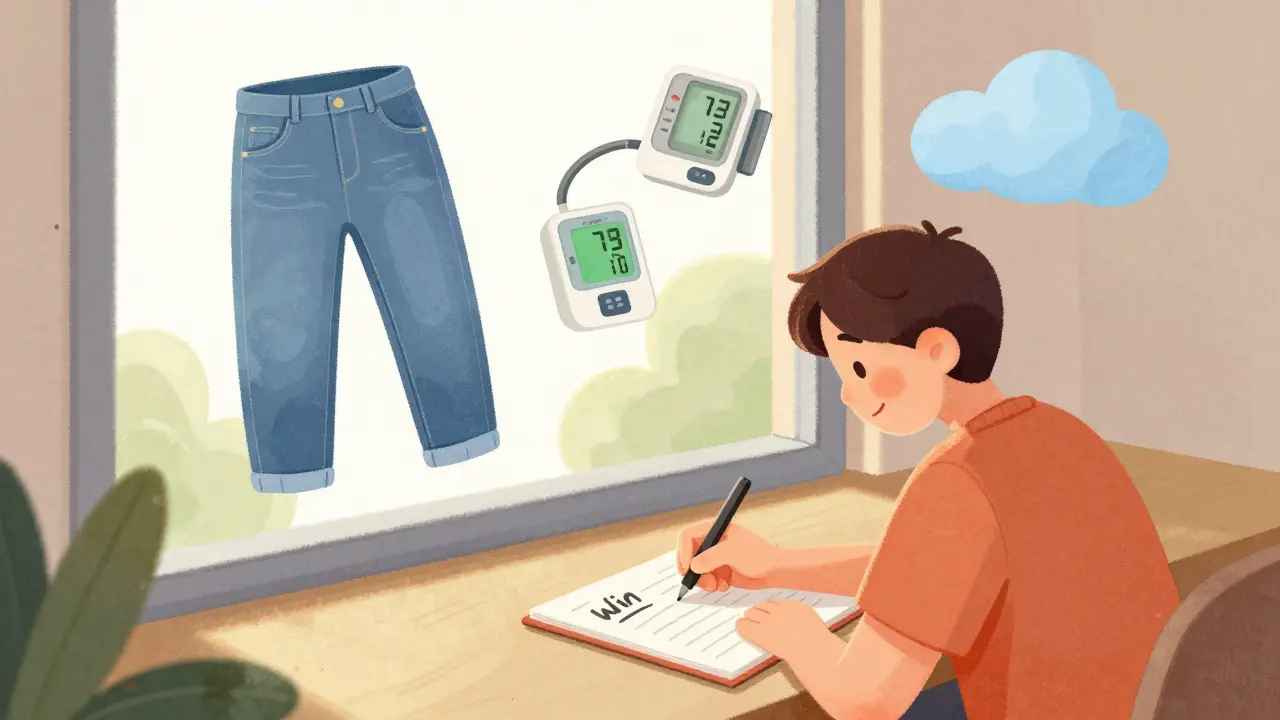
Keep a "Win Journal." Every Sunday, write down three things that went well that had nothing to do with weight. Maybe your clothes fit a little looser, or maybe you had the energy to play with your kids for an hour without needing a nap. These records become your armor when you have a bad day on the scale.
The Psychological Edge of NSVs
Why does this approach work so well? Because it changes your relationship with success. When you only track weight, you're in a binary state: you either "won" (weight went down) or "lost" (weight stayed the same or went up). This is a recipe for quitting.
By focusing on non-scale victories, you create multiple "win conditions." If the scale doesn't move, but you realize you can finally cross your legs when sitting or that your Blood Pressure is lower, you're still winning. This positive reinforcement reinforces your resolve and helps you stick to your plan during the inevitable plateaus.
Remember, you can be at a "healthy" weight and still be metabolically unhealthy, or have an undesirable ratio of body fat to lean muscle. True health is about how your organs function, how your joints feel, and how your mind operates. The scale is just one piece of a very large puzzle.
What are the most common non-scale victories for beginners?
For those starting a health journey, the most common NSVs usually involve energy and clothing. You might notice that your favorite jeans fit more comfortably, you stop feeling an afternoon energy crash, or you find that you're sleeping more soundly. Behavioral wins, like choosing water over soda or preparing a healthy lunch, are also huge early indicators of success.
Can I still weigh myself if I'm focusing on NSVs?
Absolutely. The goal isn't to ban the scale, but to stop letting it be the only judge of your progress. Many people find success by weighing themselves less frequently-perhaps once every two weeks-and treating that number as just one of many data points, rather than the definitive word on their health.
How do I know if my blood markers are improving?
The only way to track biochemical NSVs is through regular blood work ordered by a healthcare provider. Key markers to watch include Hemoglobin A1C for blood sugar control, LDL and HDL levels for heart health, and blood pressure readings. Even small improvements in these numbers can signify a massive reduction in your risk for chronic diseases.
Why does my weight fluctuate even when I'm eating right?
Weight fluctuations are normal and usually caused by water retention. High sodium intake, intense new workouts (which cause muscles to hold water for repair), hormonal shifts in women, and even the time of day you weigh yourself can cause swings of several pounds. These are not fat gains; they are simply fluid shifts.
How long does it take to see non-scale victories?
Some NSVs happen almost immediately. For instance, improved hydration can lead to better energy levels within days. Behavioral wins happen the moment you make a better choice. Functional wins, like increased strength or better sleep, usually take 2 to 4 weeks of consistency. Biochemical changes usually take longer and are best measured every 3 to 6 months.
What to Do Next
If you've been feeling discouraged by the scale, start by auditing your life outside of that number. Take a moment today to list three things you can do better now than you could six months ago. Did you stop needing a seatbelt extender on flights? Do you have more patience with your coworkers because you're less stressed? Do you feel stronger during your workouts?
If you're struggling to find your wins, try a "measurement swap." For one month, put the scale in the garage and use a measuring tape or a specific pair of "goal pants" to track physical changes. Focus on how you feel and how you function. When you stop chasing a number and start chasing a feeling of vitality, the results-including the ones on the scale-usually follow naturally.
Betty Kawira
I've seen so many clients spiral because they hit a plateau on the scale while their body composition is actually shifting in a huge way. One thing that really helps is taking progress photos every few weeks because the mirror can play tricks on you but a photo doesn't lie. Also, tracking your strength in the gym is a massive NSV-if you're lifting heavier weights, you're building muscle, and that muscle is what keeps your metabolism firing even when the weight doesn't move. Focus on the feeling of your clothes loosening up rather than the digits on the machine.
Kali Murray
finally someone says this 🌸 my jeans fitting better is way more satisfying than any number anyway ✨
Abhishek Charan
Actually, the scale is the ONLY objective measurement we have!!! 🙄 Everything else is just subjective "feelings" or expensive blood tests that most people can't afford every month!!! 📉 Why complicate a simple number with all this fluff??? 🧐
Aubrey Johnson
It is quite amusing that some people need a whole journal to realize they are failing. Most of us simply track our macros with precision. If the scale does not move, you are not in a deficit. It is simple math. This holistic approach is just a way to make people feel better about poor results.
Trish Perry
It's wild how we've tied our entire self-worth to a piece of plastic and metal on the floor. We basically let a machine tell us if we had a good day or a bad day. When you shift the goal to just feeling more alive or having a clearer head, the whole journey changes from a punishment to a practice. It's less about reaching a destination and more about the actual state of being healthy in the moment.
Thomas Jorquez
i agree with the point about water weight... happens to the best of us. its just part of the process i guess.
Steve Grayson
The point about behavioral changes is spot on. Once the habit is there, the results just happen as a byproduct. I started walking more and the energy boost was way more noticeable than any weight change in the first month.
Jenna Riordan
I bet a lot of people who use these "non-scale victories" are just avoiding the truth about their diet. You can't just ignore the numbers and pretend everything is fine if you aren't actually losing fat. I wonder if people even keep their journals or if they just write things down to feel a fake sense of accomplishment.
Kat G
Focusing on energy levels is a very good idea. It helps a lot with staying motivated.