
Pediatric Medication Dose Calculator
How This Works
Based on CDC and AAP guidelines: Always calculate doses by weight in kilograms, never by age or volume. Your child's weight determines the safe dose.
Never use teaspoons or tablespoons - kitchen utensils vary in size. Always use the measuring device that came with the medicine.
Result
Why This Matters
According to the article: One wrong decimal point can turn a safe dose into a lethal one. The CDC reports that 20% of pediatric poisonings involve household items, and 45% of pill ingestions happen because medicine was moved to non-original containers.
Critical Never give OTC cough/cold medicine to children under 6. Even common items like prenatal vitamins (with iron) or diabetic insulin can cause emergencies.
Remember: Call Poison Help immediately at 800-222-1222 if your child ingests medicine - even if they seem fine. Symptoms can take hours to appear.
Every year, 50,000 children under age 5 end up in emergency rooms because they got into medicine they shouldn’t have. Many of these cases aren’t accidents-they’re preventable mistakes. Children aren’t small adults. Their bodies process drugs differently, they can’t tell you when something feels wrong, and even a tiny dose meant for an adult can be deadly. Yet, too many parents and caregivers are flying blind when it comes to giving medicine to kids.
Why Kids Are at Higher Risk
Children’s bodies are still growing. Their kidneys and liver, which break down and remove medicines, aren’t fully developed. A dose that’s safe for a teenager might be five times too strong for a toddler. Infants under one year old can weigh as little as 3 kilograms. By age 12, they might weigh 40 kilograms or more. That’s a 13-fold difference in body size-and a massive margin for error if you’re guessing the dose. The biggest danger? Weight-based dosing mistakes. In hospitals, errors happen when staff mix up pounds and kilograms. One wrong decimal point can turn a safe dose into a lethal one. At home, the problem is often worse. Parents use kitchen spoons to measure liquid medicine, not knowing that a teaspoon is 5 milliliters and a tablespoon is 15. Giving 1 tablespoon instead of 1 teaspoon means a child gets three times the intended dose. That’s not a typo. That’s a medical emergency.What Medicines Are Most Dangerous?
It’s not just opioids or heart pills. Common household items can kill a child in minutes. Prenatal vitamins? One can contain enough iron to stop a toddler’s heart. Diabetic insulin? A single drop too much can cause a seizure. Even cough syrups, which many parents think are harmless, can cause breathing problems in kids under 6. The American Academy of Pediatrics says: Never give over-the-counter cough or cold medicine to children under 6. And under 2? Absolutely not. Even things you wouldn’t call medicine can be deadly. Diaper rash creams with zinc oxide, eye drops, liquid vitamins, and topical creams with strong ingredients like menthol or camphor have all sent children to the ER. The CDC found that 20% of pediatric poisonings involve these so-called “non-prescription” products.How Hospitals Are Trying to Fix This
Hospitals that treat kids regularly have learned the hard way. They now use strict rules:- All medication doses are calculated in kilograms only-no pounds allowed.
- High-risk drugs like morphine or insulin come in standardized concentrations so there’s no confusion about strength.
- Two trained staff members double-check every dose before giving it to a child.
- Medication prep areas are quiet zones-no phones, no distractions.
- IV bags and oral liquids are labeled in milliliters only. No teaspoons, no tablespoons.
Home Safety: What You Can Do Today
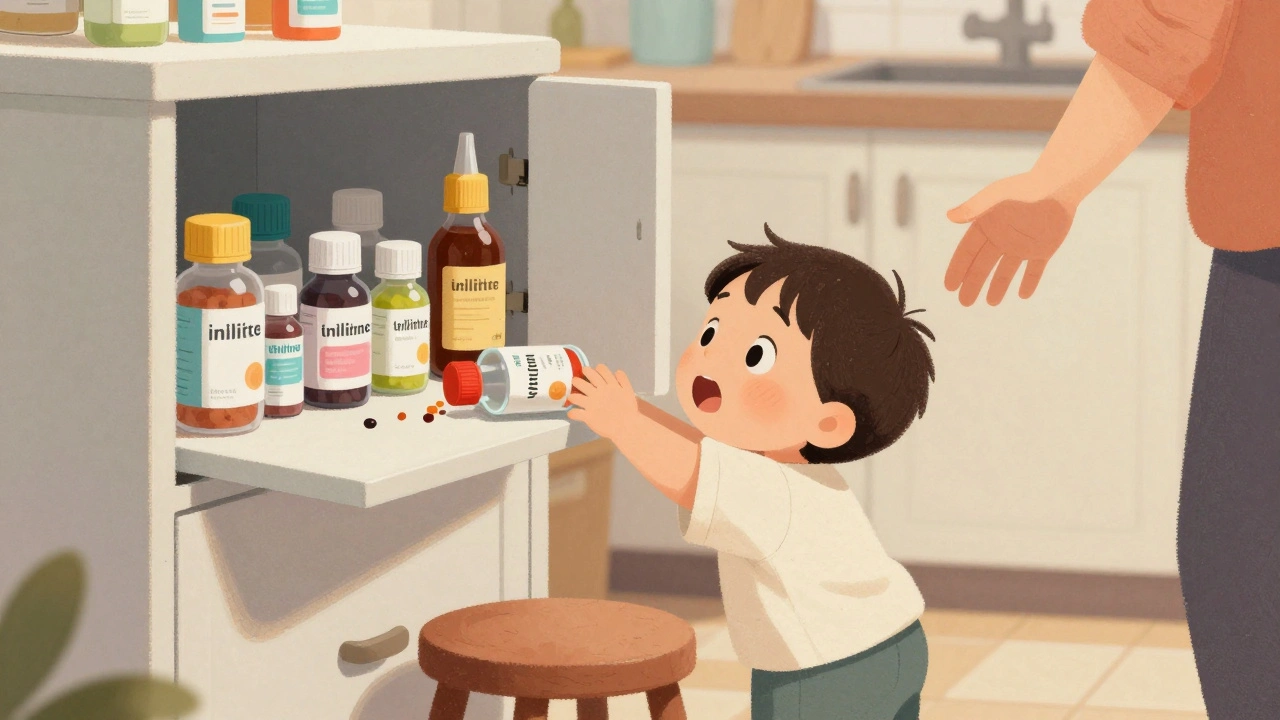
Most pediatric poisonings happen at home. Not in a hospital. Not in a clinic. In the kitchen cabinet, on the bathroom counter, in the purse left on the couch. The CDC’s PROTECT Initiative says: Store all medicine up and away and out of children’s reach and sight. That means not on a high shelf if your child can pull a chair over. Not in a drawer if the latch doesn’t lock. Not in your pocket or purse. Even if you think you’ll only be gone for a minute. And here’s what most people get wrong: child-resistant caps don’t work if you don’t close them right. A 2013 study found that kids can open bottles that aren’t fully locked in under 30 seconds. If you’re in a hurry and just twist it halfway? That’s not safe. That’s a gamble. Don’t remove pills from their original bottles. A 2020 study showed that 45% of pediatric pill ingestions happened because the medicine was moved to a pill organizer, a candy jar, or a random container. Kids know what candy looks like. If it’s in a colorful bottle with a funny label, they’ll try it.How to Give Medicine Correctly
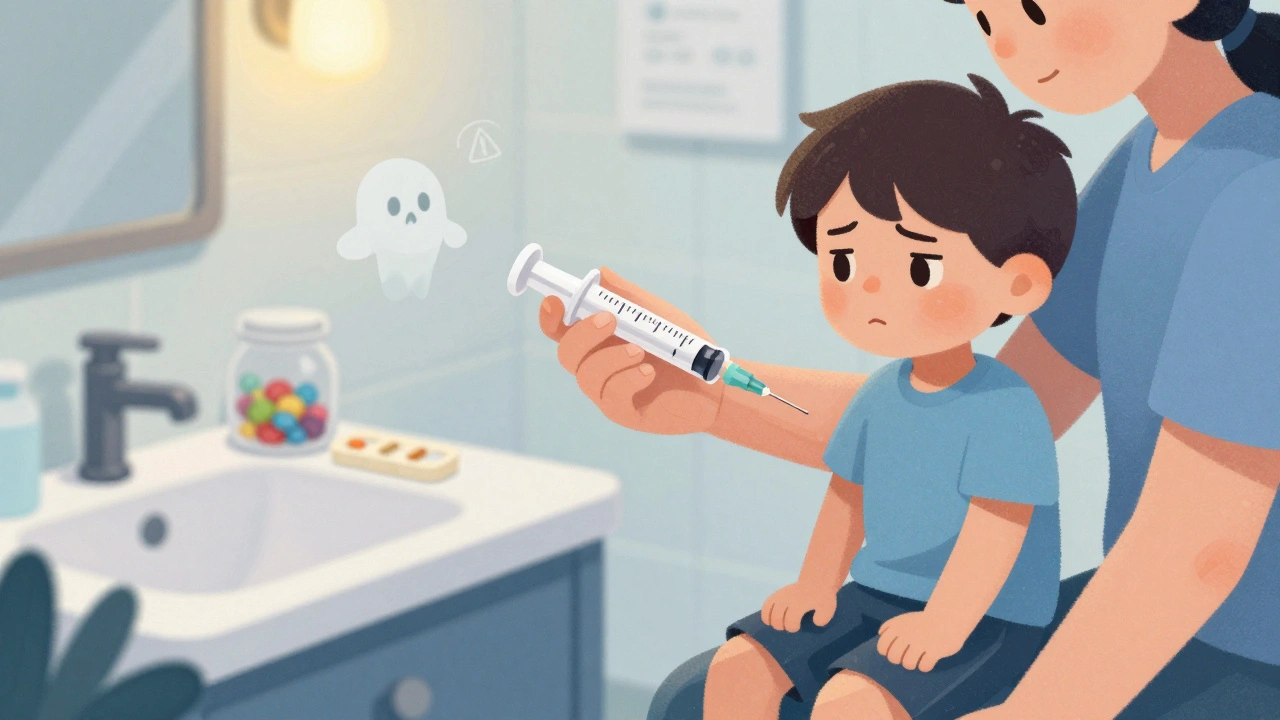
If you’re giving liquid medicine, use the device that came with it-the syringe, the dosing cup, the dropper. Never use a kitchen spoon. Even if it says “teaspoon,” kitchen spoons vary in size. A real measuring device gives you milliliters. That’s the only safe unit. When giving medicine by mouth, aim it toward the back of the cheek, not the tongue. Kids often spit out medicine if it hits their tongue. And never, ever say, “This is candy.” That’s how kids learn to sneak medicine. Poison Control data shows 15% of accidental ingestions happen because a parent told a child medicine tasted like candy.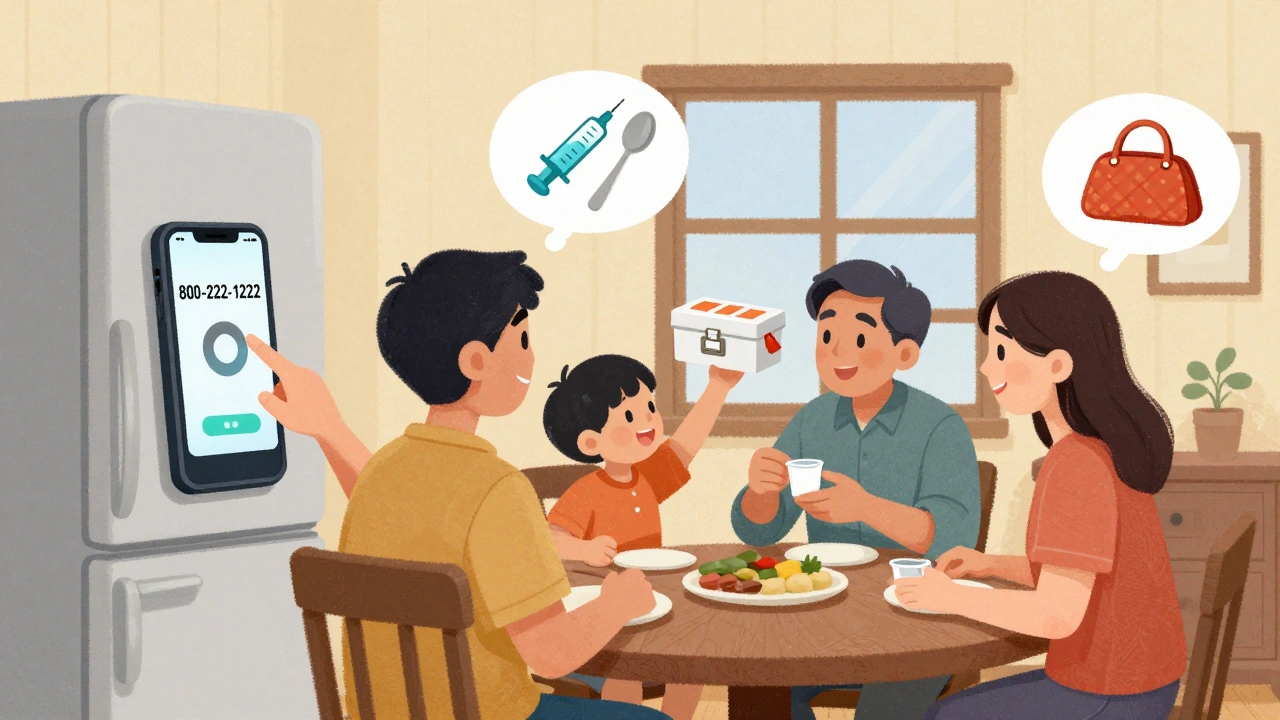
What to Do If Your Child Gets Into Medicine
If you suspect your child swallowed something they shouldn’t have, don’t wait for symptoms. Don’t call your pediatrician first. Don’t Google it. Call Poison Help immediately: 800-222-1222. That number works anywhere in the U.S. and connects you to experts who know exactly what to do. Program it into your phone. Save it on your fridge. Tell your babysitter. Teach your older kids what it means. If your child is unconscious, having trouble breathing, or having a seizure, call 911 right away. But even if they seem fine, call Poison Help. Some poisons don’t show symptoms for hours.What’s Changing in 2025?
The FDA now requires new pediatric drugs to come in standardized concentrations. That means manufacturers can’t sell a liquid antibiotic in 5 different strengths anymore. It’s one strength, clearly labeled. This should cut concentration errors by 60% in the next few years. More hospitals are using pictogram-based dosing sheets-simple pictures showing how much to give, when, and how. One study showed these improved correct dosing by 47% in families with low health literacy. That’s huge. And now, the CDC recommends “teach-back” for home instructions. That means instead of just handing you a label, the pharmacist asks you: “Can you show me how you’ll give this to your child?” If you do it wrong, they correct you right then. This reduces errors by 35%.Final Checklist for Parents and Caregivers
- Always use milliliters (mL) to measure liquid medicine-never teaspoons or tablespoons.
- Keep all medicine, even vitamins and creams, locked up and out of sight.
- Always re-lock child-resistant caps-even if you think you’ll use it again soon.
- Never refer to medicine as candy or a treat.
- Program 800-222-1222 into your phone and your child’s caregiver’s phone.
- Ask the pharmacist: “Can you show me how to give this correctly?”
- Never give OTC cough/cold medicine to children under 6.
- If you’re unsure about the dose, call your doctor or Poison Help before giving it.
Medicine isn’t harmless. For children, it’s one of the most dangerous things in the house-if it’s not handled right. But with a few simple steps, you can turn a high-risk situation into a safe one.
Michael Robinson
It's wild how we treat medicine like candy and then act shocked when kids get hurt. We don't let them touch the stove, but we leave pills on the nightstand like it's no big deal. Kids aren't little adults. They're tiny humans with fragile systems. We need to treat their meds like they're loaded guns-because honestly, they are.
Simple stuff: use the syringe. Lock it up. Don't say it's candy. Call Poison Help first, not Google. These aren't suggestions. They're survival rules.
Why do we make this so hard?
Kathy Haverly
Oh please. This is just fearmongering dressed up as public service. Kids have been swallowing pills since the dawn of time. Most of them survive. You think parents are idiots? Maybe. But they’re also tired, overworked, and trying to do their best. You want to save kids? Fix the healthcare system that makes medicine unaffordable and then blames parents for using kitchen spoons because they can’t afford a dosing cup.
Also, ‘never give OTC cough medicine under 6’? So what? I gave my kid Robitussin when he was 4 and he’s now a healthy 14-year-old. Stop scaring people into paralysis.
And why do you think the FDA is only acting now? Because lawyers got rich off lawsuits, not because kids were dying. Wake up.
Haley P Law
OMG I JUST REALIZED I LEFT MY VITAMINS ON THE BATHROOM COUNTER 😭 I’M A TERRIBLE MOM 😭
My 2-year-old opened my purse yesterday and ate three gummy vitamins. I screamed. The dog barked. My husband yelled. We all cried. Then we called Poison Help and they said ‘it’s fine, she’ll be okay.’
But I’m still traumatized. Like… why do vitamins have to look like gummy bears?? Who designed that??
Also, I now lock everything. Even my eyeliner. I’m not taking chances. 💔💊
PS: I love this post. Thank you. I’m sharing it with my entire family group chat. #MomLife #MedSafety
Andrea DeWinter
Let me tell you what I saw in the ER last month. A 17-month-old brought in after swallowing a whole bottle of children’s ibuprofen because the cap wasn’t locked. Mom thought she twisted it enough. She didn’t.
She was crying so hard she couldn’t speak. The nurse had to ask her the same question three times. That’s the moment I realized: this isn’t about ignorance. It’s about exhaustion. We’re not stupid. We’re overwhelmed.
So here’s what I do now: I keep all meds in a locked cabinet in the laundry room. No one goes in there unless they’re doing laundry. I use the syringe. I write the dose on the syringe with a Sharpie. I show my babysitter. I ask the pharmacist to demonstrate. No exceptions.
And if you think it’s overkill? Go sit in the pediatric ER for a shift. Then come back and tell me what’s overkill.
One mistake. One second of distraction. One unlatched cap. That’s all it takes. We owe it to our kids to be better.
precious amzy
One is compelled to interrogate the epistemological foundations of this ostensibly didactic discourse. The assertion that ‘children are not small adults’ is not merely a physiological truism-it is a cultural construct, a product of biomedical hegemony. Who defined ‘safety’? Whose standards of dosage were universalized? The FDA’s ‘standardized concentrations’ are not innovations-they are bureaucratic capitulations to liability aversion, not child welfare.
Moreover, the demonization of the kitchen spoon is a classist trope. In many cultures, including those with deep medicinal traditions, dosing is performed by volume estimation, not calibrated syringes. To pathologize these practices is to erase epistemic diversity.
And yet, one must concede: the data on pediatric toxicity is alarming. But the solution lies not in surveillance, nor in punitive parenting, but in the dismantling of pharmaceutical capitalism itself.
Perhaps, then, the real poison is not the medicine-but the system that commodifies it.
William Umstattd
Let me be perfectly clear: if you use a kitchen spoon to measure medicine for your child, you are not a good parent. You are negligent. You are putting your child’s life at risk for the sake of convenience. There is no excuse. Not tired. Not busy. Not ‘I didn’t know.’
Every single parent who reads this and says, ‘I’ve never had a problem,’ is just lucky. Not smart. Not careful. Lucky.
And if you think child-resistant caps are foolproof, you’re delusional. They’re designed to slow down a child, not stop them. If you don’t lock them properly, you’re literally gambling with their life.
I don’t care if you’re a single mom working three jobs. You have one job: keep your child alive. And that means using the syringe. Locking the cabinet. Calling Poison Help. No exceptions. No excuses. This isn’t opinion. This is fact. And if you ignore it, you don’t deserve to be a parent.
Tejas Bubane
Bro this whole post is so American. We got 50k ER visits? Big deal. In India, kids drink whatever they find. We don’t have dosing cups. We don’t have locked cabinets. We have moms who know their kids’ bodies better than any FDA guideline.
My cousin’s kid swallowed half a bottle of paracetamol at age 2. He was fine. He’s 18 now. Plays cricket. No brain damage.
Stop scaring people with stats. Real parents don’t need a checklist. They use their eyes. Their gut. Their experience.
Also, why do you think the FDA is only now fixing this? Because they finally got sued by rich white parents. Not because kids were dying. Just saying.
Ajit Kumar Singh
My brother’s daughter in Delhi, she took one tablet of blood pressure medicine, she was 3 years old, she slept for 12 hours, she woke up, she played with dolls, she is fine now, she is 12 now.
So why you all so scared? In India we don’t have these syringes, we don’t have locked cabinets, we don’t have poison help numbers, we have mothers, we have love, we have common sense.
Also, why you say cough syrup bad for kids? My uncle gave me cough syrup when I was 4, I still coughing, but I am alive, I am engineer now.
Maybe you need to stop worrying and let children be children. Medicine is not poison. Fear is poison.
Anna Roh
My kid got into my thyroid meds once. I didn’t even know until he threw up at 3 a.m. and I saw the bottle on the floor.
Turned out it was just one pill. He was fine. I called Poison Help anyway. They said ‘probably fine, but keep an eye on him.’
Now I lock everything. Even my vitamins. Even my husband’s testosterone gel. I’m not risking it again.
Also, I used to use spoons. I don’t anymore. It’s not hard. Just buy a $3 dosing cup. Seriously. It’s not a big deal.
Asset Finance Komrade
The notion that ‘medicine is one of the most dangerous things in the house’ is, in fact, a symptom of a broader ontological dislocation within Western parenting culture. We have infantilized risk, commodified vigilance, and turned the domestic sphere into a biosecurity zone.
One must ask: is the elimination of all potential harm truly the ethical imperative, or merely the projection of parental anxiety onto the child’s body?
Moreover, the fetishization of milliliters and syringes ignores the cultural epistemologies of dosing practiced globally. The ‘standardized concentration’ is not a universal good-it is a colonial imposition of metrological precision upon lived, embodied knowledge.
And yet-
...I do lock my meds now. I bought the cabinet. I use the syringe. I saved the number. Because even if the logic is flawed, the data is undeniable. Iron in a prenatal vitamin? Yes. That can kill. I’ve seen it.
Jennifer Blandford
I just want to say thank you to whoever wrote this. I’m a grandma raising my granddaughter and I used to keep meds on the counter ‘just in case.’ I didn’t think about it. Now I know better.
I bought a lockbox. I got a dosing syringe. I put the poison number on the fridge next to the microwave.
And yesterday, my granddaughter asked me why the medicine box has a picture of a skull. I told her, ‘Because it’s powerful, baby. And we have to be careful with powerful things.’
She nodded. Like she understood.
Thank you for helping me be the kind of grandma she needs.
Brianna Black
This is one of the most important pieces of public health information I’ve read in years. As a pediatric nurse, I see the aftermath of these mistakes daily. The child who survived but has brain damage. The toddler who needed a liver transplant after an iron overdose from a vitamin. The parents who cry, ‘I didn’t mean to.’
But here’s the truth: you didn’t mean to, but you still caused harm. And that’s why we need these rules.
Don’t wait for a tragedy to change. Do it now. Lock it up. Use the syringe. Call Poison Help. Teach your babysitter. Share this post.
One child saved is one too many to lose.
Ronald Ezamaru
I’m a dad of three. I used to think I was careful. Then I found my 4-year-old holding a bottle of melatonin like it was candy. He smiled at me and said, ‘Taste good, Daddy.’
That was the day I stopped being a dad who hopes for the best and became a dad who plans for the worst.
I now have a locked cabinet in the garage. I label every bottle with the child’s name and dose. I use the syringe. I never say it’s candy. I’ve taught my kids that medicine is for grown-ups only.
And I keep the poison number on my phone lock screen.
If you’re reading this and you haven’t done any of this yet-do it today. Not tomorrow. Today.
Ryan Brady
Why are we letting the government tell us how to parent? Next they’ll ban sugar, then hugs, then letting kids play outside.
My kid took a whole bottle of Tylenol once. He was fine. He’s 8 now. Plays football. Doesn’t even remember it.
Stop scaring parents. You’re not saving kids-you’re making them anxious. Let people use their judgment. Not a checklist.
Also, why do you think the FDA only cares now? Because they’re scared of lawsuits. Not because kids are dying. Wake up.
🇺🇸 #ParentingFreedom #StopTheFear
Andrea DeWinter
Thank you for sharing that story, Ronald. I’ve said the same thing to my friends. One of them didn’t believe me until her 3-year-old opened a bottle of liquid antihistamine and drank half. She didn’t know it was dangerous. She thought it was just for allergies.
She called Poison Help. They told her to watch for drowsiness. He slept for 10 hours. She cried the whole time.
Now she has a lockbox. She uses the syringe. She tells every new parent she meets.
That’s how change happens. Not with laws. Not with fear. With stories. With one parent telling another: ‘I almost lost mine. Don’t let it happen to you.’