

The goal isn't just to catch problems, but to distinguish between them. We need to know if a side effect is a common reaction to the drug's mechanism or a specific issue caused by the biosimilar's unique structure. Without precise tracking, we risk blaming the wrong product or missing a rare but serious safety signal.
Key Takeaways for Safety Monitoring
- Biosimilars are highly similar, not identical, to reference products, making traceability critical.
- Monitoring focuses heavily on immunogenicity-the risk of the patient's immune system reacting to the drug.
- Systems rely on a mix of spontaneous reports (FAERS, EudraVigilance) and active surveillance (Sentinel).
- The biggest practical hurdle is "attribution error," where the specific brand or manufacturer isn't recorded.
Why Biosimilars Need Specialized Surveillance
To understand why we can't just use standard generic monitoring, we have to look at the biology. Biosimilars is a biological product that is highly similar to an already-approved reference biologic, with no clinically meaningful differences in safety, purity, or potency. Unlike a simple aspirin tablet, these are massive molecules. Small changes in the manufacturing process can lead to different Immunogenicity, which is the ability of a substance to provoke an immune response in the body.
If a patient develops antibodies against a biosimilar, the drug might stop working, or worse, cause a severe allergic reaction. Because these risks are specific to the molecular structure, regulatory bodies like the European Medicines Agency (EMA) and the FDA require a rigorous post-approval plan. They don't just wait for a doctor to call; they mandate Risk Management Plans (RMPs) that specifically detail how immunogenicity will be tracked in the real world.
How Adverse Events Are Actually Tracked
Safety monitoring isn't one single tool; it's a dual-track system. First, there are Spontaneous Reporting Systems (SRSs). These are the "suggestion boxes" of medicine. When a doctor notices a patient has a rash or a fever after an injection, they report it to databases like the FDA's FAERS (FDA Adverse Event Reporting System) or the EMA's EudraVigilance.
But spontaneous reports are notoriously unreliable. Doctors are busy, and patients often forget which brand they were using. To fix this, regulators use Active Surveillance (AS). The FDA's Sentinel Initiative is a great example. Instead of waiting for a report, it proactively scans electronic health records and insurance claims to find patterns that might indicate a safety issue.
| Feature | United States (FDA) | European Union (EMA) | Canada (Health Canada) |
|---|---|---|---|
| Identification Method | Four-letter suffixes (e.g., -abp21) | Standard brand name tracking | Mandatory brand name reporting |
| Reporting Timeline | Serious: 15 days; Non-serious: 90 days | Unified biologic framework | Serious: 15 days; Non-serious: 90 days |
| Specific Requirements | PSURs every 6 months (first 2 years) | Annual PSURs + PBRER every 3 years | Detailed immunogenicity monitoring in RMP |
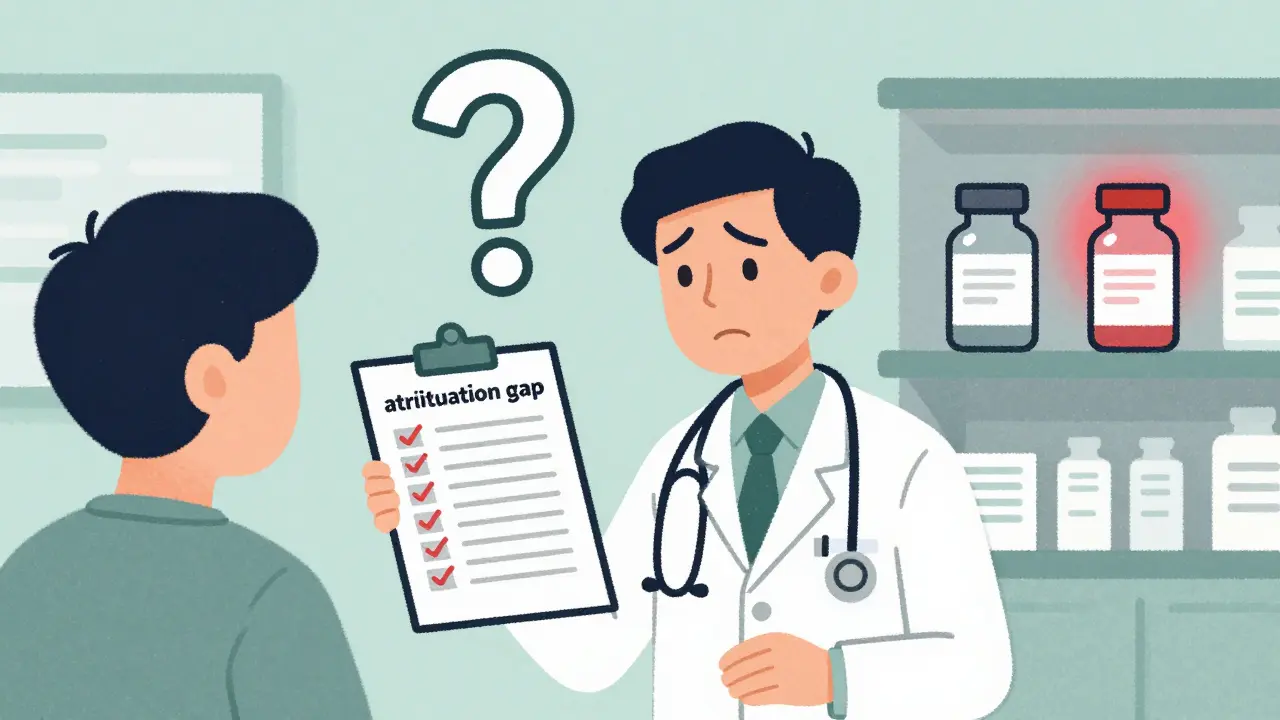
The "Attribution Gap": The Biggest Problem in the Clinic
Here is where the theory meets the messy reality of a hospital. A hematologist might prescribe a reference product, but the pharmacy switches it to a biosimilar to save costs. If the patient has a reaction, the doctor records it as a reaction to the reference product because that's what's on the chart. This is called an attribution error.
In the U.S., the confusion is real. A survey of over 1,200 physicians showed that about 63% felt confused when documenting these events. In oncology and hematology, that number jumps to over 80%. When we don't know exactly which vial was used, the safety data becomes noise. This is why some regions, like Spain, have pushed for mandatory identification of biosimilars within electronic health records, which reportedly boosted reporting accuracy from 58% to 92%.
The Role of Modern Tech in Safety Monitoring
We are moving past simple spreadsheets. The industry is now leaning on AI and Machine Learning to sift through millions of reports. The EMA's VigiLyze system uses AI to process over a million cases a year, helping regulators spot a "signal"-a potential new side effect-with over 92% accuracy.
Beyond AI, there is a push for a global unique device identifier (UDI) system for biologics. Imagine a barcode that tells the regulator exactly which batch, from which factory, went into which patient. While expensive to implement, it's the only way to truly solve the attribution problem as the number of biosimilars on the market grows from dozens to hundreds.

Avoiding Common Pitfalls in Reporting
For healthcare providers and pharmacists, the goal is "traceability." If you're documenting an adverse event, avoid generic terms. Writing "anti-TNF therapy" isn't enough. You need to specify the brand and, if possible, the lot or batch number. This is the gold standard recommended by the International Society for Pharmacoeconomics and Outcomes Research (ISPOR).
If you are a patient, keep a log. Note the exact name of the medication on the box and the date of the injection. Because 41% of patients in some surveys aren't even sure which version of a drug they are taking, your personal records might be the only accurate data point the doctors have.
What is the difference between a biosimilar and a generic drug?
Generics are chemically identical copies of small-molecule drugs. Biosimilars are made from living cells and are "highly similar" but not identical to the reference biologic. Because of this complexity, biosimilars require more intense safety monitoring, especially regarding how the immune system reacts to them.
What does "immunogenicity" mean in this context?
Immunogenicity is when a patient's immune system recognizes the biosimilar as a foreign substance and creates antibodies against it. This can lead to a loss of efficacy (the drug stops working) or cause an allergic reaction.
How are biosimilars tracked in the US vs. Europe?
The FDA often uses unique four-letter suffixes (like -abp21) to differentiate biosimilars from their reference products. The EMA generally uses a unified pharmacovigilance framework for all biologics, relying heavily on brand-name tracking and the EudraVigilance database.
What is a PSUR and why is it important?
A Periodic Safety Update Report (PSUR) is a document manufacturers must submit to regulators. It summarizes the worldwide safety experience of a drug, allowing regulators to see if the benefit-risk balance has shifted since the drug was approved.
Can a biosimilar be swapped for a reference product safely?
Many can, but some are designated as "interchangeable." For interchangeable products, the FDA requires extra data to show that switching between the two doesn't increase safety risks or reduce effectiveness.
Next Steps for Better Safety
If you're a clinician, start by auditing your EHR. Does your system capture the specific manufacturer, or just the drug class? If it's the latter, you're contributing to the attribution gap. Transitioning to a system that mandates brand and lot number entry is the best way to protect your patients.
For pharmaceutical companies, the shift is toward Real-World Evidence (RWE). Moving beyond spontaneous reports to integrated data lakes-where insurance claims and clinical outcomes are linked-will be the only way to detect rare side effects that only appear in 1 out of 10,000 patients.
Benjamin cusden
The fascination with these a-priori distinctions is quaint, but one must realize that the "attribution gap" is not a failure of the system, but a failure of the practitioners. It is quite elementary that the lack of pharmacological rigor at the point of care renders any high-level surveillance nearly moot. If the clinician cannot distinguish a biologic from a small molecule, the data is noise by definition.
dwight koyner
It is crucial to highlight that the lot number is indeed the most reliable piece of data we have for traceability. In my experience, collaborating directly with pharmacy leads to ensure that the exact brand and batch are recorded in the EHR significantly reduces the risk of attribution errors and improves patient safety outcomes over the long term.
jack hunter
honestly who cares about the labels anyway... its all just big pharma pushin stuff on us and the whole "biosimilar" thing is just a semantic game to make us feel like its safer than it actually is. why do we trust a system that admits its own reports are "notoriously unreliable" lol. its all a loop of meaningless data points and the truth is just whatever the highest bidder says it is.
Ethan Davis
Exactly. They talk about AI like VigiLyze to "spot signals" but that's just a fancy way of saying they're using algorithms to hide the real side effects until the lawsuits get too big to ignore. Trust me, the gap between the lab and the clinic is where they bury the bodies.
Windy Phillips
It is simply exhausting to see how little effort is put into basic documentation... really, it is a tragedy!!! One would think that in a professional medical setting, the difference between a reference product and a biosimilar would be treated with the utmost gravity... but alas, the incompetence is staggering!!!
Ruth Swansburg
We can definitely improve this together! Better tracking saves lives.
Daniel Trezub
I'm not sure I agree with the emphasis on the UDI system. It sounds great on paper, but the logistics of implementing a global barcode for every single biologic batch is a nightmare that no hospital admin is going to actually fund. It's way more likely we'll just keep relying on imperfect EHRs for the next twenty years while the companies pretend they're innovating.
GOPESH KUMAR
The duality of the system-spontaneous versus active-is a reflection of the human condition's inherent unreliability. We seek truth through the Sentinel Initiative because the individual is too flawed to remember a brand name. This is not a medical problem, it is an ontological one; the observer changes the observed, and in this case, the observer forgot which vial they held. The pursuit of the "gold standard" is a mirage in a desert of administrative apathy.
Stephen Luce
It's honestly scary that patients are expected to keep their own logs because the doctors are too busy. I feel for anyone who has to manage these complex meds while worrying if their record is the only accurate one left.
Nikhil Bhatia
Too much text for a simple concept.
Jamar Taylor
Let's keep pushing for better EHR standards! Every small change in how we log these meds is a win for patient safety. Keep it up, everyone!
Alexander Idle
This is an absolute catastrophe of the highest order! I am simply appalled that we are discussing "attribution errors" as if they are some minor glitch in the matrix! It is an outrage that the oncology departments are basically guessing which drug is causing the reaction! This is a medical soap opera and we are all just extras in a tragedy of errors!
Sarabjeet Singh
Good to see the focus on traceability. It helps a lot.
Michael Flückiger
I really believe we can turn this around!!! If pharmacists and doctors just communicate more, we will solve the attribution gap in no time!!! Let's get those lot numbers recorded!!!